

[비즈한국] Amid the rise of a "de-Nvidia" strategy led by China, semiconductor design (fabless) startup Rebellions is set to target the global AI infrastructure market with its domestic high-performance AI inference chips. Based on the achievements made in South Korea and global partnerships, the company aims to stake its success in overseas markets over the next five years.
Rebellions, which launched its first AI semiconductor four years ago, currently provides its self-developed NPUs (Neural Processing Units) for SK Telecom017670's "A." (Adot) call summary service and KT030200 Cloud. Rebellions has raised a cumulative 650 billion won in investment over its five-year history. Park Sunghyun, CEO of Rebellions, emphasized, "We will fight in the global arena regardless of the immediate results. Even if it doesn't happen right now, our vision is to step into the same ring as Nvidia and compete fiercely within five to ten years."
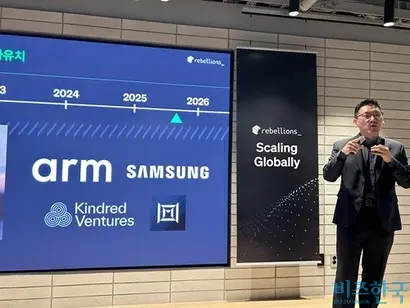
Taking A. and KT Case Studies Overseas...
To mark its 5th anniversary, Rebellions held a media day on the morning of the 16th at its office in Jeongja-dong, Seongnam, Gyeonggi Province, to unveil its achievements to date and its global business direction.
Rebellions is an AI semiconductor startup that develops hardware and software specialized for AI inference computing. Since merging with SAPEON Korea, an AI semiconductor subsidiary of SK Telecom, last December, it has become the largest semiconductor AI company in Korea and the first domestic unicorn in this field with a valuation exceeding 1 trillion won.
CEO Park Sunghyun evaluated the first five years of Rebellions as a period of building fundamental strength. To date, Rebellions has released two generations of NPU lineups, including the "ION" and "ATOM" series. The "REBEL Quad," unveiled this August, is a "big chip"-class AI semiconductor. According to the company, by applying an architecture that connects multiple chip fragments, or "chiplets" (combining semiconductor chips into a single package), it is possible to flexibly respond to various computational demands and scaling requirements.
An NPU is a dedicated accelerator with a structure optimized for neural network computing. Rebellions is promoting the NPU as an alternative to Nvidia's GPU (Graphics Processing Unit). NPUs, designed to efficiently process fixed computational patterns, are evaluated as providing high computational and power efficiency for tasks with repetitive and patterned computational structures, such as LLM (Large Language Model) inference.
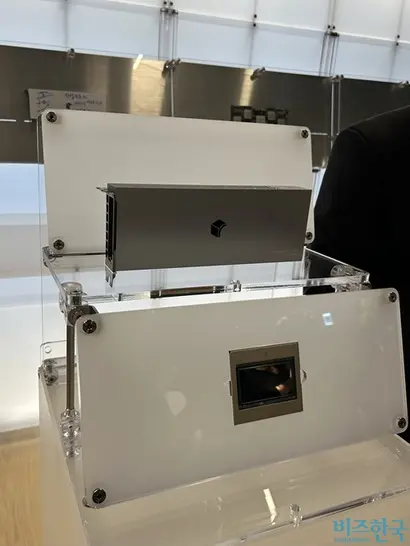
Above all, CEO Park cited the fact that their chips are being used in real-world services for end-users as their greatest achievement. For companies entering overseas markets, proving performance and reliability through reference projects is essential. For a startup with limited scale and infrastructure compared to global companies, competing with new technologies where standards have not yet solidified, actual cases of "where and how it is being used" serve as indicators that prove the technical operating method and stability at once.
He said confidently, "At the time of attracting investment from Arm (the British semiconductor design firm), there were already more than 100 teams that had surpassed the Series A criteria. However, Rebellions was the only one that could answer, 'Who is the end user?' We put the ATOM chip into A., which generates up to 50 million API calls a day. The fact that we are stably operating a real-time national service is evidence that resonates with all overseas clients."
Beyond GPUs with NPUs, Aiming for IPO and Nasdaq Listing
Rebellions' ATOM-based products were fully introduced (in 2025) to A.'s call recording feature and SK Telecom's veterinary X-ray diagnostic assistance service, "X-Caliber." Based on these collaborative achievements, including achieving the first domestic NPU commercialization within a data center with KT Cloud just three months after the ATOM release in 2023, the company plans to pursue global sales.
Attention is also focused on whether Rebellions can successfully ride the wave of the inference market, which is opening up as the next step after AI training. Rebellions chips are specialized specifically for inference among the various areas of AI. As AI technology enters the commercialization stage, the importance of inference functions that affect actual performance is growing, creating a demand for alternatives that surpass the limitations of Nvidia-dominated GPUs.
Nvidia GPUs have the advantage of high computational volume and versatility. However, as they were originally designed for graphics processing rather than exclusively for AI, they have the disadvantage of wasted performance and relatively lower power efficiency. With the skyrocketing demand for Nvidia GPUs due to the heating competition in generative AI technology, the risks companies must carry, such as excessive reliance and supply shortages, are also increasing.
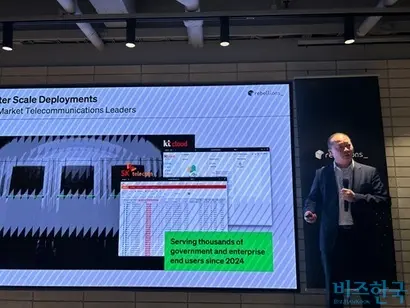
Marshall Choi, the former Chief Customer Officer (CCO) of SambaNova who recently joined Rebellions as Chief Business Officer (CBO), said, "We have plans to grow strategically in Japan, Saudi Arabia, and the United States. Japan is a market similar to Korea, centered on manufacturing and finance, with a rapidly increasing AI adoption rate due to an aging population. Focusing on Saudi Arabia, which is expressing a strong desire for AI at a national level, and the United States, where we can fundamentally prove our competitiveness, is the direction to maximize revenue while utilizing limited resources most efficiently."
CBO Choi previously worked at Oracle. SambaNova is classified as a first-generation AI semiconductor company that preceded second-generation companies like Rebellions. CBO Choi noted, "First-generation companies emerged before the arrival of ChatGPT, before the market bloomed, and focused on developing hardware to run models with hundreds of millions of parameters, concentrating on the training area rather than inference. But today's world has become an era of running trillion-parameter LLMs. Like the metaphor that 'the second mouse gets the cheese,' the second generation can design strategies by observing the trials and errors of the previous generation, presenting the most efficient and prepared products at a time when the market is becoming clearer."
On this day, Rebellions also mentioned its IPO plans. It intends to file for a preliminary listing review sometime next year. It has also left open the possibility of entering the US Nasdaq market in the future.
Regarding the government's AI infrastructure investment being concentrated on securing Nvidia GPUs, CEO Park emphasized, "While it is disappointing that AI policy is flowing toward software and centering on existing operators like large corporations and securing GPUs, I believe the future of the business lies in the survival of the ecosystem in the long term. However, I would appreciate it if the government could invest even one-tenth of the GPU introduction cost into Korean AI semiconductors to open up a path."