

[비즈한국] A fascinating video was recently uploaded to the BODA YouTube channel. It is an interview with Professor Lee Young-wook of Yonsei University, a highly respected South Korean astronomer whom I have long admired. Professor Lee's research team has recently proposed an intriguing model that diverges from the existing cosmological paradigm. They argue that far from accelerating, the expansion of the universe has already entered a phase of deceleration, where the speed of expansion is gradually slowing down. Furthermore, various independent observation results all point to the same decelerating expansion model! What will be the fate of our universe in the future?
The universe is expanding. It has been doing so consistently since it began 13.8 billion years ago. Every astronomer agrees on this. However, opinions diverge when it comes to the details. Some argue the expansion continues at a steady rate, while others suggest it is speeding up, and some believe it is slowing down.
To talk about the fate of the universe today, the most important target is the supernova. A supernova is the explosion of a single star, but it bursts so brightly that it rivals the luminosity of an entire galaxy containing hundreds of billions or trillions of stars. Because they are bright enough to be seen even from great distances, they serve as excellent lighthouses for observing the distant universe.
Moreover, it has traditionally been assumed that Type Ia supernovae have a nearly constant maximum brightness at the peak of their explosion. Type Ia supernovae are characterized by the absence of hydrogen in their spectra, as they occur when a white dwarf that has lost its hydrogen shell explodes. A white dwarf is known to explode once it exceeds a specific mass limit, known as the Chandrasekhar limit. It was assumed that this limit is always constant, and thus Type Ia supernovae could be used as standard candles, exploding with the same brightness anywhere and anytime throughout the history of the universe. If a supernova explodes in the distant universe, since we know how bright its peak should be, we can simply use that to measure the distance to the galaxy where the explosion occurred.
However, the reality is not that simple. The mechanisms that trigger Type Ia supernovae are quite diverse. Typically, they occur when a white dwarf accretes matter from a companion star or when two white dwarfs collide. A white dwarf paired with a normal giant star is called a Single Degeneracy (SD) supernova, while the collision of two white dwarfs is referred to as a Double Degeneracy (DD) supernova.
Also, the peak brightness at the moment of explosion can vary significantly depending on how much metal, such as nickel, was inside the white dwarf. Elements with many electrons act as a factor that increases opacity, absorbing more light and making the celestial object appear dimmer.
Because the origins and conditions of Type Ia supernovae are so diverse, simply assuming their peak brightness is constant and using them as standard candles is a rather crude approach. In particular, as the universe has evolved and aged, the chemical composition and metal content of galaxies and stars across the universe have changed, meaning supernova brightness can also vary based on the age of the galaxy and stars.
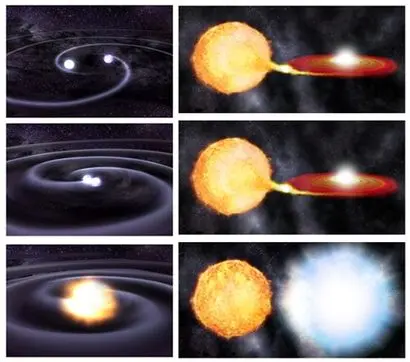
As early as the 1980s, a few astronomers argued that age-related biases needed to be carefully considered to use Type Ia supernovae as standard candles. A representative figure is Beatrice Tinsley. Distant galaxies represent the early universe shortly after the Big Bang. As we look at closer galaxies, we see a mixture of younger, late-born galaxies. In early, young galaxies, Type II supernovae—where massive, short-lived stars collapse—were more prevalent than Type Ia. Furthermore, the number of Type Ia supernovae that could explode depends on the age distribution of stars in the host galaxy and the age of the galaxy, which considers the delay time from a star's birth to its eventual supernova explosion.
This age bias in supernova brightness makes supernovae in relatively younger (more distant) galaxies appear dimmer. If this is not properly corrected, one might mistakenly conclude that the supernovae appear dim simply because the distant galaxies are further away than expected. And this leads to the conclusion that the universe's expansion is accelerating, pushing galaxies further away than anticipated.
In fact, the research team of Adam Riess, Brian Schmidt, and Saul Perlmutter reached the conclusion in 1998 that the universe is undergoing accelerated expansion. Consequently, dark energy, a mysterious energy pushing the universe to expand faster against gravity, emerged as the hottest challenge in astronomy. To this day, the identity of dark energy remains completely unknown. Not only is its identity unknown, but there isn't even a suitable candidate for it.
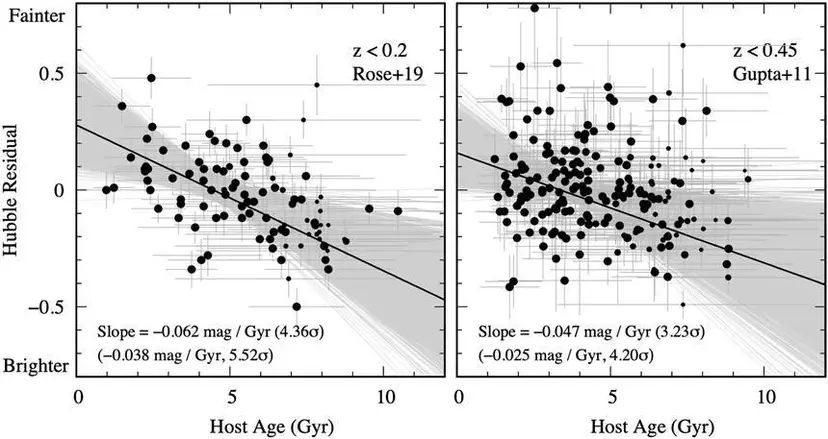
Five years ago, Professor Lee Young-wook's research team validated the luminosity evolution effect of supernovae based on age, a concern previously raised by Tinsley, using actual observational data. By checking how supernova brightness changes according to the actual age of galaxies, they found that, indeed, supernovae should appear dimmer in younger galaxies! After adjusting for this age-dependent luminosity evolution effect and re-examining the rate of change in the universe's expansion, they found that, contrary to what was previously known, the evidence for accelerated expansion cleanly disappeared.
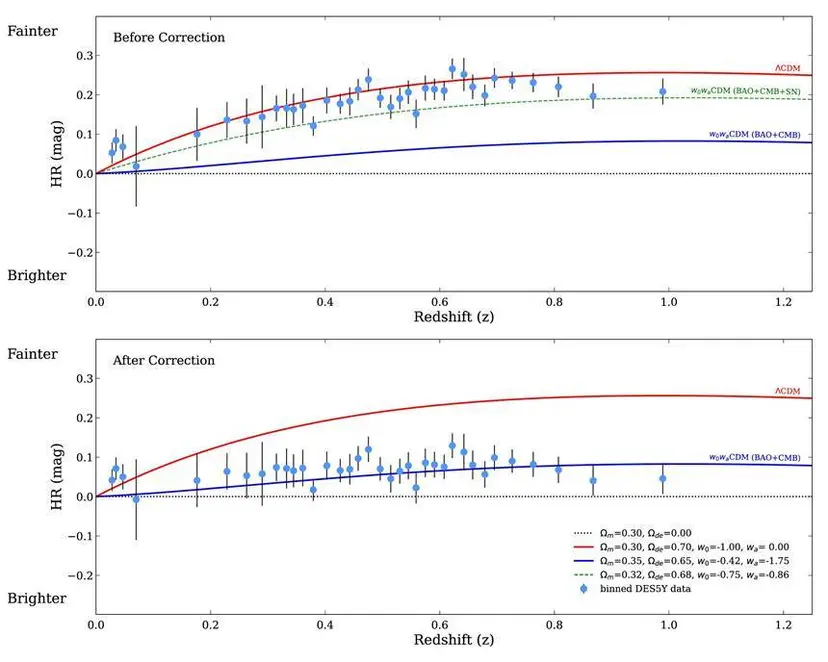
At the time, this claim was not widely accepted in the academic community. The main reason was that other observational evidence still seemed to support accelerated expansion. However, the situation has now changed. This latest paper shows that other independent observational results that have emerged in the last few years further support the model that the universe is decelerating rather than accelerating.
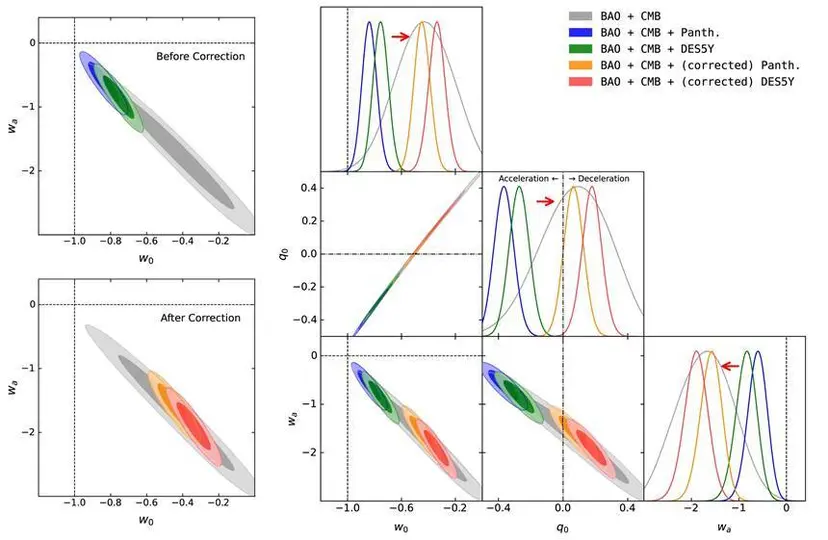
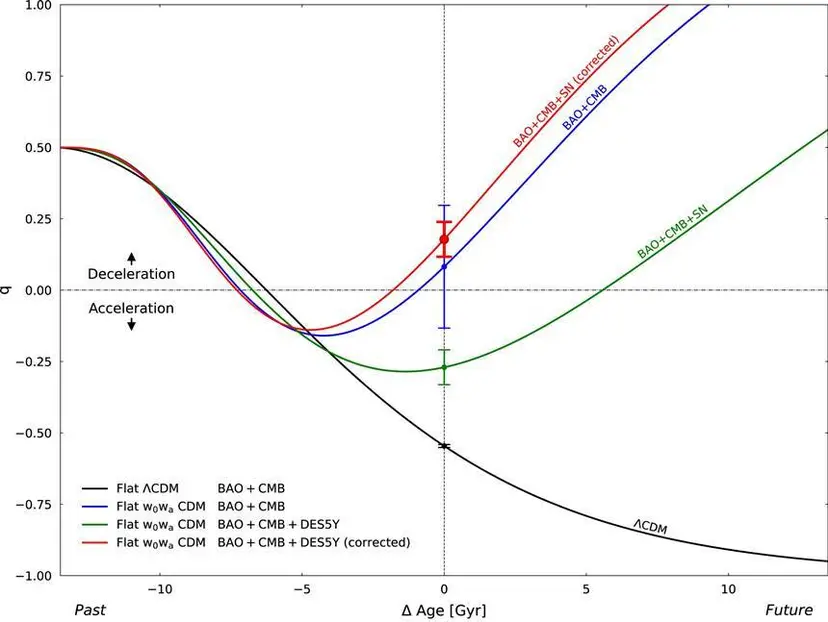
In this additional research, the data that Professor Lee Young-wook's team actively utilized is the DESI data. The name of the project itself reflects the ambition to uncover the nature of dark energy. This observation project measures the distance of the universe using a standard other than supernovae: Baryon Acoustic Oscillations (BAO).
The primordial universe was in a plasma state. Around points of slightly higher density in the early universe, waves propagated through the plasma like sound waves. As the universe expanded and cooled sufficiently, the plasma froze in place. At that moment, the sound waves of the early universe that were spreading in all directions also froze. The frozen waves became regions of higher density. Galaxies were formed around these regions. Therefore, if you look at the large-scale structure of the current universe, galaxies are not randomly distributed. Galaxies are spaced apart by the exact scale of the sound wave vibrations of the early universe created at that time. This is called Baryon Acoustic Oscillation, a trace of the primordial vibration that was imprinted on the large-scale structure of the universe when the early plasma froze.
Baryon Acoustic Oscillations should maintain the same scale regardless of the age of the universe. So, if Type Ia supernovae were the expected standard candles because their brightness was constant, Baryon Acoustic Oscillations can be seen as a standard ruler with a constant size/scale.
Last year, the DESI team analyzed Baryon Acoustic Oscillations and revealed an interesting possibility: dark energy is not a constant, but a value that changes over time. For a long time, dark energy was considered the cosmological constant proposed by Einstein. Even as the universe expanded and its volume increased, the density of dark energy was supposed to remain constant. It seemed as if the total dark energy of the universe was continuously being added. Thus, it was sometimes called ghost energy, implying it was a new energy whose origin was unknown. However, last year's DESI team results suggested a new possibility that dark energy is decreasing as time passes.
However, that result did not suggest that the universe was undergoing decelerating expansion. It merely suggested that the strength of dark energy was gradually weakening compared to the beginning. To use a car metaphor, it’s like still having your foot on the accelerator, but the pressure on the pedal has weakened slightly.
But the new results from Professor Lee Young-wook's team go beyond that. By precisely applying the age-dependent luminosity evolution of supernovae, it appears that the current universe is not just pressing the accelerator less, but is actually stepping on the brakes. The universe has already entered a phase of decelerating expansion! Even more interesting is that the DESI team actually found the same results.
However, in their results last year, they did not base their conclusions solely on the analysis of Baryon Acoustic Oscillations. Instead, they mixed in existing supernova data (which did not account for age-dependent luminosity evolution) to reach their final result. If the DESI team had used only the results of Baryon Acoustic Oscillations from the beginning, they would have obtained the result of decelerating expansion. But because they averaged it out with the existing supernova results that did not consider the luminosity evolution effect, they obtained a result that only suggested dark energy was decreasing rather than decelerating expansion.
Professor Lee Young-wook's team excluded existing supernova data and compared it directly with the DESI team's Baryon Acoustic Oscillation analysis. The result was surprising. The new result, which considered the age-dependent luminosity evolution effect of supernovae, was in perfect agreement with the results of the pure Baryon Acoustic Oscillations. The Cosmic Microwave Background also points to the same model. It is a remarkable result that three such independent cosmological observation methods point to the same model.
This result does not simply mean that there is no dark energy. It means that dark energy, which we thought was a simple constant that maintained the same density even as the universe expanded, is actually a strange entity that changes quite variably over time. Just as water changes its state (phase) through solid, liquid, and gas, the equation of state for dark energy must be changing. What behaved like ghost energy immediately after the Big Bang, once acted like a cosmological constant, and is now behaving in a strange way, gradually decreasing. To express Professor Lee Young-wook's team's results correctly, one should not say “there is no dark energy,” as is commonly misunderstood, but rather, “there is no cosmological constant. Dark energy is a volatile entity that changes over time.”
In the BODA interview, Professor Lee Young-wook said that it is not yet known exactly what kind of conclusion this will lead to. However, he stated that it indicates dark energy is not the simple cosmological constant previously thought, but a concept that is something entirely different. And he said that this discovery will be an important stepping stone toward a completely different type of cosmological model in the future.
The universe evolves. And humanity's view of the universe evolves along with it. The universe, which we thought for a long time would remain the same forever without any changes, at some point became a world expanding rapidly, and then suddenly a world where that expansion was accelerating. Now, another possibility is opening up that the expansion might be slowing down. Cosmology is not yet finished. And it will not be finished in the future. We know we cannot reach the truth perfectly, yet we continue to move slightly closer to that truth without rest.
What fate will the current cosmology, which talks about dark energy and the accelerating expansion of the universe, face? If dark energy is changing over time, what is the reason? What will be the fate of the universe in the future? The future of the universe seems as difficult to predict as the ever-changing dark energy itself.
Reference
https://iopscience.iop.org/article/10.3847/1538-4357/ab5afc
https://academic.oup.com/mnras/article/544/1/975/8281988
Who is the author Ji Woong-bae? He loves cats and the universe. After watching 'Galaxy Express 999' as a child, he developed a dream to share the beauty of the universe. He is currently an assistant professor in the Faculty of Liberal Arts at Sejong University, participating in various science communication activities including lectures and writing. He has written books such as 'A Piece of the Universe Every Day', 'Scientists of the Starry Universe', 'Cannot Go, But Know', and 'Strange Questions That Come to Mind When Looking at the Universe', and translated books including 'The Hitchhiker's Guide to the Real Universe', 'How I Killed Pluto', 'Quantum Life', and 'Cosmigraphics'.