

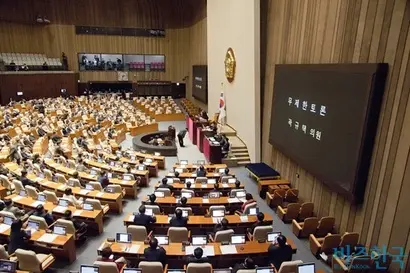
[비즈한국] The National Assembly is expected to hold a plenary session on the 13th to vote on the 'Banking Act Amendment.' The Democratic Party of Korea plans to proceed with the vote after 3:34 PM, when the filibuster (unlimited debate) by the People Power Party concludes.
The core of this Banking Act amendment, which is set to be processed under the leadership of the ruling party, is to prevent banks from reflecting legal costs, such as deposit insurance premiums and fund contributions, when calculating loan spreads. The intention is to curb excessive "interest-based profit-seeking" by banks during periods of high interest rates.
Loan interest rates are typically determined by adding a "spread," which considers bank margins and other factors, to a "base rate" that reflects market and funding rates. The spread is determined by combining a bank's operating costs, risk management expenses, and target profit margins. The ruling party points out that banks have been shifting various mandatory legal costs onto borrowers by including them in these categories.
The Democratic Party designated this bill as a fast-track agenda item in April and introduced it to the plenary session on the 12th. Following the introduction of the bill, a filibuster began at the request of the People Power Party. However, as the Democratic Party submitted a "motion to terminate unlimited debate," a vote to conclude the debate became possible starting at 3:34 PM on the 13th, 24 hours after the debate began.
The Banking Act amendment, proposed by Representative Min Byeong-deok (and 10 others), specifies that items such as reserve requirements, deposit insurance premiums, and contributions to the Korea Inclusive Finance Institute must be excluded from the detailed components of loan spread calculations. It also limits the reflection of contributions to the Korea Technology Finance Corporation and the Korea Credit Guarantee Fund to within 50% of the spread. A criminal penalty clause was also newly established, imposing up to one year in prison or a fine of up to 30 million won for violations.
The stated reason for the amendment specifies, "As the recent high-interest rate environment persists, the burden on household and corporate financial consumers is increasing, while the banking sector has seen a significant rise in interest income," adding, "One of the causes is that banks have been shifting their cost burdens onto loan borrowers."
The banking industry estimates that if legal costs are prohibited from being reflected in interest rates, it will result in an annual revenue reduction of approximately 2 trillion won.