

[비즈한국] The government's strategy for fostering the semiconductor industry is taking a sharp turn from "capital region concentration" to "local production for local consumption (producing and consuming electricity in the same region)." Following the "K-Semiconductor Vision and Strategy Report for the AI Era" held at the Yongsan Presidential Office on the 10th, analysts in the semiconductor industry and government circles suggest that the de facto "single-pole" system centered on the Yongin cluster has hit a snag. As the physical limitations of power supply and the difficulties in constructing transmission grids become apparent, attention is focused on whether a new industrial map will be drawn, moving factories to where the electricity is available.
Civil society is pointing out the unrealistic nature of the power supply plan and regional inequality, demanding a full review and relocation of the Yongin semiconductor cluster. In contrast, there are also voices arguing that the project should proceed as planned to address talent acquisition issues and leverage the agglomeration effects of existing semiconductor facilities in and around Yongin.
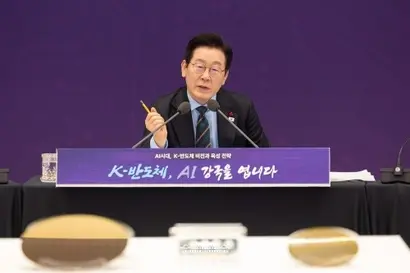
The power supply plan for the Yongin semiconductor cluster was discussed at the "K-Semiconductor Vision and Strategy Report for the AI Era" held at the Yongsan Presidential Office on the 10th. President Lee Jae-myung asked, "The electricity required for the Yongin semiconductor cluster is equivalent to more than 10 nuclear power plants," adding, "Is power transmission even feasible when building transmission grids is difficult and there is no room to build nuclear power plants nearby?"
In response, Lee Ho-hyun, Second Vice Minister of Climate, Energy, and Environment, replied, "We are planning to build four or five long-distance transmission lines to bring renewable energy and nuclear power from the Honam region to Yongin," but noted, "There are difficulties in regions like South Chungcheong and North Jeolla that the lines will pass through."
The report revealed that only 9GW of the 15GW of power required by the Yongin semiconductor cluster has been secured so far. The supply plan for the remaining 40% of total power is still a blank slate. Samsung Electronics005930 reported that it secured 6GW out of its 9GW requirement, while SK Hynix000660 secured 3GW out of 6GW through consultations with the government and Korea Electric Power Corporation (KEPCO)015760. An SK Hynix official stated, "The 2.83GW we decided to procure from the Sinanseong Substation in southern Gyeonggi through consultation with KEPCO is enough to operate 2 of the 4 planned fabs."

A significant portion of the electricity needed for the Yongin semiconductor cluster must be brought in from other regions via transmission networks. To meet initial demand by 2030, the government plans to build six LNG power plants with a total capacity of 3GW through Korea East-West Power, Korea Southern Power, and Korea Western Power. Including this, 4.5GW is scheduled to be generated within the cluster, but the remaining power of over 10GW is planned to be supplied through the construction of large-scale transmission lines from the Honam and East Coast regions.
However, critics point out that such a power supply plan is unrealistic. Yoo Je-guk, head of the Industrial, Resources, Agriculture, and Fisheries team at the National Assembly Research Service, pointed out in a report titled "Diagnosis of Power Supply Risks for the Yongin Semiconductor Cluster" that the physical feasibility of stably supplying the required power must be examined first. The report noted that the power supply density per area of the Yongin cluster is 32 times that of Seoul, and to supply power to such a small area, the intensive installation of substations and the redundancy/undergrounding of transmission and distribution networks are essential, requiring a precise review of technical feasibility.
The instability of long-distance transmission was also pointed out. The semiconductor industry requires high-quality electricity to maintain high yields during facility operation. High-quality electricity requires constant voltage and frequency, as well as an uninterruptible power supply. It is known that a semiconductor manufacturing fab can suffer billions of won in damages from just one minute of power outage.
However, long-distance transmission and a centralized power system in the capital region degrade voltage stability. If transmission limits are set to address this, long-distance grids transmit only limited power relative to their scale, leading to wasted costs. Furthermore, the High-Voltage Direct Current (HVDC) lines planned to connect East Coast power have long recovery times in case of failure and may cause interference issues with existing AC lines.
Ha Seung-soo, a lawyer at the Public Interest Lawyers Group 'Nongbon', pointed out, "The Yongin semiconductor cluster cannot be stably supplied with power due to issues with voltage stability and the complexity of the power grid," adding, "The current power supply plan, which incurs huge social and economic costs for a specific company, is not realistic."
Civil society argues that the semiconductor cluster should be relocated to non-capital regions, which could contribute to resolving regional imbalances while providing a stable power supply. They especially point out that the residents of South Chungcheong and North Jeolla cannot be forced to make sacrifices for the construction of transmission lines.
Lee Jung-hyun, chairperson of the Jeonbuk Committee for the Cancellation of Transmission Tower Construction, said, "Companies have grown through the sacrifices of the people, and even to practice RE100, they should relocate to regions with renewable energy," adding, "Regions should also look for ways to improve the quality of life in line with these companies."
On the other hand, there are voices that the Yongin semiconductor cluster should proceed as planned, considering talent acquisition and the agglomeration effect. They argue that the Yongin location is inevitable given the preference of semiconductor talent for the capital region. There is also the opinion that the cluster must remain in Yongin to increase agglomeration effects, as semiconductor facilities are already located there and in the vicinity.
Ahn Ki-hyun, executive director of the Korea Semiconductor Industry Association, said, "Companies are willing to pay high costs to stay in the capital region because of the talent," adding, "Active implementation is needed according to the planned power and water supply schedules."
At the report meeting, the government emphasized the "local production for local consumption" principle and urged that semiconductor production facilities be built in regional areas for balanced development. President Lee Jae-myung said, "We can no longer avoid a transmission distance-proportional pricing system where transmission costs are borne by electricity rates," adding, "Transmission costs may eventually be included in semiconductor production costs, and for the sake of balanced development, it would be good to build [semiconductor production facilities] in local regions whenever possible."
Second Vice Minister Lee Ho-hyun added, "In the future, it is desirable for national balanced development to locate power-intensive projects, such as new semiconductor clusters or national high-tech strategic industries, in local areas or regions with abundant power."
Local semiconductor companies requested government support to expand regional investments. Lee Jin-an, CEO of Amkor Technology Korea, a semiconductor packaging company located in Gwangju, said at the report meeting, "Overseas customers are strongly demanding the direct use of new and renewable energy to implement RE100, but there are concerns that competitiveness will weaken due to insufficient supply and high costs," adding, "If support such as expansion of solar energy subsidies, mediation for Power Purchase Agreements (PPA), and exemption from network usage fees is expanded, it will be a great help for domestic semiconductor companies to become growth hubs in local regions."