

[비즈한국] It appears that the Republic of Korea (ROK) Marine Corps will finally be able to embrace the ‘K2 Black Panther’ tank. With a 1 billion won initial funding for the introduction of K2 tanks for the Marine Corps reflected in the 2026 defense budget bill currently under review by the National Assembly, the replacement project for the Marine Corps' aging tanks, totaling approximately 420 billion won, has taken its first step. The K2 tank is the ROK Army’s main battle tank, proven effective through exports to Poland, and is considered one of the world's top-tier tanks, recently being treated as a core agenda item in defense cooperation with Peru. This decision, made about 10 years after its actual deployment in the Army in 2014, holds great significance in that a long-cherished goal of the Marine Corps has been resolved.
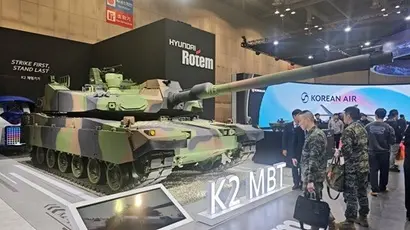
As a Strategic Mobile Force, the Marine Corps is classified as an elite force in countries around the world, including the United States, the United Kingdom, and Thailand. However, unlike their high status, they have always been second in priority for equipment supply, trailing behind the Army. They operated the M47 tank from shortly after the Korean War for a long time, and the current mainstay, the K1 tank, is also seriously outdated, having been in service for over 30 years.
However, some raise criticism regarding this K2 tank introduction, asking, “Why introduce tanks that even the US Marine Corps has abandoned?” In fact, following the ‘Force Design 2030’ plan, the US Marine Corps has been retiring its entire fleet of M1A1 Abrams tanks since 2020 and reorganizing into a lightweight unit centered on drones and missiles.
But this argument overlooks the differences in the battlefield environment. The US Marine Corps’ reorganization is optimized for ‘Expeditionary Advanced Base Operations’ assuming conflict with China, focusing on mobility by hitting and running across small islands in the Pacific. In contrast, the ROK Marine Corps’ core mission remains ‘Amphibious Assault,’ which involves breaking through firmly defended enemy coastlines to secure a bridgehead, as well as defending the flanks of the capital region.
In particular, the Northwest Islands and the Gimpo/Ganghwa areas are the front lines directly facing North Korea’s mechanized units. As North Korea recently unveiled its new ‘M2020’ tank to strengthen its armored power, our Marine Corps responding with outdated tanks could result in a fatal gap in the defense of the capital region. Considering the strategic value of one Marine division inducing and dispersing the enemy’s main force into the rear through landing operations in an emergency, the K2 tank, with its powerful shock effect, is not an option but a necessity.
Of course, it is true that due to modern warfare environments and North Korea's continued military buildup, it is very difficult for our Marine Corps to conduct a division-level landing operation in the North’s rear during wartime. In particular, North Korea is threatening us with long-range anti-ship missiles, North Korean versions of Spike NLOS missiles, and new loitering munitions (suicide drones) targeting K2 tanks.
However, if we abandon our mission because threats are increasing, North Korea’s invasion power could become stronger than before under current operational concepts, raising high concerns that Seoul, near the DMZ, could be captured early by the enemy’s concentrated, large-scale force. Therefore, we cannot abandon amphibious assault operations without an alternative. No matter how excellent advanced future warfare concepts may be, we must admit that if they are not based on reality, they are less valuable than outdated tactics of the past.
Also, in terms of performance, the K2 tank is optimized for the ROK Marine Corps. The US M1A1 tank has many limitations in being loaded onto landing ships and maneuvering in Korea’s tidal flat terrain due to its weight, which nears 70 tons. Conversely, the 55-ton K2 is easy to load onto the ROK Navy’s future landing ships (LST-II), and its hydropneumatic suspension system provides excellent off-road breakthrough capabilities. This provides firepower and protection that overwhelm the ZTD-05 light tanks operated by the Chinese Marine Corps or North Korea’s new tanks.
However, this introduction should not end at mere ‘equipment replacement.’ As proven in the Ukraine war and recent Middle East conflicts, countermeasures against drones and anti-tank missiles that threaten the survivability of tanks are essential. Therefore, the K2 tank for the Marine Corps must also be able to defend itself against enemy drone attacks by mounting an RCWS and a hard-kill APS, similar to the export version for Poland (K2PL).
Furthermore, I propose the introduction of the Italian Leonardo company’s ‘Vulcano 120mm’ guided projectiles or the development of an equivalent domestic guided projectile. This technology, which dramatically increases the effective range of existing tank guns (approx. 3km) to precisely strike targets 30km away, would be a ‘game changer’ for the Marine Corps to suppress enemy coastal artillery or missile bases from a distance during landing operations. It would not only improve the survivability of Marine tanks but also eliminate threats to landing forces faster and more precisely than naval gunfire or air support.
It is clear that the status of tanks in modern warfare has changed from the past. However, in Korea’s security environment, a Marine Corps without tanks is merely a ‘toothless tiger.’ I hope that the introduction of the K2 tank by the Marine Corps will serve as a new milestone for a ‘Korean-style Marine mechanized unit’ beyond simple force reinforcement. I look forward to seeing the Marine Corps riding the Black Panther—the strongest shield to deter North Korean provocations and protect the people—as soon as possible.