

[비즈한국] The enactment of the Digital Asset Basic Act, also known as the Phase 2 Virtual Asset Act, is being delayed. This is because financial authorities failed to submit a government proposal by the 10th. The Phase 1 act, the Virtual Asset User Protection Act, which went into effect in July 2024, focused on asset protection and regulating unfair trading, failing to encompass the entire industry. As the legal vacuum persists relative to the speed of market growth, leading to ongoing consumer losses and industry confusion, a forum was held to discuss virtual asset consumer protection and the direction of future legislation.
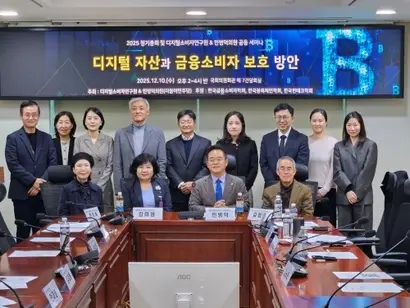
The Digital Consumer Research Institute and Min Byung-duck, a lawmaker of the Democratic Party of Korea, hosted the ‘Digital Assets and Financial Consumer Protection Measures’ seminar at the National Assembly on the 10th. Rep. Min, who sits on the National Assembly’s National Policy Committee, spearheaded the proposal of the Digital Asset Basic Act last June. Several legislative proposals from lawmakers are currently pending for the Digital Asset Basic Act, and it remains in a state of awaiting coordination with government proposals being prepared by the Financial Services Commission and the Bank of Korea.
At the seminar, Rep. Min emphasized the need for the swift introduction of the Digital Asset Basic Act. Rep. Min stated, “In the era of digital assets, speed is more important than direction. It is regrettable that our laws and systems cannot keep pace with that speed. Innovation has become reality, and our safety nets must not remain in the past.” He added, “For digital assets to shed the stigma of being a ‘coin gambling den’ and leap forward into a sound financial market, we need predictable legal standards, tight protection mechanisms for investors, and clear responsibility and disciplinary systems for operators to follow.”
Rep. Min pointed out that while discussions on including stablecoins as a payment method arose during the amendment of the Foreign Exchange Transactions Act, the lack of refined regulations on linkage plans could lead to institutional confusion. He also urged the creation of management regulations for when stablecoins are expanded into the real economy for trade settlement and overseas remittances. He further noted that despite the increasing number of incidents involving the forced liquidation of virtual assets due to the rise in leverage trading on domestic and foreign exchanges, there are currently no consumer protection measures in place.
Kim Mi-young, Head of the Financial Consumer Protection Bureau at the Financial Supervisory Service, said in her congratulatory speech, “Currently, the National Assembly and financial authorities are pushing for a Phase 2 legislative bill that encompasses issuance, listing, disclosure, business entry regulations, and stablecoins to ensure the stabilization of the digital asset system.” She added, “Voluntary efforts by the industry are also necessary. Please do your best to deliver information and prevent damages so that consumers who are unfamiliar with the complex structure and technology of digital assets can participate in the market with peace of mind.”
Professor Im Byung-hwa of Sungkyunkwan University’s Graduate School of Business, who served as a presenter, explained the status of domestic and global virtual asset markets and their regulations. Prof. Im stated, “It is said that 10% of the world’s virtual asset trading volume occurs in Korea. The fact that 10% of volume comes solely from spot trading without derivatives is a massive scale.”
Prof. Im cited Japan’s legislative status as a case study. He said, “The reason we should treat Japan as a cautionary tale is that legislation aimed solely at regulation fails to foster the industry.” He continued, “Japan was the fastest to legislate digital assets. Because it was a regulatory bill born out of a hacking incident, the industry failed to grow despite the fact that stablecoins were already legalized in 2023. They have only recently been moving busily, such as preparing issuance consortiums.”
Prof. Im also analyzed that domestic stablecoin issuance “needs to be considered from a broad perspective,” adding, “Recently, major Wall Street banks in the U.S. have been discussing joint stablecoin issuance. If these institutions enter, the market landscape will change completely.”
Regarding Central Bank Digital Currencies (CBDC) and bank-issued deposit tokens, he pointed out that an ‘on-chain finance’ (finance operating on blockchain) system that considers both should be established. Prof. Im predicted, “Korea has a financial system similar to that of Europe. If the Eurozone issues a CBDC, it is highly likely that similar forms of financial services will appear. Deposit tokens and CBDCs will likely coexist rather than compete. I believe deposit tokens will be used by institutions, while stablecoins will be used by the private sector.”
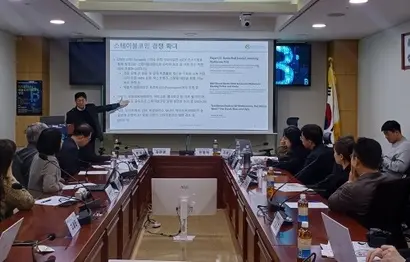
The need for expanded investor protection following changes in the domestic virtual asset market was also raised. Lee Jung-min, a researcher at the Korea Financial Consumer Protection Foundation, pointed out that protection measures are needed as the number of virtual asset users is rapidly increasing among the digitally vulnerable, specifically the younger generation (under 20s) and the elderly (over 60s).
Researcher Lee stated, “Approximately 70% of victims related to virtual assets did not take any particular action. This is because they either do not know how to respond or give up because the damage amount is small. We must consider relief methods such as collective damage dispute mediation.”
Additionally, she added, “Because the technology is complex and information asymmetry is severe, it is difficult for consumers to prove the damage themselves. We should also consider shifting the burden of proof in damage compensation. Consumers must be protected throughout the entire process from issuance to distribution. Problems with information imbalance and conflicts of interest must be resolved in Phase 2 legislation.” She advised that just as financial education is provided when signing up for derivatives, mandatory trading education should be imposed for digital assets to expand consumer choice.
Kim Hyung-joong, a distinguished professor at Korea University’s Graduate School of Information Security, presented on issues that could arise when introducing stablecoins as a payment method. While noting that it will take time for the stablecoin market to expand, Prof. Kim emphasized the need to discover institutional methods to solve problems that will arise when they are used like currency in the future.
Prof. Kim said, “Stablecoins inevitably have to be issued in a centralized manner. This is because if an accident occurs or coins are used for money laundering, only a centralized stablecoin allows for blocking the problematic block and preventing further use.” He added, “If introduced for payments, remittance fees will occur. Platforms might support this, but we should also consider plans like creating zero-gas-fee networks. If they perform the role of currency, one should be able to receive benefits in year-end tax settlements, which would also require amending the Restriction of Special Taxation Act.”
Questions were also raised at the seminar about whether stablecoins can secure soundness and validity as a payment method. Dr. Kim Do-nyun of the Korea Consumer Agency said, “I am preemptively concerned about what role stablecoins will play in terms of government price management, and how to respond if collective consumer disputes arise in the event of an accident.” He added, “Under current law, collective litigation is only possible under the Capital Markets Act because all trading records can be seen and there is transparency. Such parts must be kept in mind during the institutional design of digital assets.”
Opinions were also voiced that the perspective on consumer protection should be viewed differently from traditional finance. Kim Hyo-bong, a lawyer at Bae, Kim & Lee (BKL), pointed out, “The most important thing in digital asset regulation is consistency with global regulations. If we give up on this, we lose both the industry and consumer protection.” He added, “For example, there is no reason for overseas issuers to comply with Korea's strict regulations and enter the market. Singapore currently recognizes licenses obtained overseas, and such a flexible framework is needed.”
Meanwhile, it is reported that on the 11th, the Democratic Party reached a consensus to push for party-led legislation during January 2026, separate from the government proposal. If a government proposal is not submitted to the National Assembly within this month, the Phase 2 virtual asset legislation is expected to carry over to next year.