

[비즈한국] As the year-end approaches, corporate ESG management activities are in full swing, drawing attention to this year’s ESG performance. Domestic and international ESG institutions have recently announced their 2025 evaluation results. With a noticeable polarization in governance evaluations across the financial sector—including financial holding companies, banks, credit card firms, investment firms, insurers, and specialized credit finance businesses—we examined the 2025 governance evaluation results for major domestic insurance companies.
This year, the governance grades for the domestic insurance sector remained in the low-to-mid range. According to the Korea Institute of Corporate Governance and Sustainability (KCGS), which conducts ESG evaluations, proposal analysis, and policy research for domestic listed companies and financial institutions, only three out of 19 major life insurance companies—KB Life, NH NongHyup Life, and Shinhan Life—received an 'A' grade (Excellent) in the 2025 governance evaluation. These companies have maintained an 'A' grade or higher for the past three years (2023–2025).
Among insurers, there was also a company that received a 'C' grade (Weak) in governance for the first time in three years. MetLife Life Insurance, an American insurer, dropped one notch to a 'C' grade this year after maintaining a 'B' grade (Average) in 2023 and 2024. Five life insurance companies—IBK Pension, AIA, KDB, Hana, and DB Life Insurance—received a 'B' grade. The remaining 10 life insurance companies (IM Life, ABL, Fubon Hyundai, Heungkuk, Hanwha, Mirae Asset, Samsung, Tong Yang, Kyobo, and Lina Life Insurance) all received a 'B+' grade.
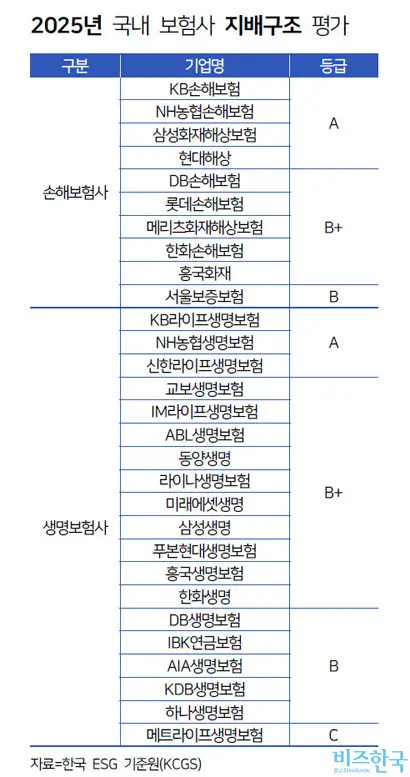
Non-life insurance companies saw frequent fluctuations in 'A' grades. Among the 10 domestic non-life insurers evaluated, four received an 'A' grade in governance for 2025: KB Insurance, NH NongHyup Insurance, Hyundai Marine & Fire Insurance001450, and Samsung Fire & Marine Insurance000810. The number of 'A' grades fell from five in 2023 (including Hanwha General Insurance) to three in 2024 (KB, NH NongHyup, and Hyundai Marine & Fire), before Samsung Fire & Marine rejoined the list this year. The remaining non-life insurers, with the exception of Seoul Guarantee Insurance, which has remained at a 'B' grade for three consecutive years, all received a 'B+' grade (DB, Lotte, Hanwha General Insurance, Meritz, and Heungkuk Fire & Marine Insurance).
ESG evaluation grades are classified into a total of seven levels based on scores, from S (Excellent) to D (Very Weak). A grade of 'B+' (Good) or lower indicates that efforts are needed to improve the sustainable management system, while a 'C' grade signifies a weak sustainable management system that requires significant efforts for improvement.
An official from the Korea Institute of Corporate Governance and Sustainability explained the results: "When evaluating financial company governance, we use a comprehensive model that considers not only industry-specific issues but also board leadership, shareholder rights protection, CEO management, internal control, risk management, and communication with stakeholders. For financial firms, cases of regulatory sanctions are also included in the evaluation. Receiving a 'C' grade means that the company was rated below average in most evaluation criteria."
Meanwhile, the governance level of the financial industry is trending toward polarization. While holding companies, banks, and credit card companies frequently receive an 'A' grade or higher, the proportion of 'B' grades or lower is high among financial investment firms (securities firms) and insurance companies. In particular, out of the eight specialized credit card companies (KB Kookmin, Lotte, BC, Samsung, Shinhan, Woori, Hana, and Hyundai Card), all except BC Card and Hana Card successfully maintained an 'A' grade for two consecutive years (2024–2025).
On the other hand, among securities firms, due to financial regulatory sanctions and disclosure violations, some companies received not only 'C' grades (DB, Mirae Asset, Yuanta, and Korea Asset Investment Securities) but also 'D' grades (Korea Investment & Securities, Eugene Investment & Securities), which stand for "Very Weak." In the banking sector, financial incidents such as employee embezzlement and breach of trust impacted the results. Industrial Bank of Korea (IBK)024110, following the discovery of an 80 billion won unfair loan case in March of this year, became the only bank to receive a 'C' grade in the 2025 governance evaluation.
In its November 2025 ESG evaluation and grade announcement, the Korea Institute of Corporate Governance and Sustainability analyzed, "The evaluation results have polarized due to a model revision that strengthened effectiveness. While financial holding companies saw an increase in top-tier performers, leading to higher scores, the average total scores for banks, insurance, credit finance, and financial investment firms generally declined." In fact, the number of financial companies receiving an 'A+' governance grade increased from two in 2024 to four in 2025, but the number of financial companies receiving the lowest grade, 'D', also increased from five to 10 during the same period.
Regarding this phenomenon, an industry official noted, "The financial industry is a regulated sector. Governance is one of the areas that authorities closely monitor and regulate. Banks and holding companies are subject to particularly high levels of regulation, and companies respond sensitively, so they have well-established related systems. Conversely, investment firms or insurance companies tend to observe the situation before applying changes rather than reacting immediately."
The official also observed significant differences in the ability of each sector to respond quickly when regulatory guidelines are issued or institutional improvements are required. "Institutional restructuring is necessary to improve governance within a company, and holding companies and banks have extensive know-how and human resources. However, insurance companies, investment firms, and specialized credit finance businesses often need to establish new personnel or systems, so even if there is a will to improve at the company level, it inevitably takes time until actual implementation," the official analyzed.