

[비즈한국] Discovered last July, ATLAS has been capturing the hearts of sci-fi fans everywhere. It is already the third interstellar object to visit our solar system, following Oumuamua and Borisov. Some are even buzzing with the possibility that this time, it might actually be an alien spacecraft. Personally, I would love it if there were friendly extraterrestrials on board.
We are particularly lucky this time. Unlike Oumuamua, which was discovered only after it had already swept past the Sun and was exiting our solar system, ATLAS was spotted early on as it traveled toward us from afar. Currently, our solar system is filled with various probes deployed by humanity, all peering into the corners of space. Just as we track a person's trajectory through street-level CCTV, we can monitor every move of ATLAS using probes scattered around Jupiter, Mars, and the Sun-Earth vicinity, analyzing its constantly changing appearance. As a result, we have gained surprising clues as to why ATLAS looks so strange. It holds a marvelous secret of the universe that we had overlooked!
Recently, various space telescopes have been targeting ATLAS. These include the James Webb Space Telescope—the largest in existence—and SPHEREx, which South Korea co-developed with NASA. All of them observe the universe in the infrared spectrum, and they have confirmed the presence of clear carbon dioxide signatures on ATLAS.

However, ATLAS contains an excessive amount of carbon dioxide. Compared to water, its carbon dioxide content is 7 to 8 times higher. It also appears to have a significant amount of carbon monoxide—twice as much as its water content. This is quite unique. Most comets are overwhelmingly composed of water, essentially clumps of water ice mixed with trace amounts of other chemicals. ATLAS, however, contains far more carbon dioxide relative to water. Of course, such comets have existed before; Comet 2016 R2, for instance, was similar.
The rare characteristics of ATLAS leave us with numerous questions about its origin. Where did it come from? How can a comet with such chemical composition exist? Was it born with more carbon dioxide than water from the start? Or did it change into its current, extreme state while traveling from its home to our solar system?
In the interstellar space of our galaxy, outside the solar system, countless cosmic rays are constantly showering down. From the ultraviolet light of bright stars filling the galactic disk to the intense flashes of supernovae occurring here and there, various cosmic ray particles permeate the galaxy. The interstellar object ATLAS must have endured this "carpet bombing" of cosmic rays during its long journey from its home to our solar system. These are known as Galactic Cosmic Rays (GCRs). If ATLAS has been traveling for a very long time, its current incomprehensible appearance can be explained. A comet subjected to the relentless bombardment of cosmic ray particles for eons loses the lightest element on its surface—hydrogen—and its water content decreases. Conversely, carbon dioxide survives in much larger quantities, leading to the current state where it overwhelmingly outweighs water.
In fact, ATLAS is estimated to be older than our solar system. Looking at its exceptionally high speed and trajectory, the object appears to have existed for at least 7.4 billion years. Having roamed space for that long, ATLAS has been struck by an abundance of cosmic ray particles. Consequently, its surface would not have been able to maintain its original state; it is now entirely altered.
I had thought that because of its age, ATLAS would be a fossil preserving the moment of its home star system's birth. However, because it was formed so long ago and traveled through space for so long, it has been "rusted" and altered by the barrage of cosmic rays. This is why its appearance is so different from the comets we see at the edge of our solar system.
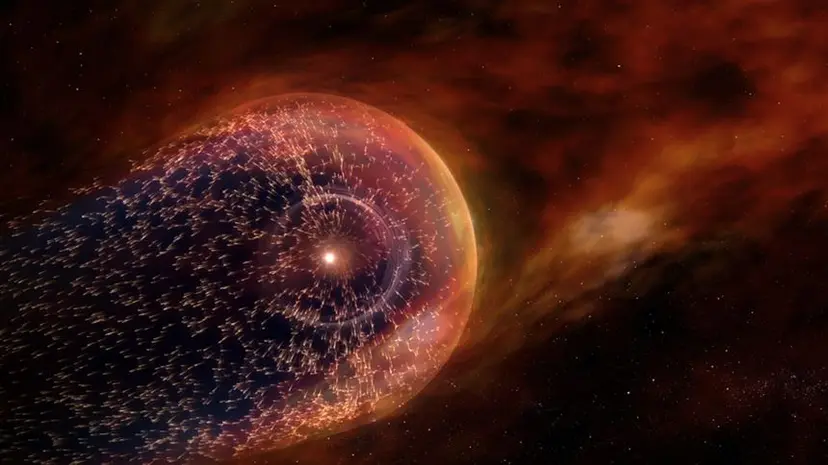
There is further evidence showing how tattered ATLAS has become over its long journey: the carbon-chain molecules commonly found in other comets are almost non-existent on ATLAS. Generally, many comets in our solar system show not only water ice but also large molecules consisting of multiple carbon atoms. This sometimes serves as a clue for panspermia—the theory that the ingredients for life on Earth may have originated from comets rather than Earth itself.
Yet, these carbon-chain molecules are barely visible on ATLAS. It is likely that most of the carbon chains that remained on the surface were broken and destroyed by the relentless bombardment of cosmic ray particles over the eons. The fact that traces of such complex organic molecules are hard to find actually dashes the hopes of sci-fi fans who expected that ATLAS might be carrying alien life or extraterrestrials.
With the long U.S. government shutdown ending a few weeks ago, NASA has started scrambling to release various backlogged probe data. First, China's Mars orbiter Tianwen-1 captured a blurry image of the fast-moving ATLAS. NASA's Mars Reconnaissance Orbiter (MRO) also succeeded in getting a blurry image of the elongated ATLAS by turning its camera, which usually points at the Martian surface, toward the sky. Of course, since these probes were designed to observe the surface of Mars, capturing a sharp image of a fast-moving object crossing the distant sky is a tall order. Meanwhile, Europe's ExoMars also aimed at ATLAS; while it didn't capture a sharp photo, the data allowed scientists to track its orbit with 10 times greater precision than before.
Beyond the orbiters circling Mars, landers settled on the Martian surface also caught ATLAS. The Mars rover Perseverance captured the view of ATLAS crossing the Martian night sky via its MastCam. The faint, barely visible smudge in the photo is ATLAS. It isn't at a level suitable for scientifically significant analysis, but the mere fact that we can observe from Mars what we see from Earth gives one a strange feeling.
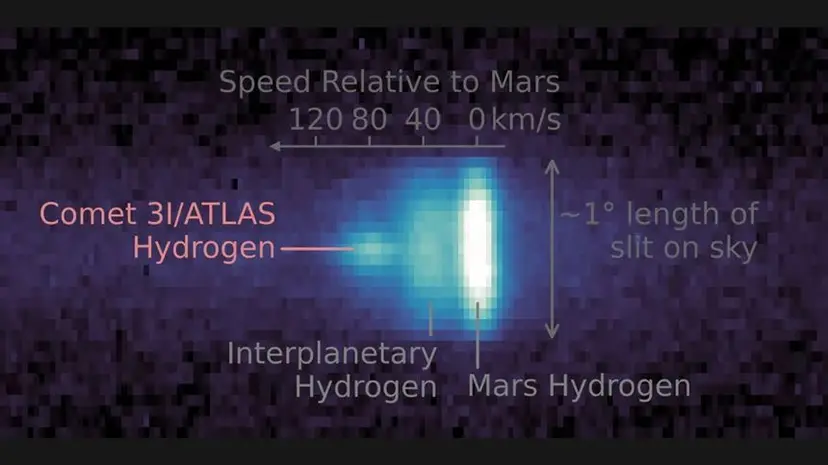
More interesting data comes from MAVEN's observations in September 2025. MAVEN detected the presence of hydrogen atoms in ATLAS using its onboard imaging ultraviolet spectrograph. This instrument is designed to break down light passing through a very narrow slit across the Martian sky into wavelengths to observe its spectrum. Astronomers focused on the clear hydrogen line from ATLAS.
In MAVEN's photo, the vertical axis represents the position of ATLAS in the sky, while the horizontal axis represents different wavelengths. There are three blue smudges in the photo; the hydrogen line emitted from ATLAS is the faint one on the far left. The two brighter smudges to the right are hydrogen lines emitted from deep space beyond Mars and from near Mars, respectively. Because MAVEN orbits Mars, its relative velocity to Mars is the slowest, making the Martian hydrogen line the clearest. Conversely, since the object is moving very fast at 60 km/s relative to the probe, it underwent a significant Doppler shift in wavelength, leaving its mark on the far left where the wavelength is distinctly different.
The MeerKAT radio telescope array on the ground even captured radio waves from ATLAS. Of course, these are not broadcast signals from aliens. Instead, MeerKAT's observations support the fact that ATLAS is indeed a comet clump frozen with water ice. This radio emission comes from hydroxyl radicals consisting of one oxygen and one hydrogen atom—a common component created as water molecules break apart under the Sun's intense ultraviolet light. It is a chemical component commonly seen when comets pass near the Sun.
Last week, ATLAS passed its perihelion, the point in its orbit closest to the Sun. At that time, gas emission from its surface was most active, and solar observation satellites like SOHO, PUNCH, and STEREO, which always face the Sun, were lucky enough to consecutively capture the brightly glowing ATLAS.
Probes departing for asteroids and other planets in the solar system also rushed to look at ATLAS. The Psyche spacecraft, currently flying toward the asteroid Psyche, happened to pass near ATLAS. It tracked the object as the distance narrowed to a mere 0.3 AU. Images from Psyche will also serve as a great tool for tracking the orbit of ATLAS more precisely. Another asteroid probe, Lucy, also aimed its camera at ATLAS. Notably, thanks to Lucy’s unique position, it was able to view ATLAS from a completely different angle—nearly 90 degrees offset compared to other telescopes. We were able to obtain a montage of ATLAS from a wider variety of directions.
The JUICE spacecraft, currently on its way to Jupiter, also collected some data while passing through the comet's tail. However, because the distance is currently quite far and the probe's data transmission speed is slower than expected, this observation data is not expected to reach Earth until around February 2026. Without ATLAS, these probes would have continued their long, boring journey toward their final destinations; but thanks to the sudden appearance of an unexpected, mysterious visitor in the solar system, they found a useful purpose sooner.
There is one piece of misinformation circulating in some news reports: that ATLAS shattered into pieces after failing to withstand the intense solar light over the past few days. This is not true. The one that shattered was C/2025 K1 ATLAS. It is a different comet discovered by the same telescope that discovered the interstellar object ATLAS in question, leading to a mix-up due to the shared name. C/2025 K1 ATLAS did indeed shatter into several pieces on November 13, 2025. However, our main subject today, the interstellar object ATLAS, is still doing just fine.
Has there ever been another celestial object that received such a warm welcome from countless probes scattered across the solar system while drawing everyone's attention at once? Thanks to the visit of ATLAS, we have experienced a whole new level of astronomy, where we mobilize all the probes, telescopes, and cameras scattered throughout the solar system—staying at or heading toward the Sun, Earth, Mars, Jupiter, and asteroids—to continuously target and observe a single object. I don't know if there are actual aliens on board ATLAS, but it is certain that it has served as an opportunity for us to achieve a higher level of scientific progress, much like the monolith in the movie.
There is an important lesson we are learning from ATLAS through data observed by various telescopes and cameras: the space outside our solar system, our galactic space, is harsher than we thought. Astronomers estimate that ATLAS is at least 7.4 billion years old. It is older than our solar system. We hoped it would be a fossil, an ice warehouse preserving the materials from the moment its home star system was born. However, the state of ATLAS confirmed by actual observation deviates from those expectations. During its billions of years of travel across the galaxy, it has been altered by the bombardment of countless cosmic ray particles. In other words, it is no longer in its original state, but rather stripped by cosmic ray particles and coated with new byproducts. Unfortunately, ATLAS does not easily reveal the memories of its original home. Instead, it only proves how harsh the space outside our solar system is.
The Vera C. Rubin Observatory, which was recently completed and has been conducting its first year of observations, expects to discover more than 70, and up to 100, such interstellar objects every year with its giant eyes. If we continue to discover so many interstellar objects, they will no longer be special. The reason Oumuamua and ATLAS feel exceptionally special right now is likely because we have so little experience seeing such objects.
But if, in the future, more telescopes gaze at the sky and find dozens or hundreds of interstellar objects within a year, they will no longer feel mysterious. They might even become so common that we won't feel much excitement when a new one is discovered. When that day comes, no one will wonder if there are aliens on board the interstellar objects discovered daily. By then, we will face the surprising fact that the edge of our solar system is actually filled with more external visitors than the original inhabitants of our own solar system.
About the author, Ji Woong-bae: He loves cats and the universe. After watching 'Galaxy Express 999' as a child, he dreamed of sharing the beauty of the universe. Currently serving as an assistant professor in the Faculty of Liberal Arts at Sejong University, he engages in various science communication activities, including lectures and writing. He has authored books such as 'A Piece of the Universe Every Day', 'Scientists of the Starry Universe', 'Cannot Go, But Know', and 'Strange Questions That Come to Mind When Looking at the Universe', and has translated books including 'The Hitchhiker's Guide to the Galaxy', 'How I Killed Pluto', 'Quantum Life', and 'Cosmigraphics'.