

[비즈한국] Golf is generous toward alcohol. Of course, this applies to rounds among amateur golfers, not professional tournaments. It is not uncommon to see a bottle of soju on a restaurant table before a round even begins, or to find makgeolli or beer on the tables of a starter house after finishing the front nine. Some golfers take a refreshing gulp of makgeolli and remark, “This is why I play golf” or “I play rounds just to drink makgeolli.” What other sport in the world involves drinking in the middle of a game? You don’t finish a set of tennis or table tennis, have a beer, and then start again.
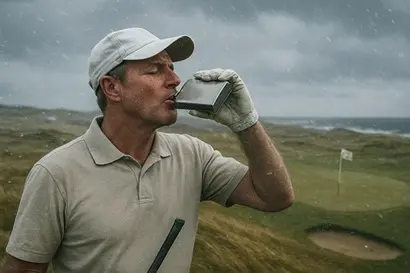
The home of golf is Scotland. Golfers travel to and play on Scottish links courses, including the Old Course at St. Andrews where The Open is held, as if on a pilgrimage. When one thinks of Scotland, Scottish whisky—Scotch—also immediately comes to mind. One of the items on many golfers’ bucket lists is to play a round in Scotland and tour a Scottish whisky distillery. Naturally, this includes doing what the old-time Scottish golfers did: carrying whisky in a flask, much like a soldier’s canteen in the world wars, and taking a sip during the round.
In 1457, King James II of Scotland issued a ban on golf. The reason was that soldiers were so obsessed with golf that they were neglecting archery practice and failing to observe the Sabbath. Scottish whisky also faced a history of alternating bans and regulations due to taxes and bootlegging. Given that what is now a representative cultural icon of Scotland was once perceived as something “bad” or “harmful,” it proves that culture is ultimately not defined by the object itself, but by the era that embraces it.
Golf and whisky are intertwined in many ways. In the early days, the course at St. Andrews consisted of 22 holes. It was later reorganized into 18 holes, and there is a theory that this was because a bottle of whisky yields exactly 18 shots. While this isn’t a widely accepted historical fact and leans more toward a “tall tale,” the story of drinking one shot of whisky per hole to endure the harsh winds, cold, and barren links courses of Scotland sounds quite plausible.
The “highball,” a whisky cocktail currently very popular in Korea, also has a connection to golf. It is said that the term originated from golfers becoming so intoxicated while drinking highballs during a several-hour round that their balls started flying in erratic “high balls.” This, too, is not a widely accepted theory, but one can easily think, “That could be true.”
When visiting golf courses in the U.S. or Europe, there is a “bar” in a corner of the clubhouse restaurant. This is where golfers go after finishing their 18-hole round to enjoy a “shot of whisky” or a “glass of beer.” Golfers call this the “19th hole.” This shows just how generous golf is toward, and how much it invites, alcohol. It is for this very reason that whisky brands like Ballantine’s, Johnnie Walker, Cutty Sark, and Suntory have sponsored numerous golf tournaments with large prize purses. In fact, a young Tiger Woods even won the Johnnie Walker Classic, a European Tour event held in Thailand, twice.
When talking about alcohol and players, one cannot leave out major champion and “bad boy” golfer John Daly. According to the testimonies of his fellow players, Daly often played rounds while still feeling the effects of alcohol, and there were even accounts of him drinking during his rounds. Many argue that if John Daly had exercised a little more restraint with alcohol, his career would have been even more prolific and long-lasting.
Chi-Chi Rodríguez, the Puerto Rican PGA legend famous for his unique outfits and his trademark ceremony of putting his putter back into its “sheath,” reportedly drank a bottle of Puerto Rican rum before his first Masters appearance to calm his nerves. Although he recorded a lackluster score of 82, he said, “I was really happy.” Some weekend golfers also claim they drink to ease their nerves, with some saying that a glass of beer at the turn helps them relax and improve their putting.
However, overdrinking is, quite literally, too much of a good thing. While people may share stories of the amount they drank during a round like a heroic tale, those listening do not hear it that way. Even light drinking is only permissible for those who do not have to drive. Driving under the influence is never acceptable. The thought, “If I drink now, it will be fine later,” is also a very dangerous mindset. While golf may be generous toward alcohol, there should be no generosity anywhere in the world for drunk driving.
Who is the author, Kang Chan-wook? An advertiser and writer. He began his career as a copywriter at Cheil Worldwide and is currently the CEO of the video production company ‘Gaze of the Era’ (Sidae-ui Siseon). A golf enthusiast, he earned a USGTF teaching professional certification and, out of a love for writing, has published golf-related books including ‘The Joy of Golf’, ‘Bad Golf’, ‘Sincere Golf’, and ‘Golf Thoughts, Thoughtful Golf’. He runs the YouTube channel ‘Bad Golf,’ where he shares various stories and thoughts surrounding golf with readers and viewers.