

[비즈한국] The Busan International Art Fair (BIAF), which began in 2007, has evolved into the "Eurasia International Art Fair" in its 24th year. We met with Heo Sook, chairperson of the non-profit organization K-Art, which operates the event, to discuss the past, present, and future of the fair. Dressed in a yellow hanbok, Chairperson Heo emphasized that the Busan International Art Fair is a "promise" she is committed to keeping.
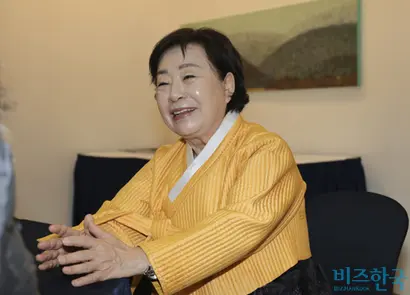
"It brings me great joy to see emerging artists discovered at the Busan International Art Fair grow into featured artists and even professors," said Chairperson Heo, noting that the growth of artists is the fair's top priority. This is also the reason why they continue to hold competitions for children and adolescents.
Chairperson Heo stated, "We were holding youth and children's competitions even before the Busan International Art Fair. It's already been 40 years." She added, "In our country, art education has shifted toward an exam-oriented focus, so it is wonderful to see children engaging in free, creative expression." A separate exhibition space for the children and youth competition is set up at the fair. This year, students from St. Paul International School also hosted a booth, further raising the event's profile internationally.
Why start an international art fair in Busan rather than Seoul or the metropolitan area? Chairperson Heo recalled, "At first, everyone told me not to hold an art fair in Busan. Back then, Busan was considered a cultural barren land." However, she pushed ahead because she believed Busan was the most suitable location for an art fair. Its status as a port city makes it advantageous for transporting and storing artwork, and it is close to Japan. Chairperson Heo listed the advantages of Busan: "Busan is ideal for an individual to operate without government support. It's cheaper than Seoul, people are warmer, and just a short trip away, you're surrounded by rural scenery. It has a family-like atmosphere that artists find comfortable."
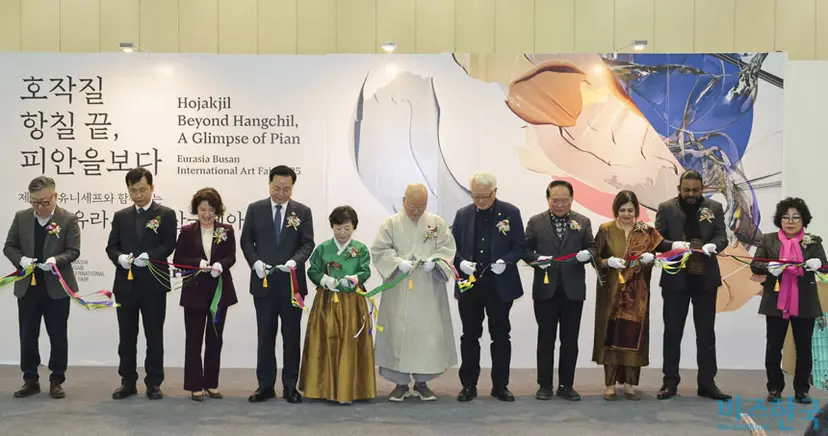
The art market is particularly sensitive to the economy; what is the secret to maintaining the Busan International Art Fair for over 20 years? Chairperson Heo replied in one word: "Because a promise must be kept." That promise is to the artists, the visitors, the international partners, and above all, to herself.
Such struggles took a toll on her health. In 2019, Chairperson Heo was diagnosed with terminal rectal cancer. Three days after her surgery, she visited the exhibition of Indian students who had visited Korea, and her surgical stitches burst. During chemotherapy, she stood on the art fair stage wearing a wig and a hat. She overcame the illness with the determination to keep her promise to the end. She finally received a clean bill of health this year.
There were many difficult times when the event ran at a loss. Chairperson Heo shared, "During those times, the artists would step up to help." This process also opened up new opportunities. Her relationship with the InKo Centre in India began this way. Twenty years ago, due to the event, she was in heavy debt and went on a meditation trip to India. As a Korean woman visiting only Indian temples to meditate, rumors spread among the locals. Someone introduced her to the director of the InKo Centre, Rathi Jafer, who has now become like a sister to her. On that foundation, the Chennai Biennale and Mumbai Biennale were born.
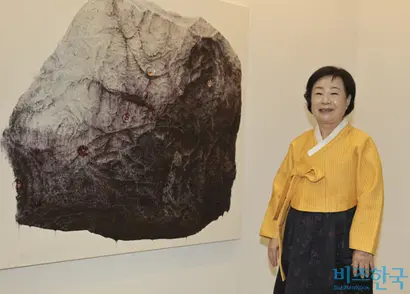
Recently, the world has shown deep interest in Korean culture, such as K-pop and K-fashion. However, the reality is that traditional Korean painting is disappearing from the regular curriculum of art universities. Chairperson Heo emphasized, "Korean painting and landscape painting are the only markets where our art can sell globally." She added, "If you look at Duffy and Seo in the Netflix animation 'K-Pop: Demon Hunters', you can immediately tell it's Korean Jakho-do. I hope we don't discard such roots."
Finally, Chairperson Heo told visitors, "I hope you look at the paintings with sincerity rather than looking at the fame of the artists. I believe you will gain more through a dialogue with the paintings."