

[비즈한국] There is a company called "Anduril Industries," known as the "rising star" of the U.S. defense industry and a sister company to "Palantir," the big data firm familiar to South Korean retail investors, often called "Seohak Ants."
If Palantir was named after the "seeing stone that peers across the world" from J.R.R. Tolkien’s *The Lord of the Rings*, Anduril is the "sword wielded by the king." Led in its early funding stages by Peter Thiel, these two companies have grown by dividing the software and hardware sectors, respectively, just like their namesakes. In particular, Anduril has established itself as the symbol of a "defense unicorn," recognized for a valuation in the trillions of won despite remaining a private company.
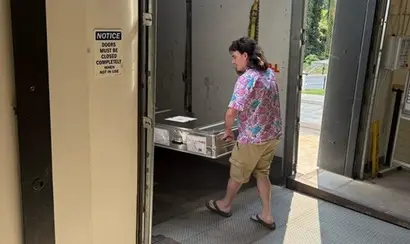
However, warning lights have recently turned on for Anduril. Founder Palmer Luckey, a geek genius who enjoys Japanese anime and appears at official events in Hawaiian shirts and flip-flops, is currently engaged in sharp exchanges with major foreign media outlets, including the Wall Street Journal (WSJ). Through social media, he poured out blunt criticism toward the media and analysts, stating, "They ignore the chronic delivery delays and cost overruns of traditional large defense contractors and exaggerate only a few trial-and-error instances occurring during the startup's development process."
Behind this intense reaction lies a series of questions raised regarding the reliability of Anduril's weapon systems. At the heart of the controversy are technical defects revealed during the Ukraine war and U.S. military testing processes.
According to reports, the small drone "Altius 600" and the reconnaissance drone "Ghost-X" supplied by Anduril to the Ukrainian military proved vulnerable to the Russian army's powerful electronic warfare (EW) and GPS jamming attacks. As a result, it is reported that the Ukrainian military has suspended or restricted the operation of Altius on some frontlines since 2024.
Test results within the U.S. have also raised concerns. During a U.S. Navy exercise off the coast of California in May 2025, an accident occurred where 12 unmanned surface vessels (USVs) produced by Anduril lost control. At the time, a harrowing situation unfolded as the vessels drifted and nearly collided with other ships. To make matters worse, the YFQ-44 "Fury," a candidate for the U.S. Air Force's Collaborative Combat Aircraft (CCA) program, suffered a mechanical failure due to foreign object ingestion during ground engine tests, and the interceptor drone "Anvil" crashed at an Oregon test site, causing a fire that burned approximately 22 acres (about 89,000㎡).
This series of accidents stems from Anduril's unique "Agile" development approach. Unlike the traditional method of entering production only after a perfect design is finalized, Anduril adheres to a Silicon Valley-style methodology: "Build fast, collect data through failure, and improve immediately." While Palmer Luckey argues that these failures are "an intentional part of the development process and an essential learning cost," critics argue that a "speed-first" approach that fails to guarantee "safety" and "reliability" is dangerous when it concerns weapon systems that directly involve human life.
The problem is that Anduril's issues are not someone else's business. Currently, major companies in South Korea's defense industry are deeply linked to Anduril. HD Hyundai Heavy Industries329180 is cooperating with Anduril to develop small modular unmanned surface vessels and is discussing technological collaboration on the large unmanned surface vessel project, "Modular Attack Surface Craft (MASC)." Korean Air003490 is also exploring the integration of Anduril's AI software technology into low-cost unmanned wingmen and the "Ground-Launched Barracuda (SLB-500)" cruise missile.
The fortunate aspect is that Anduril is strengthening partnerships with Asian countries known for their excellent manufacturing capabilities to dispel these reliability controversies. Following the start of Altius drone training by the Taiwanese military last month, Palmer Luckey visited Japan on December 4 to meet with Defense Minister Shinjiro Koizumi, broadening their reach.
This carries significant implications for the Korean defense industry. Collaboration between Anduril and Korean firms is expected to move beyond the simple MOU (Memorandum of Understanding) stage into full-scale Joint-Development starting next year. Paradoxically, the reliability concerns raised within the U.S. could be an opportunity for Korean companies. If Korean defense firms provide their world-class "manufacturing reliability" and "mass production capability" to Anduril, while absorbing Anduril's unparalleled "AI autonomous flight technology" and "rapid prototyping" capabilities, both sides could become strategic partners that perfectly complement each other's weaknesses.
Palmer Luckey emphasized that "slowing down is exactly what the competitors want, and it is the path to ruining cost-effective weapons." His philosophy is innovative, but one must not overlook that on the battlefield, a small defect can become a weapon that threatens one's own forces. If Anduril joins hands with the solid manufacturing know-how of the Korean defense industry, they could add the wings of "unshakable reliability" to the "overwhelming speed" they pursue.