

[비즈한국] Voices calling for the relocation of the Korea Development Bank (KDB) headquarters to Busan are growing louder, centered around the local community in Busan. Former President Yoon Suk-yeol pushed for the relocation of the KDB headquarters to Busan, but the plan failed to clear the legislative threshold, as the Korea Development Bank Act must be amended to allow for such a move.

President Lee Jae-myung has stated that relocating KDB to Busan is realistically difficult. Instead, he promised to move the Ministry of Oceans and Fisheries and HMM011200 (formerly Hyundai Merchant Marine) to Busan and to establish a Southeast Region Investment Bank. However, given the role and ripple effect of KDB, the institution is something the city of Busan cannot easily give up. The People Power Party still maintains a positive stance toward the relocation. This could act as a variable in the local elections scheduled for next June. While the Democratic Party of Korea is actively trying to win over Busan's voters, it has yet to provide a definitive stance on the KDB relocation.
Moreover, after its inauguration, the Lee Jae-myung government announced that it would establish a "Southeast Region Investment Corporation" rather than an "Investment Bank." Jeon Jae-soo, Minister of Oceans and Fisheries, explained at a Cabinet meeting in September, "Establishing it as a bank would make rapid and stable financing difficult, so we will allow it to issue corporate bonds," adding, "By establishing it as a corporation, if we invest 1 trillion won through bond issuance, we can leverage it to secure 15 trillion won, and with a 3 trillion won investment, we can quickly and stably secure 50 trillion won."
Local political circles in Busan are continuing to voice their opposition. Busan Mayor Park Heong-joon criticized the move on social media, stating, "This is an act of casting aside the long-held aspirations of Busan citizens," and "It is a clear breach of the President's campaign promise and an act of disregarding Busan citizens." During a government inquiry in September, Representative Lee Heon-seung of the People Power Party pointed out, "Following the scrapping of the KDB relocation, to propose an investment corporation that cannot accept deposits and has limited funding capabilities is an act that ignores the people of Busan."
There is a difference between an investment bank and an investment corporation regarding deposit-taking functions. An investment bank can accept deposits, while an investment corporation cannot. Without the ability to accept deposits, capital is limited, and available funds are restricted. Furthermore, it is pointed out that because investment corporations rely mostly on bonds, they are highly exposed to risks from the external environment.
As the Lee Jae-myung administration announced the plan for the Southeast Region Investment Corporation, demands for the KDB relocation have surged again in Busan, as the plan for a Southeast Region Investment Bank—which was intended to replace KDB—has been aborted. In November, Busan City and the People Power Party jointly proposed nine key tasks to the government, including the relocation of KDB. Mayor Park Heong-joon stated, "We urge a progressive shift in the government's stance so that the relocation of KDB, which has been pursued by past administrations, can bear fruit under this government."
The Lee Jae-myung administration has not expressed a specific position on the KDB relocation to Busan. The Democratic Party of Korea has historically maintained an atmosphere of subtle opposition to the relocation. In 2023, Lee Su-jin, then-floor spokesperson for the Democratic Party of Korea (a member of the National Assembly), stated, "Pushing for the relocation of KDB recklessly without even parliamentary consent is no different from being a thug," and added, "A reckless relocation of KDB for the sake of dividing up spoils can never be tolerated."
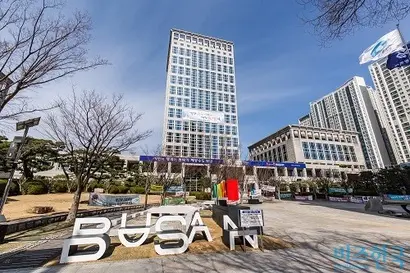
However, considering the local elections next June, it is difficult for the Democratic Party of Korea to simply ignore the demands of the local community in Busan. While the party is putting effort into winning over voters in the PK (Busan-Gyeongnam) region, it remains unresponsive to the demands for KDB's relocation.
Various opinion polls conducted over the past few years have shown that more than half of Busan citizens favor the relocation of KDB. If the Democratic Party of Korea ultimately opposes the move, it could act as a variable in next year's local elections in the PK region. Furthermore, substituting KDB's relocation with the establishment of a Southeast Region Investment Corporation is not easy. Above all, it lacks justification given that it is not the Southeast Region Investment Bank originally promised by President Lee Jae-myung.
Critics also argue that the relocation of the Ministry of Oceans and Fisheries and HMM, which the Lee Jae-myung government is promoting instead, is insufficient. The fundamental role of KDB is corporate finance. If KDB relocates, it could foster growth for industries across the entire Busan region.
The process of moving HMM to Busan is also not smooth due to internal opposition. Additionally, unlike KDB, which is a public enterprise, there is significant criticism regarding the forced relocation of the headquarters of HMM, a private company. The HMM branch of the Korean Federation of Service Workers' Unions (the HMM land-based labor union) stated, "The government's push to forcibly relocate a private company's headquarters to Busan is a serious abuse of power that infringes on the autonomy of corporate management," adding, "The impact on the workers' right to survival is extremely serious."
There are predictions that even if the Lee Jae-myung administration succeeds in relocating HMM to Busan, ignoring the demands for KDB's relocation will eventually be detrimental to the ruling party. A political insider remarked, "The KDB relocation has become a significant issue, and since a majority of Busan citizens demand it, ignoring this will be a negative factor regardless of past achievements."
At the very least, Lee Jae-sung, former chairman of the Democratic Party of Korea's Busan City Committee, mentioned last July, "I will actively work to resolve pending issues in Busan, such as the relocation of KDB, the creation of a global hub city, and the timely opening of Gadeokdo New Airport." Lee declared his candidacy for Busan Mayor in November. He is currently the only person in the Democratic Party of Korea to have officially announced a bid for Busan Mayor. If Lee becomes the final candidate, he will find it difficult to avoid questions regarding his stance on the KDB relocation. Although he previously appeared to support the relocation, it is unclear whether he will offer a pledge that contradicts the Lee Jae-myung administration's policy in the current climate.