

[비즈한국] Kangstem Biotech217730 is set to accelerate the commercialization of its skin organoid (organ analog) platform by establishing a dedicated brand. With the global movement to abolish animal testing for new drug and cosmetic development gaining momentum, demand for skin organoids is expected to rise.
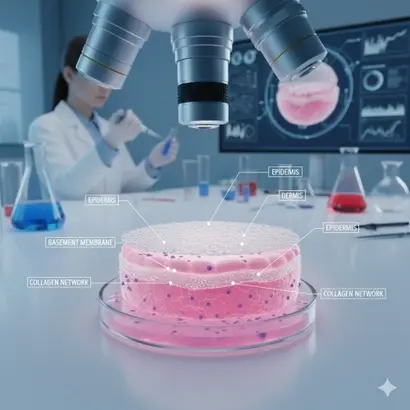
According to KIPRIS, the patent information search service, Kangstem Biotech filed a trademark application for 'Skinoid' with the Korean Intellectual Property Office on the 25th of last month. The designated goods for the trademark include biological tissue reinforcement patches, skin regeneration patches (biological tissue), burn treatments, surgical artificial skin, and artificial skin for replacing human skin membranes.
A Kangstem Biotech representative expressed optimism, stating, "As interest in our skin organoid platform from external parties is growing, we decided to file for the trademark to establish our identity. Since the demand for organoid-based testing methods and organ replacement is continuously increasing, we expect this to quickly become one of our key pipelines."
Kangstem Biotech is currently collaborating with LG Electronics066570 to develop the world's first skin organoid-based medical device evaluation method. The partnership utilizes Kangstem Biotech's skin organoids to verify the substance absorption rate and the efficacy of skin-whitening active ingredients in LG Electronics' beauty devices. Unlike existing skin organoid models, the advantage of the Kangstem Biotech platform is its ability to make direct contact with the epidermal layer and its capability to evaluate beauty devices of various sizes.
Kangstem Biotech acquired its skin organoid technology through a contract with the Seoul National University Industry-Foundation in August 2021. Based on this, it is researching efficacy screening analysis methods for cosmetic raw materials and hair loss treatments.
For Kangstem Biotech, expanding the commercialization of its skin organoid platform is crucial for improving its financial structure. Its atopic dermatitis stem cell therapy, 'Furestem-AD', failed to meet primary endpoints despite successive Phase 3 clinical trials, and its osteoarthritis treatment, 'OSCA', is still in Phase 2a clinical trials, suggesting a long road to commercialization. Listed on the KOSDAQ in December 2015, Kangstem Biotech has recorded operating losses for nine consecutive years until last year, with total operating losses during this period exceeding 152.5 billion won. With 13.4 billion won in operating losses reported up to the third quarter of this year, it is highly likely the streak of ten consecutive years of operating losses will continue.
However, as initiatives to reduce or abolish animal testing—led recently by the U.S. Food and Drug Administration (FDA)—are gaining traction, the spotlight is shifting toward organoid testing as a viable alternative. This is creating an environment where interest in Kangstem Biotech's skin organoid platform could increase. In April this year, the FDA announced plans to phase out animal testing requirements for monoclonal antibodies and other drugs, and on the 2nd (local time), it released a draft guidance for reducing animal testing for monoclonal antibodies. The industry expects that 6-month primate toxicity tests, currently required before new drug clinical trials, will be either abolished or reduced.
Beyond the FDA, the U.S. Centers for Disease Control and Prevention (CDC) plans to end monkey experiments by the end of this year, and the U.S. National Institutes of Health (NIH) has established an organization dedicated to replacing animal testing and invested $87 million to build an organoid modeling center, signaling that the use of alternative testing methods is becoming a necessity rather than a choice. The FDA stated, "We will promote the use of human organoids and organ-on-a-chip systems grown in laboratories that mimic human organs such as the liver, heart, and immune system to test drug safety," adding, "These can reveal toxic effects that might not be easily detected in animals, allowing for a more direct understanding of human responses."