

[비즈한국] "I feel like I need to write an apology letter. Until now, we have only talked about how to spread K-Pop globally, and we failed to realize the fact that K-Pop concerts emit such massive amounts of carbon." This was stated by National Assembly member Min Hyung-bae (Democratic Party of Korea), who attended the 'Discussion on Establishing Guidelines for the Standardization of K-Pop Low-Carbon Concerts' held at the National Assembly on December 2.
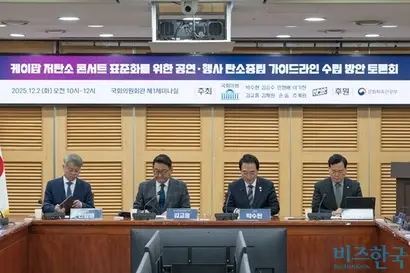
From the dazzling lights powered by massive amounts of electricity to the trash generated by tens of thousands of fans, the K-Pop industry is facing a shift in tide as it battles the stigma of being a "culprit of environmental pollution." Much like the concert tours of international pop stars such as Coldplay and Billie Eilish, the need to establish guidelines for a low-carbon transition in K-Pop concerts has been raised.
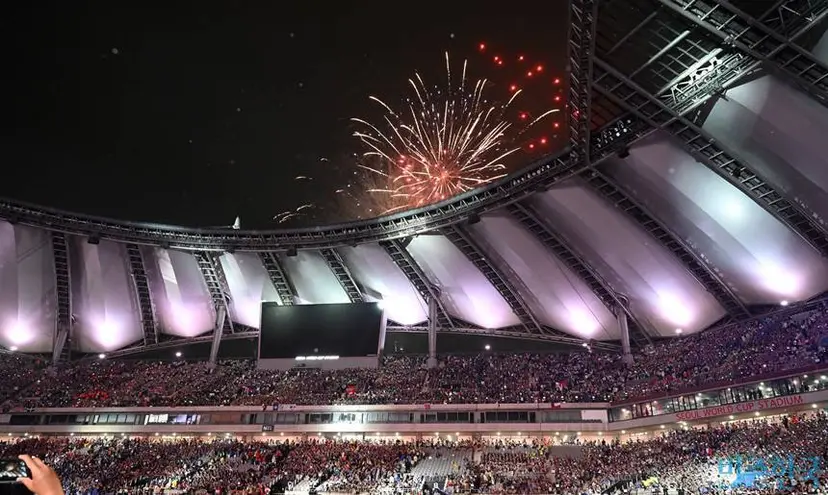
The discussion saw opening remarks and congratulatory messages from 15 assembly members, including Minister of Culture, Sports and Tourism Choi Hwi-young and National Assembly member (and Democratic Party leader) Park Chung-rae. Representative Lee Ki-heon (Democratic Party of Korea), whose constituency includes Goyang City, stated, "I live in the area where the most K-Pop performances take place. While Coldplay's efforts are often cited as an example, I remember worrying while watching the fireworks from Coldplay's concerts through my window every evening. Now that K-Pop enjoys worldwide popularity, I believe K-Pop must also align with South Korea's efforts toward carbon neutrality."
Kim Na-yeon, a campaigner for Kpop4Planet, an environmental group formed by K-Pop fans, said, "I attended my 'ultimate' idol's concert for three consecutive days last July. Concerts are incredibly precious to fans as they are places where we can directly connect with our idols. Fans want to enjoy concerts in this era of climate crisis without the anxiety that they might be shut down." The event saw fans expressing their strong support for the necessity of creating carbon-neutral guidelines for K-Pop concerts.
Fans Also Want Low-Carbon Concerts
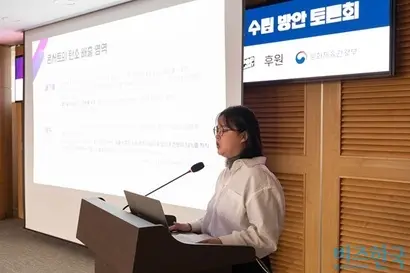
Presenter Kim Na-yeon emphasized that K-Pop fans are the ones who truly desire low-carbon concerts for the sustainable growth of K-Pop. She stated, "Concerts are the sector that emits the most greenhouse gases in the music industry. The reason why the low-carbon transition is important in the music industry is due to soft power. Just as K-Pop fans voluntarily engage in donations and social movements inspired by BTS RM's message at the APEC keynote, the climate crisis messages delivered by idols have a very high potential to lead to climate action among fans."
According to Kpop4Planet, a survey of 601 global fans showed that 92.2% responded that they "want low-carbon concerts more." Seven out of 10 respondents urged the industry to take immediate action, choosing "now (56.3%)" or "within next year (13.1%)" as the target time for transition. Key requirements identified by fans include: raising awareness through the artist's climate messages, using eco-friendly transportation, operating on renewable energy, and banning single-use plastics.
Campaigner Kim Na-yeon pointed out, while explaining the carbon-neutral efforts of domestic entertainment companies such as YG, SM041510, HYBE352820, JYP, and CJ ENM, that "the reality of K-Pop concerts is that there are no substantial carbon reduction activities yet."
Kim argued, "The low-carbon concerts that K-Pop fans are talking about involve measuring carbon emissions and establishing reduction plans. Furthermore, they must be based on renewable energy. Finally, there must be a clear message from the artist regarding the climate crisis."
The second presenter, Kurt Langer, a board member of the Music Sustainability Association (MSA), analyzed, "Sustainability in the music industry is not a new field. Over the past five years, efforts to make the music industry eco-friendly have already increased explosively around the world. Artists and fans are demanding that companies and governments take more active steps in responding to the climate crisis."
Langer pointed out that the biggest sources of carbon emissions at concerts are fan travel (62%) and food (17%), and suggested encouraging the use of public transportation and providing plant-based food. He also stated that electricity should be replaced by renewable energy sources such as solar power rather than fossil fuels.
Starting with Infrastructure
K-Pop industry officials lamented that a lack of "infrastructure" is holding them back. Kim Myung-shin, team leader at Live Nation Korea, who managed Coldplay's concert in Korea last April and reduced carbon emissions by 50% compared to previous levels, said, "Global interest is rising daily, but the substance of the industrial ecosystem responding to the climate crisis is still lacking. The biggest hurdle is the lack of infrastructure." Kim pointed out, "Unlike advanced overseas concert venues, Korea still lacks many venues, and most are limited by their reliance on fossil-fuel-based generators. We must lead by attempting low-carbon concerts at large venues first."
Heo Eun, CEO of E-Onus, emphasized the need for institutional support. Heo stated, "When replacing a 100kW diesel generator with a mobile ESS (Energy Storage System), carbon emissions can be reduced by about 73%. To expand adoption, it is realistic to provide incentives such as subsidies for ESS usage, similar to subsidies for electric vehicles."
"Essential from a Financial Perspective"... Will Legislative Discussions Begin in the National Assembly?
An official from the Ministry of Culture, Sports and Tourism, the governing body for the K-Pop industry, also attended the discussion. Kim Hyun-mok, head of the Popular Culture Industry Division at the Ministry, admitted, "It is true that the government has not prepared much in this field until now."
Kim Hyun-mok stated, "Most domestic concert venues are classified as sports facilities and are owned by local governments. In the case of performances, the responsible authorities are divided between the Ministry of Culture, Sports and Tourism and the Ministry of the Interior and Safety, making the supervisory subject ambiguous. Carbon neutrality is the responsibility of the Ministry of Environment. As concert venues vary from 500 to 60,000 seats, it does not seem easy to regulate them uniformly. I believe social discussion, including incentive systems that can induce voluntary participation from the industry, is necessary."
Park Hyuk-tae, team leader at the Korea Creative Content Agency (KOCCA), said, "KOCCA has researched a carbon emission calculator that can measure carbon emissions. We analyzed and calculated various carbon emission sources generated in the concert event sector, including energy use, stage and set lighting, travel of creators and staff, and lodging. To revitalize eco-friendly content production across the content industry, including performances, it is necessary to continuously verify the carbon emission calculator and establish it as an official standard tool that can be used in practice. We also need to database and standardize carbon emissions for various items such as albums, merchandise, and accommodations."
The financial sector expressed the view that the low-carbon transition is a matter directly linked to a company's survival. Choi Yong-hwan, ESG research team leader at NH-Amundi Asset Management, emphasized, "Low-carbon concerts are not just 'good campaigns' but are very important issues for investors from the perspective of 'financial materiality.' This is because concerts are an area where the revenue proportion and carbon proportion of entertainment companies are both high. For all major agencies, the proportion of concert revenue will only grow in the mid-to-long term."
After the discussion, Representative Min Hyung-bae ordered relevant agencies to identify the current status of carbon neutrality, stating, "It seems we need to form a task force."