

[비즈한국] A new installment in James Cameron’s ‘Avatar’ franchise is set to be released soon. While the previous film explored a world of water, the upcoming one is expected to delve into a world of fire and ash. The main stage of the ‘Avatar’ movie is the alien moon Pandora. Many audience members think Pandora is just an alien planet, but that is not the case. Pandora is a moon orbiting a massive gas giant called Polyphemus! Located 4.2 light-years away near Proxima Centauri, the closest star system to our own, is the planet Polyphemus, and Pandora is the moon circling it. Recently, an interesting experiment has been conducted to turn this movie concept into reality: a concrete plan to find a real-life version of Pandora has been proposed.
It is fascinating that the setting is not an alien planet, but an alien moon. Even real-life astronomers are now considering the possibility of life on moons that orbit massive gas giants. While our solar system has only eight planets, there are over 400 moons orbiting them. Among them, places like Europa, Ganymede, Enceladus, and Titan—which orbit Jupiter and Saturn—feature underground oceans and even atmospheres. As perspectives on alien moons shift, the potential for extraterrestrial life has grown.
The real-life version of Pandora, whose existence is gradually being revealed, shows an intriguing possibility that life might exist right in our celestial backyard, without having to search too far.
We have discovered nearly 6,000, or perhaps up to 10,000, exoplanets so far. Naturally, there must be even more exomoons orbiting them. If so, shouldn't we look closely at exomoons, not just planets? However, it is not that simple. Moons are significantly smaller than planets. Ganymede, the largest moon in our solar system, is only about the size of Mercury. Therefore, it is difficult to apply the same methods used to find exoplanets directly to hunting for exomoons.
Usually, the method for finding exoplanets involves "transit" observations—where starlight dims as a planet passes in front of its star—or observing the subtle "wobble" of a star caused by the gravitational pull of a massive orbiting planet. Another method is gravitational microlensing, where a planet's gravity slightly bends the surrounding space-time. However, for a small exomoon, it is difficult to see clear traces using any of these three methods. We would need to detect a change in the central star caused by something orbiting it, but an exomoon is far too small compared to its star. Just because an exomoon is fidgeting around a star does not easily cause any observable changes in the star itself.
That is why astronomers turned their attention to the changes in exoplanets, which are closer in scale. While an exomoon would struggle to cause a noticeable effect on the central star, Proxima Centauri, it could influence the nearby planet. As it happens, a massive gas giant orbits Proxima Centauri. If there really is a moon orbiting that planet, how many years would we need to observe it to confirm its existence?
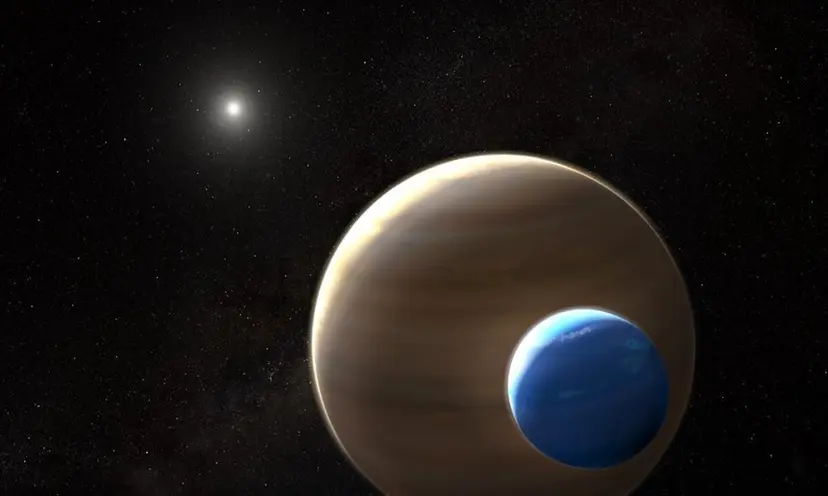
Astronomers ran a simulation assuming a large moon about 30 times the mass of Earth. As a result, the orbit of the planet orbiting Proxima Centauri wobbled minutely. By subtracting the orbital components of the planet itself, one can extract the effects of gravitational perturbation caused purely by the surrounding moon. Of course, a moon 30 times the mass of Earth is not the typical moon we expect. At that size, it is essentially a large planet. Therefore, astronomers conducted more experiments assuming more realistic moon sizes.
As the assumed mass of the moon decreases, the degree of distortion in the planet's movement becomes negligible. Thus, it is difficult to make a meaningful judgment after only one or two years of observation. Even if the orbital distortion is slightly visible, it is hard to distinguish whether it is truly due to orbital perturbation or just standard observational noise. Therefore, astronomers assumed a virtual observation environment and calculated how much observation time and how powerful a telescope would be needed to meaningfully confirm the existence of a moon.
They assumed more realistic, smaller moons, ranging from 50% to 10% of Earth’s mass. The results showed that to statistically determine the existence of such a moon, at least five years of accumulated data are required. Assuming various orbital periods ranging from 4 to 30 days, the existence and orbit of the moon could be determined in all cases. This method of analyzing the minute changes in the movement of celestial bodies across the night sky is called astrometry.
According to the simulation, an exomoon that could be found orbiting an exoplanet near Proxima Centauri using this astrometric method must be at least 20% of Earth’s mass. If it is lighter than that, no amount of long-term observation can lead to a meaningful judgment. Of course, even at this mass, it is much heavier than our Moon, which is only 1% of Earth's mass.
However, there is another pitfall. To discover an exomoon in this way, one must observe it once every hour for five years. If observed less frequently, it would take even longer to accumulate meaningful data. In other words, it requires a dedicated telescope focused solely on that one spot, watching the star and planet continuously for five years. Proxima Centauri is the closest location in our solar system, and a place where humanity will soon attempt to send probes to take direct photos. It is also the main stage for the movie 'Avatar,' which excites many SF fans. Yet, is it worth dedicating the entire time of a massive telescope to it? Is it a worthwhile attempt?
The situation might improve with larger telescopes. Europe is currently building the E-ELT, a new giant telescope with a 39-meter diameter. Also, the Habitable Worlds Observatory (HWO), a new 6-8 meter space telescope designed specifically to find exoplanets and signs of life, is currently under construction. With such telescopes, even observing once a day could accumulate meaningful data over five years to judge the presence or absence of an exomoon. Of course, even at this frequency, it still means the telescope is favoring a specific celestial body.
Recently, the James Webb Space Telescope aimed at Alpha Centauri, which forms a triple star system with Proxima Centauri. It succeeded in taking a direct photo of an exoplanet there! Unfortunately, the possibility that this planet harbors life has decreased, as it appears to be a gas giant rather than a rocky planet. Of course, if there are other icy moons nearby, it is too early to give up hope. But perhaps, before discussing the potential for life on exomoons, we should first confirm whether or not there is life on the moons of the other planets in our own solar system.
Proxima Centauri is the closest place to us, which is why it is the most loved and the stage for the most imagination. Is it truly special enough to pour that much time and energy into? Is it worth it? Is there really a moon hiding there beyond the planet?
Until recently, we only imagined stars when looking at the night sky, but now we can imagine the countless planets that might accompany those stars. And before long, we will also imagine the even greater number of moons circling them. The cosmic landscape unfolding before our eyes remains the same, but we are increasingly sensing a busier, more crowded universe.
Reference
https://iopscience.iop.org/article/10.3847/2041-8213/ae0741
Who is author Woong-bae Ji? He loves cats and the universe. After watching 'Galaxy Express 999' as a child, he developed a dream to share the beauty of the universe. He is currently an assistant professor in the Faculty of Liberal Arts at Sejong University, participating in various science communication activities such as lectures and writing. He has written books such as 'A Piece of the Universe Every Day', 'Scientists of the Starry Universe', 'Unreachable but Knowable', and 'Strange Questions That Come to Mind When Looking at the Universe', and has translated works including 'The Hitchhiker's Guide to the Real Universe', 'How I Killed Pluto', 'Quantum Life', and 'Cosmigraphics'.