

[비즈한국] Tensions are rising in China-Japan relations after Japanese Prime Minister Sanae Takaichi announced a strategy stating that Japan could exercise its right to collective self-defense in the event of a crisis in Taiwan. Adding to this, the Chinese private aerospace firm 'Space Transportation' recently unveiled a simulation of its hypersonic missile, the 'YKJ-1000,' striking the Japanese archipelago, drawing significant attention from the defense industry.
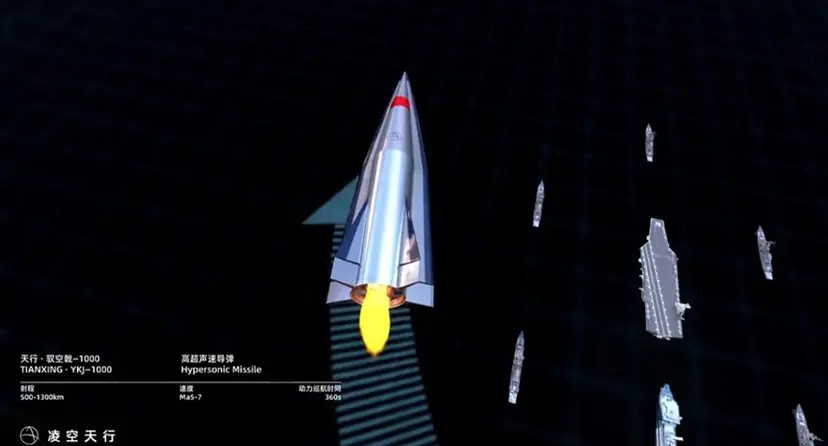
To dismiss this simply as a stunt driven by patriotic marketing or anti-Japanese sentiment would be a mistake, as the technical foundation and potential of Space Transportation are substantial. The company was founded in 2018 by Wang Yudong, who, after graduating from China's prestigious Tsinghua University, served as a chief designer for major national projects at the China Academy of Launch Vehicle Technology (CALT). The firm has proven its technical prowess by successfully achieving horizontal landing of its reusable rocket 'Tianxing-I' in 2019 and successfully launching a ramjet engine-based hypersonic test vehicle this past January.
While the company had previously focused on commercial space technology development, such as reusable launch vehicles and the suborbital spaceplane 'Cuantian Shihou,' it has recently been expanding into the defense sector. The YKJ-1000, unveiled by Space Transportation, is considered the world's first hypersonic missile developed under private enterprise leadership. It is drawing attention as a development that could change the paradigm of existing weapons systems.
In terms of appearance, the YKJ-1000 is a Hypersonic Glide Vehicle (HGV) similar to an improved version of North Korea's 'Hwasong-11Ga (KN-23).' This missile, capable of flying approximately 1,300km at speeds of Mach 7 or higher, is accelerated by a rocket booster and then glides in the upper atmosphere to strike its target. It is considered to have made interception extremely difficult for existing missile defense (MD) systems due to its high maneuverability. The YKJ-1000 is equipped with two auxiliary engines on the glide vehicle itself, allowing for sharp evasive maneuvers and detours comparable to those of an aircraft.
The application of 'Swarm AI' technology to an HGV for the first time in the world is also highly significant. Multiple missiles share location and status information in real-time through mutual data links, executing optimal formation flight tactics to neutralize interception networks. This implies it possesses intelligent air strike capabilities that go beyond simple physical impact.
Space Transportation has also dramatically lowered the production cost of the missile. By utilizing commercial-grade microprocessors (MCUs) intended for automobiles and replacing over 90% of parts with industrial standard components (COTS) rather than expensive military-spec (Mil-Spec) parts, the company has cut costs significantly. The use of a self-developed 1,800-degree heat-resistant special cement composite for the missile's core body is also cited as a key cost-saving factor. According to U.S. Congressional Budget Office (CBO) data, the mass production cost per unit of the U.S. Army's Long-Range Hypersonic Weapon (LRHW), the 'Dark Eagle,' is approximately $41 million (about 55 billion KRW). In contrast, Space Transportation claims that the YKJ-1000 can be supplied for $4 million (5.4 billion KRW), which is one-tenth the cost of the Dark Eagle.
Such moves by China hold significant implications for 'K-Defense.' In a battlefield where a missile costing one-tenth the price is incoming, responding with interceptor missiles that are ten times more expensive cannot be a sustainable equation for victory. In modern warfare, where wars are increasingly becoming prolonged wars of attrition, the cost-effectiveness of weapon systems and supply chain stability are directly linked to the ability to sustain the war effort, making the importance of 'low-cost mass production' capabilities greater than ever. In particular, the bold introduction of commercial parts, as seen in the YKJ-1000 case, could be a key factor in not only reducing production costs but also enabling rapid procurement of parts and maintenance of production lines during wartime.
Our military and defense industry are also moving swiftly. In addition to performance improvements, such as the application of anti-jamming GPS to the Chunmoo guided rocket, the development of next-generation missiles is underway. South Korea must also actively utilize its strengths in private sector technologies—such as semiconductors and actuators—in missile components to achieve efficiency in acquisition costs.