

[비즈한국] The Korean Art Promotion Project, which began as an initiative solely to support artists, has continued for 10 years. Keeping true to our initial intentions, we have supported over 230 artists. It was a unique endeavor, never before attempted by any media outlet, cultural organization, or government agency in Korea. We take pride in the fact that this decade of persistence has been etched into the 21st-century Korean art scene as a significant value. Consequently, it is recognized that the 10-year history of the Korean Art Promotion Project has established a perspective from which to observe the trends of contemporary Korean art. Now, in Season 11, we intend to pave another path for Korean art.
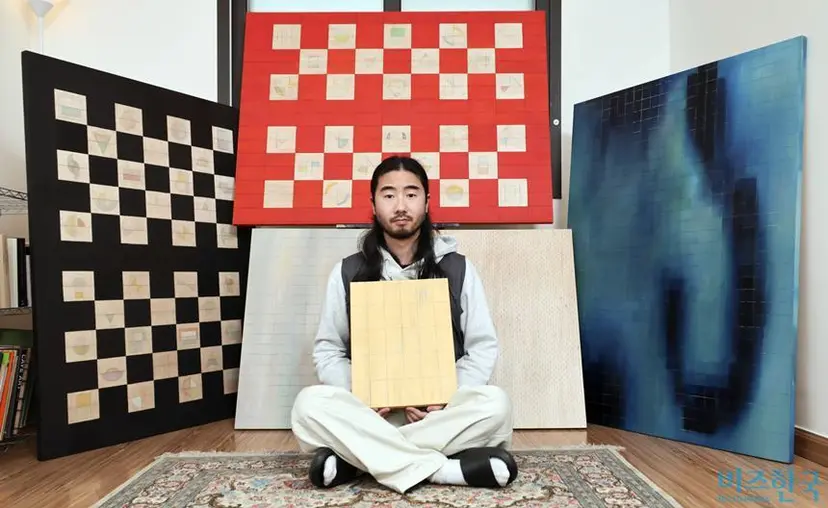
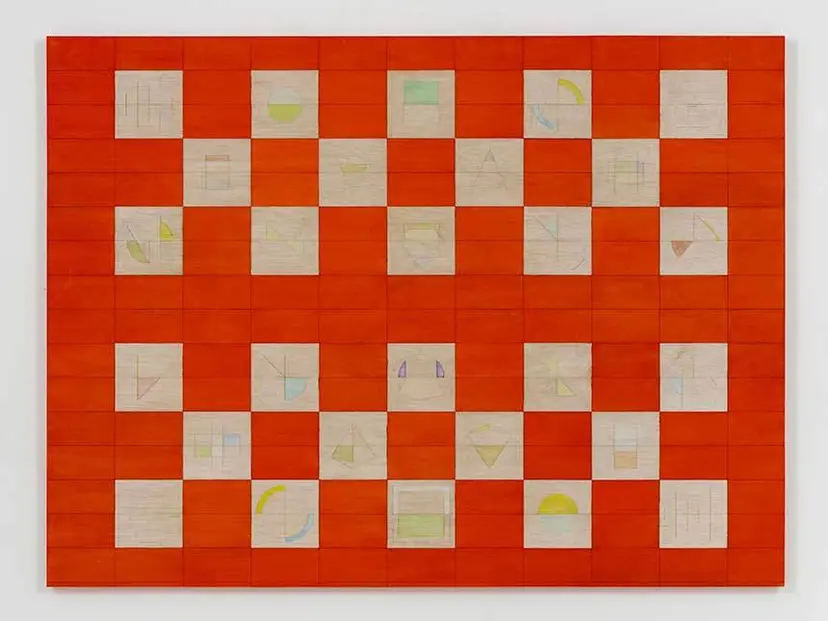
The artist, whose real name is Kim Dong-seok, goes by the professional name "Paul Kim." Looking at his paintings, one sees nothing more than a checkerboard-like grid screen with a limited palette. Within the small squares, there are also shapes such as triangles, circles, and rhombuses drawn subtly in pale colors. People call these paintings by Paul Kim "abstract art."
"Abstraction" means to remove concrete forms. A concrete form refers to a painting that realistically recreates the visible world, or shapes and appearances used to explain stories such as myths or historical facts. Think of paintings with clear forms that we easily associate with art, or paintings from which we can read a specific content.
In other words, abstraction refers to work that lacks easily recognizable shapes or stories. Paintings created using forms or colors that do not explain anything, or those created using the material properties of the medium, are called abstract paintings.
Therefore, an abstract painting is a painting without content. Since it is a painting without content, strictly speaking, it is not art intended for "appreciation." In Western art history, abstract painting is considered to have first appeared around the 1910s. The paintings created by Kandinsky and Mondrian were completely different from the paintings that came before them. In art prior to that, one could read the content.
Thus, if you were moved by seeing an abstract painting, you haven't properly understood it. Conversely, there is no reason to be ashamed if you felt nothing after looking at an abstract painting.
Then what should one look for in an abstract painting? You should look for innovations in form, expression methods, or various experimental uses of materials. In other words, can you find a new sensibility in the arrangement of lines, planes, and colors? Or, you can look at and understand what materials or techniques were used to construct the canvas.
The reason for this long-winded introduction is that Paul Kim's work can be seen as abstract. Moreover, it features the geometric composition commonly seen in abstract art from the 1910s. If we conclude this, it would mean he is doing "trite" abstract art, like outdated fashion.
So, is Paul Kim truly just following the path of abstract art that is over a century old? Of course not. Then why is he so immersed in this work, which is highly prone to such misunderstandings?
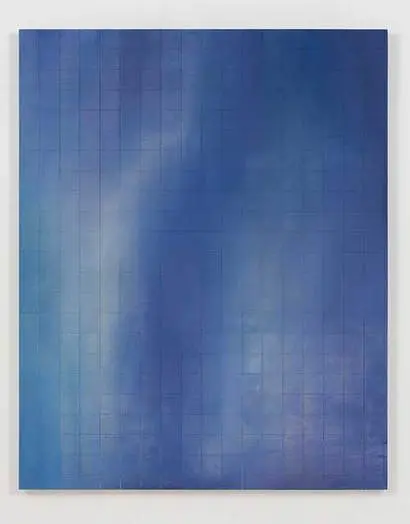
Strictly speaking, Paul Kim's work is not abstract art. This is because he is using the composition and methods of abstract painting to tell his own thoughts. Why, then, does he choose an abstract form? It is because the very thoughts the artist intends to put into his paintings are highly abstract. What thoughts, you ask?
They are about the finiteness of existence and the universal principle that everything changes. He attempts to capture this through the material properties of his medium, subtle changes in color, and geometric lines created with carving knives. It is painting that expresses abstract thoughts in an abstract way.