

[비즈한국] "In the summer, the temperature inside the sorting facility exceeds 40 degrees Celsius. All we have is one electric fan next to the conveyor belt." "Even when I wear a mask, dust keeps coming out of my nose and ears." At recycling sorting facilities, women in their 50s standing before conveyor belts work tirelessly to sort through incoming plastics, cans, and shards of broken glass. The air is thick with stench and dust; the noise is deafening; and because they never know when their hands might be cut or caught, they live in constant tension. Just a few months ago, a worker was crushed to death after getting caught in a compactor. Accidents involving workers being pulled into compactors or shredders are frequent at recycling sorting facilities.
On November 27, a "National Assembly Forum on Legal Reform for Improving the Treatment of Environmental Infrastructure Workers," hosted by National Assembly member Yong Hye-in (Basic Income Party), the Basic Income Party’s Labor and Safety Committee, the National Environmental Labor Union, and the Korea Women’s Environment Network, was held at the National Assembly. The forum discussed the problems of the private outsourcing structure and directions for institutional improvement, alongside the results of Seoul City’s long-term health impact study—the first of its kind conducted by a local government in Korea.
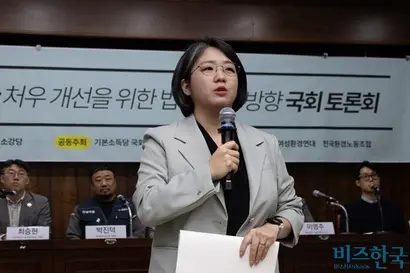
Park Jin-deok, Chairman of the National Environmental Labor Union, who served as a keynote speaker, pointed out that because environmental facilities are currently operated based on mere guidelines or manuals, the safety and treatment of workers are not guaranteed. Chairman Park criticized, "Most environmental facilities are operated through private outsourcing or sub-outsourcing, making employment forms unstable. Wages and welfare levels are trapped in a structural inequality dictated by bidding prices. Although they provide public services, there is a significant gap between different regional contractors."
Chairman Park explained, "Most operational systems for environmental facilities are managed by notifications and guidelines. Since these guidelines focus on administrative efficiency and cost reduction, worker safety is sidelined. Even essential items like safety gear and rest areas remain at a 'recommended' level."
The "undergrounding" of environmental facilities is also currently underway. Local governments have a tendency to move these facilities—which residents often avoid—underground to keep them out of sight. However, facilities built underground are lethally vulnerable to fires. According to the National Environmental Labor Union, when a fire broke out at the Dongdaemun Environmental Resource Center last year, it took 135 firefighters and 37 fire trucks 21 hours to extinguish the blaze.
"Rest periods are not guaranteed, and there is a shortage of personnel because current guidelines do not set clear staffing standards. Since protection guidelines have no legal binding force, they are treated as mere references in the field. We must mandate essential contract conditions and grant workers proper legal status," the Chairman urged.
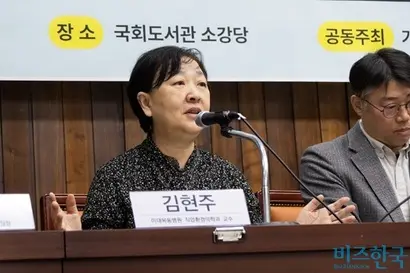
Following this, Professor Kim Hyun-joo of the Department of Occupational and Environmental Medicine at Ewha Womans University Mokdong Hospital pointed out the need to establish a management system that clearly unifies operational systems and safety/health responsibilities. A work environment without such a system leads to major disasters. According to the Ministry of Employment and Labor, there were 104 deaths in the waste processing industry between 2017 and 2021, caused by incidents such as "getting caught," "falling," or "being struck." Professor Kim said, "While the harmful effects of dioxin are well-known due to the Agent Orange case in Vietnam, the fact that incinerator workers are exposed is not widely recognized. In other countries like Japan, there are cases where dioxin levels have been measured in workers, but in Korea, measurements are only taken for nearby residents."
Professor Kim also mentioned the health survey of incinerator workers being conducted by the Seoul Metropolitan Government since last year. She noted, "Starting research on dioxin levels for incinerator workers is a very important opportunity. However, key risk factors such as PFAS (per- and polyfluoroalkyl substances) and phthalates were not included in the study."
Professor Kim emphasized, "The actual safety and health responsibilities of the local government (the primary client) must be stipulated in writing," adding, "We must redefine environmental facilities not as simple 'environmental equipment' but as 'high-risk workplaces where labor occurs.'"
In the subsequent discussion, Ki Ho-woon, Secretary General of the Korean Irregular Workers Center, argued, "Workers at environmental facilities such as waste treatment and recycling plants, which are most closely tied to citizens, mostly work for private contractors. Private outsourcing operates on a lowest-bid system for the sake of cost reduction. In that process, worker safety is excluded. This outsourcing structure has now reached a point where public responsibility is passed on to individual workers." Ki added, "This is a structural limitation inherent in the private outsourcing model itself. Realistic disaster prevention is only possible if operations are brought under direct public management or run by facility management corporations."
Ahn Hyun-jin, Head of the Women's Health Team at the Korea Women’s Environment Network, highlighted the problems occurring at recycling sorting facilities. She explained, "While the estimated percentage of female workers in the waste management industry is 13–15%, recycling sorting facilities are composed of more than 95% female workers. These are workplaces heavily concentrated with middle-aged and elderly women."
According to the Institute for Occupational and Environmental Health, 23 types of chemicals, including cadmium, chromium, and phenol, have been detected in workers at recycling sorting facilities in Indonesia. Ahn Hyun-jin argued, "Harmful chemicals released from plastics are highly likely to disrupt female hormonal functions, which can lead to more serious health risks for female workers."
Ahn stated, "Last year, we conducted a survey on the working environment of domestic recycling sorting facility workers. They cited dust, odor, heat, cold, noise, uncomfortable postures, and bacterial contamination as hazardous factors. In fact, every single worker surveyed had experienced being poked or cut."
Seo Jung-gu, Head of the Changwon Branch of the General Labor Union under the Korean Confederation of Trade Unions (KCTU), shared his experience, saying, "I am also an incineration worker working in Jinhae. I came here today after working until 4:30 AM." He continued, "Environmental facilities—including incineration, landfill, recycling, sewage treatment, and food waste processing—are core public service sectors, yet we are neither granted the status of public workers nor protected. We must define the public nature of these facilities in writing and establish clauses for worker protection. Furthermore, we must abolish the lowest-bid system for private outsourcing and strengthen standards for work environments and welfare."
Lee Young-ju, a professor of Fire and Disaster Prevention at Kyongil University, explained why underground spaces are vulnerable during disasters. "Underground spaces are deadly because heat and smoke cannot escape, leading to rapid fire spread. In the event of heavy rainfall, there is also a risk of flooding. Underground environmental facilities carry even greater risks than typical underground spaces because they contain high volumes of combustible materials, raising the possibility of large-scale fires," she pointed out.
Seoul City Conducts Nation's First Incinerator Worker Health Survey... Must Expand Nationwide
Seoul City is currently conducting a three-year "Work Environment Measurement and Worker Health Impact Study for Resource Recovery Facilities" (2024–2026), the first of its kind by a local government. This follows a 2022 survey by the Korea Occupational Safety and Health Agency, which detected dioxin in the blood of 10 workers at a Seoul incinerator. The study, targeting workers at four resource recovery facilities in Seoul (Gangnam, Nowon, Mapo, and Yangcheon), has currently completed the second phase of results.
Although concentrations of hazardous substances in the work environment and inside workers' bodies were measured within reference ranges, the problem remains that there are no clear, definitive standards. According to Seoul City's study, the averages for the first and second surveys were 0.4 picograms of dioxins in the work environment (reference: 0.6) and 6.17 picograms in the workers' bodies (reference: 6.83).
Jang Ji-hoon, a team leader at the Seoul Metropolitan Government's Resource Recovery Facility Division, who participated as a panelist, explained, "Seoul is the first in the nation to implement a long-term three-year survey. We studied 40 people in the first phase, 48 in the second, and plan to study 60 in the third. Since there are currently no legal standards for the work environment of incineration facilities, we applied air quality standards, and the results came out within the limit. We also measured the concentration of hazardous substances in workers' bodies. However, because there is no baseline data, we compared it with health impact studies conducted for residents since the 2000s."
Team Leader Jang emphasized that health surveys for incinerator workers should be implemented nationwide. "As the Seoul City study is the first, it appears necessary to expand the survey items and establish national standards. Securing long-term data is crucial. There is growing discussion recently about moving resource recovery facilities underground, but we need a direction that considers both residents and workers. Under relevant laws, moving waste facilities underground near residential areas is sometimes unavoidable. Nevertheless, we need to ensure main workspaces are located above ground or that safety zones are secured, considering movement patterns," he emphasized.
During the session, a question was raised on whether the bodily dioxin levels measured near the threshold can be considered a "safe state." Professor Kim Hyun-joo of Ewha Womans University Mokdong Hospital explained, "When exposed to only one hazardous factor, it is relatively safe if it doesn't exceed the threshold. However, workers at incinerators are exposed to a complex mix of dioxin, fine dust, and heavy metals. They are also exposed to carcinogens that are not even being measured. Therefore, it is difficult to judge based on a single indicator. Also, since exposure standards are a social consensus for management, maintaining minimal exposure is a principle of managing carcinogens."
Assembly member Yong Hye-in stated, "I received many requests for the forum’s briefing materials from other lawmakers this morning. I believe this reflects the high level of interest in environmental facility workers across the regions," adding, "I will work to ensure this leads to practical institutional improvements and changes in the environment."