

[비즈한국] Naver Financial, the No. 1 domestic simple payment service provider, and Dunamu, operator of Upbit, the largest cryptocurrency exchange in Korea, are initiating merger procedures. Once the share exchange between the two companies is completed in June of next year, Dunamu will be officially incorporated as a wholly owned subsidiary of Naver Financial and a sub-subsidiary of Naver.
The top executives of Naver, Naver Financial, and Dunamu collectively emphasized that this "big deal" goes beyond a simple business combination. The ultimate plan is to secure a foothold in the next-generation global market by integrating Web3 (user-centric decentralized internet based on blockchain) with artificial intelligence (AI) capabilities and IT infrastructure. They also pledged an investment of over 10 trillion won in the relevant ecosystem over the next five years.
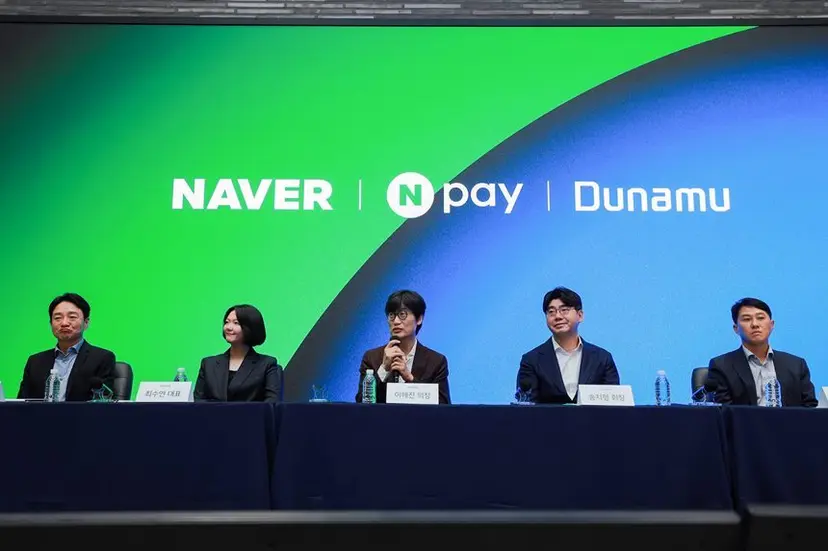
'Reclusive Leaders' Lee Hae-jin and Song Chi-hyung Agree: "Now is the Time"
The three companies held a joint press conference at the Naver office in Seongnam-si, Gyeonggi-do, on the 27th to officialize the business combination and explain the purpose and vision of "corporate convergence," which will bring Dunamu under the Naver umbrella. The three companies announced the previous day that their respective boards of directors had approved the plan for Naver Financial to incorporate Dunamu through a comprehensive stock swap.
Both leaders, often called "reclusive executives" for their tendency to avoid public appearances, attended the conference. Naver Board Chair Lee Hae-jin and Dunamu Chairman Song Chi-hyung appeared on stage together to emphasize the necessity of the merger. They described it as an inevitable choice for survival amidst intensifying AI technology hegemony and the rapid transformation of the blockchain-based digital asset market.
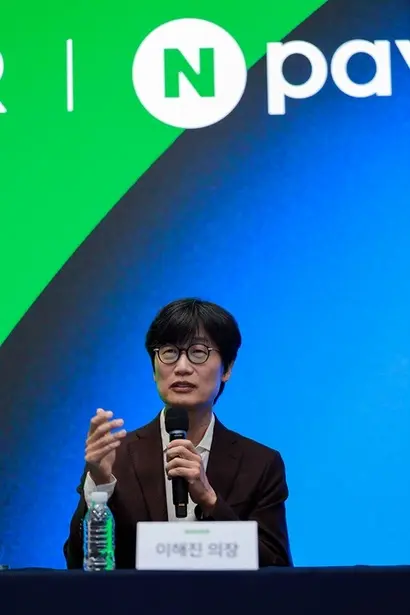
Chairman Song Chi-hyung explained that while the gap with global competitors like Coinbase and Circle is still bridgeable, an alliance with Naver is essential to compete "outside the exchange" in areas such as payments, stablecoins, and tokenization.
Chairman Song stated, "Globally, new blockchain-based services are emerging in all areas, starting with payments and extending to deposits, loans, investment, asset management, and capital markets. If Dunamu, Naver, and Naver Financial combine their respective strengths at this juncture, we can secure global competitiveness in technology, trust, and customer base. If we miss this timing, it will become difficult to keep up with global competitors."
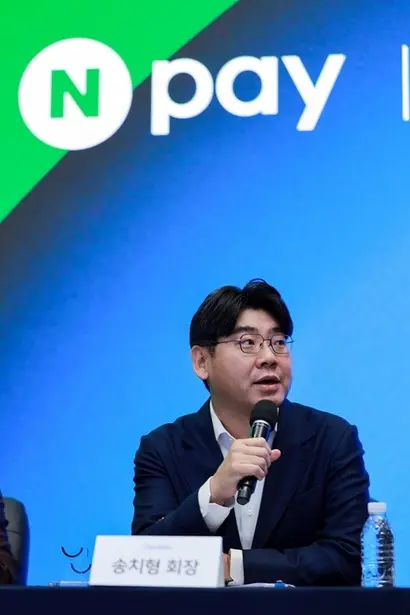
Chair Lee Hae-jin highlighted that collaboration with technology-based service companies has been Naver's key engine, citing the merger with online game service 'Hangame' in the 'PC era' and the acquisition of search engine 'First Snow' in the 'mobile era.' He also implied that he was the one who first proposed the business combination to Chairman Song.
Chair Lee said, "Compared to global big tech firms, Naver is a very small company—one-hundredth the size in terms of market capitalization or R&D investment. We have been engaged in an extremely difficult competition for 25 years, worrying about our survival every single year. Now, a massive wave of AI and Web3 has emerged. I believe that to survive and compete meaningfully here, we must join forces with a company that possesses the best technology and understanding of Web3."
CEO Choi Soo-yeon added, "It is very rare for companies with global competitiveness in AI and Web3 to attempt a corporate convergence, even in IT powerhouses like the U.S. or China. Our goal is to create unprecedented financial transactions by combining AI and blockchain technology, and to build an independent, global blockchain-based network."
Regulatory and Review Hurdles Remain; Focus on Industry Reshaping
As the companies envision something greater than '1+1', expectations for synergy following the merger are rising. Ahn Jae-min, a researcher at NH Investment & Securities, noted in a report, "While Naver's M&A of Poshmark did not gain sympathy from investors, this integration is a new growth engine that everyone acknowledges."
Dunamu, which previously faced restrictions on entering the financial sector—such as acquiring securities firms—due to the principle of separating finance and virtual assets, has now secured conditions to explore new business areas like stablecoin issuance by joining the Naver group. For Naver, which has instantly secured virtual asset infrastructure through Dunamu's blockchain technology and Upbit, a foundation to maximize synergies with existing businesses has been established. Analysts suggest that Naver could quickly push for new digital asset-related businesses, such as NFTs and Security Token Offerings (STO), by grafting Web3 technology onto its core businesses like search and commerce. Scenarios involving the use of stablecoins as actual payment methods within the Naver Pay online and offline network are also being discussed.
However, reviews by financial and competition authorities, regarding concerns over monopoly and financial system risk, remain hurdles. Naver Pay is the industry's No. 1 simple payment service with an annual transaction volume of 80 trillion won. Upbit's market share is around 70%. Before the merged entity is born, they must undergo procedures including: △submission of a securities registration statement and review by the Financial Supervisory Service, △approval for change of major shareholder under the Credit Information Act, △business combination review by the Fair Trade Commission, and △reporting changes for Virtual Asset Service Provider (VASP).
CEO Park Sang-jin said, "There are review and approval procedures with the Fair Trade Commission and the Financial Services Commission before the merger is finalized. While I am cautious about stating our position prematurely, we will communicate closely with the authorities to explain our market size and global strategy."
CEO Choi added, "We expect many regulations to emerge as virtual assets and fintech businesses move further into the institutional sphere. While such regulatory frameworks may appear to soften corporate growth, I believe they will create a safer ecosystem in the long term. Since we must compete with global companies, we will align our positions through communication."
Naver and Dunamu plan to invest 10 trillion won over the next five years to expand the domestic blockchain, Web3, and AI technology ecosystem. Naver CEO Choi Soo-yeon explained, "10 trillion won is the minimum scale. Because Naver and Dunamu are platform companies that can only do business when the ecosystem is solid, the investment will go toward supporting startups and other ecosystem participants, as well as security and infrastructure to secure global competitiveness."