

[비즈한국] Amid the industry-wide downturn, HDC Shilla Duty Free has successfully renewed its downtown duty-free license. The company is using this extension as an opportunity to signal its commitment to recovering performance. However, with brands pulling out of the duty-free shop one after another, there are growing concerns that its market position is steadily shrinking.
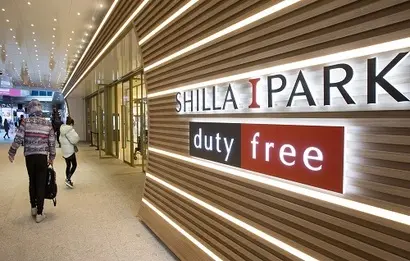
Empty Spaces Throughout the Cosmetics Section
On the 18th, the Korea Customs Service’s Bonded Sales License Review Committee approved the renewal application submitted by HDC Shilla Duty Free for its downtown store in Seoul. Although the duty-free business license was set to expire in December, passing this renewal evaluation allows the company to continue operating its Seoul downtown store for another five years, until December 2030.
HDC Shilla Duty Free appears to be preparing for a fresh start following the license extension. The company expressed its ambition to continue revenue growth by establishing itself as a key global tourism and shopping hub in Yongsan. However, industry insiders warn that with the overall competitiveness of downtown duty-free stores declining due to a prolonged slump, HDC Shilla Duty Free is also facing a difficult environment.
When visited on the 26th, the HDC Shilla Duty Free store at IPARK Mall in Yongsan, Seoul, felt generally quiet. Despite having large-scale parking infrastructure—the only one among domestic downtown duty-free shops capable of accommodating over 100 tour buses simultaneously—there were no group tourists to be seen.
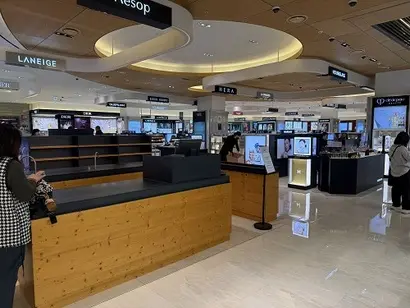
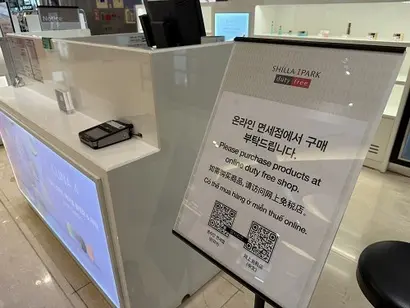
The atmosphere on the third floor, where cosmetics brands are concentrated, was even more desolate. Following the recent exit of numerous brands such as Aesop, Elizabeth Arden, IOPE, and Foreo, parts of the duty-free shop now sit empty. Notices asking customers to ‘please make purchases via the online duty-free shop’ were posted in front of vacant storefronts, and the empty spaces were being used by customers to organize luggage or conduct live broadcasts.
HDC Shilla Duty Free already experienced a large-scale exodus of beauty brands back in May. As the L'Oréal TR (Travel Retail) division scaled back its operations, major brands including Biotherm Homme, Urban Decay, and Shu Uemura pulled out of the store one after another. With the trend of brand departures continuing, industry experts are concerned that the competitiveness of HDC Shilla Duty Free is gradually weakening.
An industry official pointed out, "In the case of Brand A, HDC Shilla Duty Free was the only location in downtown Seoul where it decided to close its store. Since the revenue volume at HDC Shilla Duty Free is lower compared to other downtown stores, the pace of brand exits seems to be accelerating," adding, "If the brand exodus continues, its market position will inevitably continue to shrink."
HDC Shilla Duty Free plans to secure competitiveness by bringing in new brands. An official from HDC Shilla Duty Free explained, "There has been a trend of duty-free business contraction across domestic and foreign cosmetics brands recently," adding, "Many brands are choosing to close their downtown duty-free storefronts due to their own internal circumstances. We plan to fill the currently vacant spaces with new brands sequentially."
Repeated Issuance of Hybrid Capital Securities Raises Financial Concerns
HDC Shilla Duty Free is a joint venture established in 2015 with equal 50% investments from HDC and Hotel Shilla008770. At the time, as the government decided to grant three new downtown duty-free licenses for the first time in 15 years, HDC Hyundai Development Company294870 and Hotel Shilla established a joint legal entity and began operations after winning the license.
The company was initially praised for settling into the market quickly, turning a profit in 2017, the year after operations began. In 2019, it recorded its highest-ever performance with 769.4 billion won in revenue and 10.8 billion won in operating profit. However, the COVID-19 pandemic dealt a severe blow to the duty-free industry. HDC Shilla Duty Free also turned to a loss in 2020. Revenue that year was 377.7 billion won, a 51% decrease from the previous year, and the company recorded an operating loss of 27.4 billion won.
Around this time, other operators who had won new downtown duty-free licenses in 2015 alongside HDC Shilla began exiting the market one after another. Hanwha Galleria Duty Free 63 closed operations in 2019 due to poor performance, and SM Duty Free also ceased its Seoul downtown duty-free operations in 2020 after continued losses.
Conversely, while HDC Shilla Duty Free has maintained its business until now, it has continued to struggle with poor performance. Its operating losses were 38 billion won in 2021, 29.2 billion won in 2022, and 29 billion won in 2023. Last year, it recorded another loss of 20.4 billion won.
As losses accumulate, HDC Shilla Duty Free appears to be increasingly reliant on hybrid capital securities (perpetual bonds) as a means of fundraising. Starting with 30 billion won in 2021, the issuance scale expanded to 56.5 billion won in 2023 and 65 billion won in 2024. Just last month, it issued an additional 15 billion won, totaling 30 billion won raised in four separate instances this year alone.
Although hybrid capital securities are debt, they are recognized as capital in accounting, which has the effect of making the debt-to-equity ratio appear lower. Recently, Shinsegae DF, which operates Shinsegae Duty Free, also issued hybrid capital securities for the first time to secure funds. However, the industry is expressing concern over the growing reliance of HDC Shilla Duty Free on perpetual bonds.
Because hybrid capital securities carry higher interest rates than regular corporate bonds, interest burdens can accumulate over the long term, and repeated issuances could lead to a vicious cycle where the financial structure becomes increasingly vulnerable. Ultimately, critics point out that without fundamental improvements in profitability, long-term risks will inevitably grow. This is leading to concerns regarding the financial health and business sustainability of HDC Shilla Duty Free.
An official from HDC Shilla Duty Free stated, "Revenue trends are showing signs of improvement this year," and added, "While it is difficult to expect a rapid recovery in the duty-free industry next year due to external variables like exchange rates, we believe gradual improvement is possible." They further explained, "We plan to strengthen our competitiveness in the fashion sector by expanding the attraction of brands centered on K-fashion, which is highly preferred by foreign tourists, and use this to drive improvements in performance."