

[비즈한국] "It feels like an era is coming to an end." Offline cultural consumption spaces are being reorganized from bookstores and movie theaters into experiential hubs and pop-up stores. Large bookstores and multiplex cinemas are closing down or downsizing one after another. The spaces left behind by bookstores and cinemas are being filled by experiential venues and pop-up stores.
Closing Down or Scaling Back… The Decline of Large Bookstores
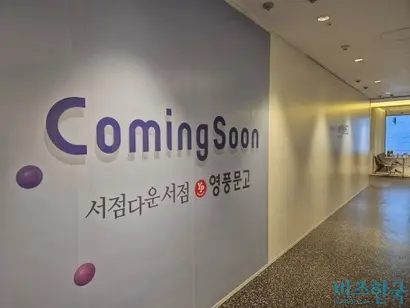
Youngpoong Bookstore's Yongsan I-Park Mall branch, which was a landmark of the Seoul HDC I-Park Mall Yongsan store, is relocating to the 8th floor of the Living Park on the 27th to reopen. Until last May, the bookstore was located on the 3rd floor of the Living Park, a prime location directly connected to Yongsan Station. Upon moving to the 8th floor, Youngpoong Bookstore will reduce its scale to half its original size.
While preparing for the reopening, a temporary pop-up store is operating on the 1st floor. Kim Ji-won, a resident of Yongsan-gu who often frequented the bookstore, said, "This was the only large bookstore in Yongsan, so if not here, I would have had to go to another district," adding, "It's a shame that the size is shrinking."
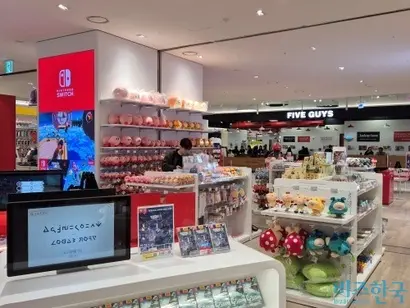
On August 6, the "Dopamine Station," an experiential play space, moved into the spot vacated by Youngpoong Bookstore. The Dopamine Station hosts shops targeting specific enthusiast groups, such as Nintendo, PlayStation, animation and game merchandise, Gacha parks, and caudex plants.
Local large bookstores are also facing a crisis. The Kyobo Book Centre Daegu branch, located in Dongseong-ro, the heart of Daegu, ended its operations on the 3rd floor on October 21 and put the space up for lease. As one of Daegu’s representative large bookstores, the Daegu branch had occupied four floors, from the basement to the 3rd floor, since 2000.
The children's/teen books and humanities/social science book shelves previously on the 3rd floor have been relocated to the basement and the 2nd floor. Hwang Ji-hoo, a resident of Daegu, expressed regret, saying, "The 3rd floor had plenty of space to linger, so it was the place I visited most often since I was young. To hear that such a place is closing makes it feel like an era is ending."
Kyobo Book Centre cited efficiency enhancement as the reason for closing the 3rd floor. A Kyobo official stated, "This decision was made to resolve operational inefficiencies, such as managing counters by floor and long-distance customer traffic." However, some analysts suggest that management difficulties may have played a role, as Kyobo has been making moves to cut operating costs for over a decade, such as reducing staff stationed at counters on each floor.
On the 20th, Changbi Busan, a bookstore and multi-cultural space in Choryang-dong, Dong-gu, Busan, closed its doors after five years. Changbi Busan was a space operated by the prominent publisher Changbi and was a well-known spot near Busan Station, housed on the 2nd floor of the former Baekje Hospital, a registered cultural heritage site.
The number of visitors to Changbi Busan increased from an average of 30,000 until 2023 to nearly 50,000 this year. However, book sales alone could not cover operating expenses and cultural program costs. Lee Gyo-seong, CEO of Changbi Busan, noted, "The pressure of rising costs for space and program operations was significant," adding, "Although the space is disappearing, we are considering ways to continue supporting reading programs in the region."
Experts diagnose that it is impossible for bookstores to survive in this era by selling only books. Noh Myeong-woo, a sociology professor at Ajou University who operates the independent bookstore 'Nieun Bookstore,' assessed, "Due to low birth rates, the reading population itself has shrunk, and the younger generation entering the reading market is more accustomed to e-books or subscription services than paper books." He added, "While a transformation into a space where activities mediated by books can take place is necessary, independent bookstores are small-scale, and large bookstores are stuck in a system specialized in book sales, making change difficult."
Movie Theaters Are Also Fading
News of multiplex cinema closures is also arriving one after another. CGV Myeongdong Station Cine Library (Myeong-Cine) ended its operations on October 29. Myeong-Cine held symbolic importance as a cinema featuring an Arthouse, the Kim Ki-young Tribute Hall, and the nation's first film-specialized library.
"Cinephiles" are deeply saddened, as the theater primarily screened art films. Park Seung-ho, who frequently visited Myeong-Cine, said, "I used to go there to watch the Pride Film Festival or arthouse movies. I thought it was a space where a large corporation showed at least minimal sincerity toward independent or art films, so I was surprised to hear it closed."
CJ CGV079160 stated that they decided to end operations after considering the complex factors of structural difficulties persisting since the COVID-19 pandemic, changes in urban commercial districts, and operational efficiency. The film-related books from the Myeong-Cine library were donated to the Korean Film Archive, and the two arthouse theaters will be relocated to the CGV Gangbyeon and Dongdaemun branches.
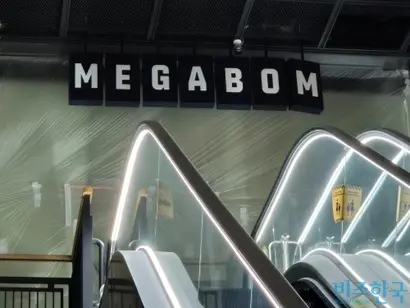
Megabox Seongsu closed on October 12. Megabox Seongsu began operations in 2019 when the Megabox JoongAng headquarters moved to the building. However, in December 2023, Megabox sold the building and land to Krafton259960, the game developer famous for 'Battlegrounds'. The space where the Megabox Seongsu branch once stood will be converted into Krafton offices.
Now the Era of Experience and Pop-ups
Assessments suggest that offline cultural consumption spaces are being reorganized from bookstores and movie theaters into experiential hubs and pop-up stores. A representative example is the aforementioned Youngpoong Bookstore Yongsan I-Park Mall branch. The Dopamine Station has moved into the spot vacated by the bookstore on the 3rd floor of the Yongsan I-Park Mall, which has the best foot traffic.
The Dopamine Station has configured its space with 'The Pop-up,' a super-sized pop-up space; 'Culture Station,' where one can find merchandise of popular domestic and international characters, games, and K-pop IPs; 'Select Spot Zone,' which gathers popular brands; and 'Trendy Food Zone,' featuring unique fruit cafes and popular F&B brands.
The Nintendo Switch store located in the Dopamine Station has expanded its offerings beyond gaming devices to include IP merchandise, such as selling dolls of the popular character 'Kirby.' 'Wine-mu,' opened by wine YouTuber 'Wine King,' emphasized experiences such as wine recommendations and free tastings in addition to selling wine.

Game company Krafton, which purchased the Megabox Square, is also focusing on operating experiential spaces and pop-up stores. Beyond the site of their new headquarters, which was formerly an E-mart Seongsu store, they have purchased several other plots to build a "Krafton Town" in Seongsu-dong. This is the so-called 'K-Project.' They have created a highly popular experiential space for Battlegrounds called 'PUBG Seongsu' and also held a 'Battlegrounds in Seongsu' pop-up store at the former Megabox Square.
Ahn Ji-hoon, director of the Social Innovation Research Institute, commented, "I believe we are in a transitional period where large capital is building experiential spaces as we enter the OTT era. Pop-up and experiential spaces that target the tastes of fandoms rather than the general public are drawing attention."