

[비즈한국] People say Korean cinema is in a difficult spot, but there is still hope. The crisis is not with the creators, but with the structure of investment, production, and distribution. The crisis of Korean cinema lies in an industrial structure centered on blockbusters and multiplexes. This is even more evident when looking at the recent achievements of the independent film scene. In this context, the film 'Master of the World' is a work worthy of attention.
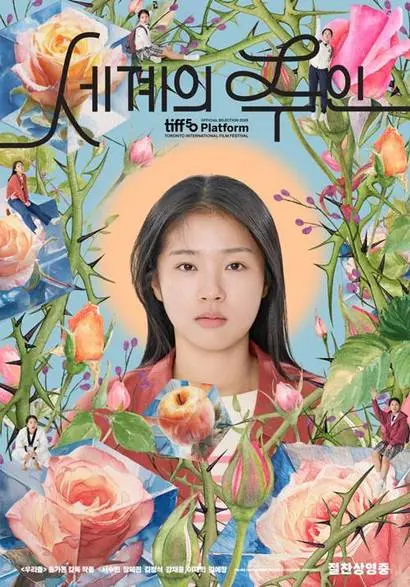
As of November 25, director Yoon Ga-eun's 'Master of the World' reached 130,000 cumulative viewers. It surpassed the 110,000-viewer record set by director Kim Hye-young's 'It's Okay, It's Okay, It's Okay' to become the highest-grossing independent film of 2025. It has received glowing reviews at international film festivals and has even been officially exported to China, leading some to say it has broken through the 'Hallyu Ban' (ban on Korean cultural content). The support from fellow filmmakers, which continued like a relay of special screenings, also drew attention. Beyond the label of 'independent film,' the significance of 'It's Okay, It's Okay, It's Okay' and 'Master of the World' is profound. They make us think about the roles of young female directors in this era, which may become the future coordinates for Korean content for some time to come.
※Caution: This article contains spoilers for the film 'Master of the World'!
The film 'Master of the World' is a subversive 'high-concept' film, a rarity in recent independent cinema. A high-concept film is one that makes you want to see it just by hearing a brief summary. While the term 'subversive' is easy to use, the perspective can change depending on the creators. In fact, this film deals with a thematic consciousness that is difficult for male creators to address. This is less about the limitations of a male worldview or thematic focus, and more about the realistic and social constraints related to gender.
Let's assume there is someone who tells a female victim of a rape crime, "Why are you falling into depression or even making extreme choices just because you were attacked by some man?" The practices of the Joseon Dynasty, where women took their own lives for failing to preserve their chastity, lack persuasiveness from a modern perspective. Even so, it must be the individual's choice to overcome their trauma and find happiness. Above all, there is a societal atmosphere where the same words carry entirely different weight depending on whether they are spoken by a woman or a man.
Director Yoon Ga-eun's 'Master of the World' elevated itself to a unique class by focusing on this point. We can easily guess the collective psychology of teenage girls when a sex offender lives in their neighborhood. It is natural for them to take collective action to move the offender's residence to another area. If the protagonist does not participate in that vote, those around her would immediately step in to persuade her. It is highly likely they would assume she lacks gender sensitivity or awareness. One could approach this from a socially conscious or activist perspective. However, all those people around her might not be victims of sex crimes. That is precisely where the twist lies: the protagonist herself was a victim of a sex crime.
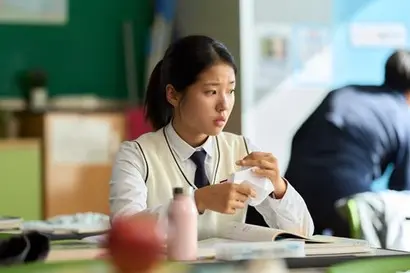
Looking at films that have dealt with sex crimes, the victim characters and their narratives have been trapped in a stereotypical frame. Not only in taking or representing the victim's perspective, but they all consistently emphasize extreme pain and trauma. The endings are invariably depressing or tragic. Such works are hard to sustain because they are difficult for the audience to watch. If the goal was to show the reality of victims through film and hope for a change in public perception, that goal is difficult to achieve. Furthermore, the responses of victims in reality are bound to have limits. They are expected to endure miserable suffering and unhappiness, and it seems as though they shouldn't be allowed to find happiness. Through this, one might try to induce reflection and pain in the criminal, but in reality, criminals have no interest in such things. They merely rationalize or justify their actions.
In this context, 'Master of the World' awakens us from the 'victimhood' that people often mistakenly believe in or falsely claim as advanced gender sensitivity. It attempts to subvert the frame of the 'irrecoverable victim.' While not comparable to the Joseon Dynasty era, which valued lost chastity enough to demand one's life, it still serves as a wake-up call to the consciousness that thinks a victim's suffering is a given. If there is no visible pain or scarring, some assume the situation isn't serious, and if a victim continues with their daily life, some even suspect they are 'faking it.'
Even in court, it often happens that victims must prove they are suffering from extreme pain and that their daily lives have been devastated. Yet, the victim's situation and the punishment for the criminal act itself should be separate matters. Even if a victim heals from the pain and trauma and lives a vibrant life, the offender's crime does not become any lighter. Just because a body was violated does not mean the mind must be shattered; a victim not being shattered does not diminish the gravity of a sex crime.
Daily life should be recoverable and not destroyed by criminal acts, and it must be that way. Society should help individuals recover their daily lives, and the judicial system should strictly punish offenders. In some quarters, there is a tendency to use 'victimhood' to pursue other interests without fully reflecting the victim's true feelings. It is another form of gender politics. What is important is the days ahead. For young people, that is even more vital. Continuing to grow and move toward one's dreams is desirable for the individual as well as for the community, society, and the nation.
New films that freshly delve into the underside of reality are the hope of Korean cinema. In particular, Director Yoon Ga-eun's attempt can be called a task possible only because she is a woman. It has become a time when female narratives and critical consciousness play a greater role than ever. In 2019, Director Kim Bora's 'House of Hummingbird' received 45 awards for its comprehensive and dialectical gaze at family, gaining significant attention overseas. The Korean film industry must change so that new female directors like Kim Bora, Kim Hye-young, and Yoon Ga-eun can play an active role in mainstream cinema. I support their path with desperation and sincerity.
Author Kim Heon-sik has been walking or navigating the forests of popular culture phenomena since his 20s, driven by the expectation that there are ways to make the world better through culture. He continues on the same path with the same belief in the 21st century, where artificial intelligence and quantum computers are at the forefront.