

[비즈한국] It has been confirmed that the water quality at the Seongdong Bridge section of Jungnangcheon Stream in Seoul has reached its worst level this year. The water quality at this location dropped to Grade 3 based on Biochemical Oxygen Demand (BOD) levels during August and September, marking a sharp decline. Radioactive iodine is also detected at this site every year.
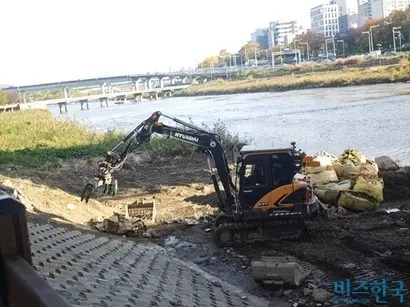
“The smell of a sewer is overwhelming,” says a resident living near the lower reaches of Jungnangcheon. The stream’s water quality issues have persisted since 2000. The odor has been severe, and there have been incidents of mass fish deaths and water quality dropping to Grade 5. At the time, the unauthorized discharge of wastewater from nearby factories was cited as the cause, prompting district offices and civic groups to begin environmental monitoring for illegal wastewater discharge and littering.
In 2010, the Seoul Metropolitan Government installed advanced sewage treatment facilities at Water Reclamation Centers to improve the Han River's water quality, which helped improve the annual average water quality at Seongdong Bridge from Grade 6 in 2006 to Grade 3 in 2011. Since 2020, there has been a noticeable improvement in water quality, with the stream maintaining Grade 1 to 2 levels based on BOD, except for a few months.
Maintaining Grade 1–2, but dropping to Grade 3 in August and September
However, the water quality has recently worsened rapidly. According to water quality measurement data from the Ministry of Climate, Energy and Environment, the "Jungnangcheon 6" monitoring point at Seongdong Bridge maintained Grade 1–2 levels earlier this year, but BOD levels surged in August and September, causing it to deteriorate to Grade 3. This location also saw its water quality drop to Grade 3 in March and August of last year.
Although irregular declines in water quality occur every year at Seongdong Bridge in the lower reaches of Jungnangcheon, it is difficult to find significant improvement measures. Even if water quality deteriorates sharply, if it is not the maximum or minimum value of the last 10 years, it is classified as an outlier and individual investigations into the causes are not conducted.
The Seoul Research Institute of Public Health and Environment, which oversees the Jungnangcheon site at Seongdong Bridge, explains the irregular deterioration as a recurring pattern caused by seasonal and meteorological factors. The institute stated, "It is estimated that during rainfall in August and September, non-point source pollutants near Jungnangcheon and biodegradable organic matter in the riverbed sediment move to the Jungnangcheon 6 downstream point, increasing the pollution level."
If the institute's explanation were accurate, the water quality at Seongdong Bridge should worsen every August and September, but the actual figures vary from year to year. An official from an environmental group pointed out, "In the case of Jungnangcheon, the water quality actually improves when there is a lot of rainfall," adding, "The level of water pollution in the lower reaches of the stream is serious." In fact, the water at Seongdong Bridge in the lower Jungnangcheon fluctuates between Grade 3 and 5 based on Chemical Oxygen Demand (COD). While BOD represents the amount of organic matter that can be decomposed by microorganisms, COD represents the total amount of pollutants, including chemical contaminants that microorganisms cannot decompose.
Radioactive iodine also detected every year… No management standards in place
The Seongdong Bridge section of Jungnangcheon is also a point where radioactive iodine (I-131) is detected annually. Iodine has been detected every time since the Ministry of Climate, Energy and Environment began measuring radioactive substances. While medical wastewater discharged after radiation therapy at hospitals is cited as the main source of radioactive iodine, the cause of the detection has never been definitively identified (Related article: 'Carcinogen' Radioactive Iodine Found Again in Jamsil and Seongsu on the Han River; Related article: [Exclusive] Radioactivity Continues to be Detected in the Han River, Why Aren't the Culprits Caught?).
The Seoul Research Institute of Public Health and Environment stated, "We are also closely monitoring radioactive substances at the Jungnangcheon 6 point and plan to respond in cooperation with the government if necessary."