

[비즈한국] How far into the universe can we see? In space, looking far away is equivalent to looking into the distant past. This is known as the look-back time effect. The further we peer, the closer we get to the primordial darkness that existed right after the Big Bang, when nothing else existed. To witness that primordial moment, telescopes continue to aim further and deeper. Of course, no matter how hard we try, we have mostly only been able to look back to when the universe was at least 1 billion years old.
However, astronomers recently captured a galaxy in the James Webb Space Telescope’s data with a staggering redshift of 32. If this value is accurate, we are seeing this galaxy as it appeared when the universe was merely 90 million years old. That is a point in time representing just 0.6% of the universe's current age! If this holds true, we have truly captured a glimpse of the universe's primordial dawn. Astronomers are not yet certain exactly what this galaxy is.
Prior to this discovery, the most distant galaxy captured by the James Webb was MoM-z14. Last April, the telescope captured faint light from this distant galaxy, which has a redshift of about 14.44. That light dates back to when the universe was only 280 million years old. As a primordial galaxy from the early universe, its size is incredibly small—only 240 light-years across. Not 240,000, but 240 light-years. Its mass is also only about 10 million times that of the Sun, similar to the Small Magellanic Cloud that orbits our own galaxy.
But we cannot dismiss it just because it is small. These tiny primordial galaxies clearly existed when the universe was very young. This shows that a significant number of galaxies had already formed shortly after the universe was born. As the James Webb continues its mission, astronomers have come to realize that far more galaxies existed from the very beginning than previously expected. And they have begun to rethink the mechanism behind the birth of the first galaxies from scratch.
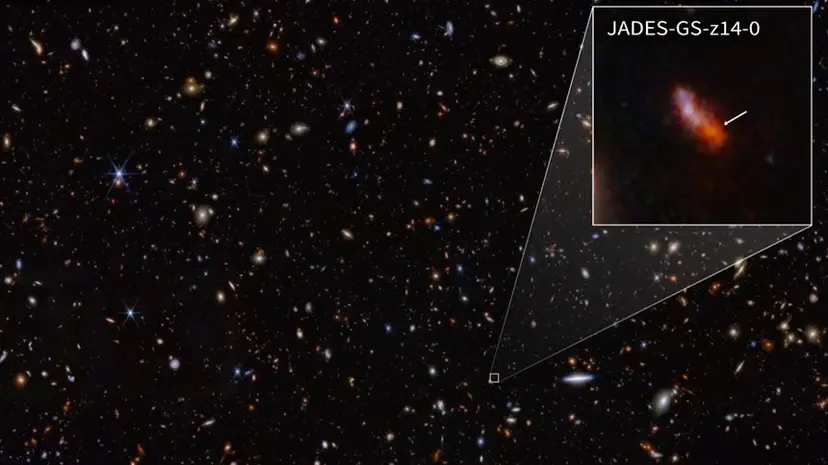
For a long time, astronomers believed that stars and galaxies could not have formed immediately after the Big Bang. There was a period of darkness after the universe began its rapid expansion where neither stars nor galaxies existed. It was believed that it took at least 400 million years for matter to aggregate and for stars and galaxies to begin to take shape. The consensus was that the first stars were born 200 million years after the Big Bang, and entities worth calling galaxies emerged only after 400 million years—marking the end of the "Cosmic Dawn" and the beginning of the era of stars and galaxies.
However, the James Webb has recently provided successive evidence that stars and galaxies existed even before that "dawn." This suggests the shocking possibility that the universe was a fairly mature world from a much earlier point than we thought. It is in this context that this redshift-32 galaxy was discovered.
This is a level of observation we never thought possible. After carefully analyzing the faint spectrum captured by the James Webb, astronomers confirmed the possibility that its redshift could be an extreme value of 32. This galaxy predates the previous record-holder, MoM-z14, by 200 million years. Does this mean galaxies already existed when the universe was only 90 million years old? This primordial galaxy has been nicknamed "Capotauro," named after an Italian mountain.
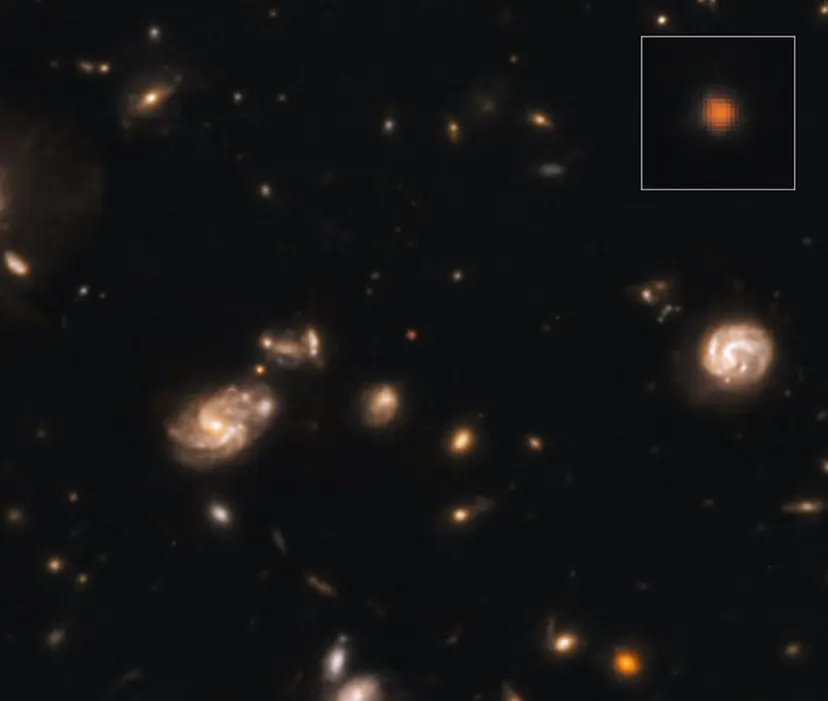
Capotauro was observed using the James Webb’s NIRCam with seven different filters in the infrared wavelength range between F115W and F444W. Among these, the object is only visible in the longest wavelength filters, F444W and F410M. It is completely invisible in filters with shorter wavelengths, such as F356W and below. This indicates that the light has undergone such intense redshift that its wavelength has become extremely long. This phenomenon, where an object's light suddenly appears and disappears depending on the wavelength, is called a "dropout." Judging by the extreme dropout in the infrared range seen in the James Webb images, it can be inferred that this object has a very extreme redshift. Observations from the Hubble Space Telescope, which uses shorter wavelengths, show that this object is completely invisible in standard visible or near-infrared light.
However, because it is such a faint and dim object, there is significant noise in the spectrum. In astronomy, galaxy spectra are analyzed by assuming various models of stars with different temperatures and chemical compositions to see which assumptions best fit the observed spectral shape. Various fitting algorithms like BAGPIPES and ZPHOT are used; however, in this analysis, because the signal was so faint and obscured by noise, the results were inconclusive regardless of the algorithm used.
There are two main possibilities to explain the observation. First is the hypothesis that it is a very bright galaxy that existed in the early universe, right after the Big Bang, with a redshift of 32. For it to be visible even faintly while being at the edge of the observable universe, its actual brightness would have to be immense. Its mass would need to be around 1 billion solar masses, which is a size that cannot be expected in the early universe. To attain such massive weight, the universe would have to be at least several hundred million years old.
For such a large galaxy to exist when the universe was only 90 million years old, stars and galaxies would have had to form at an incredibly high speed from the very beginning. For this rapid growth to occur, 100% of the gas material within the galaxy would have to be converted into stars with 100% efficiency. This is considered impossible under current models.
According to standard stellar evolution models, stars must eventually explode. Especially in the early universe, stars are heavier and have shorter lifespans. They must evolve and explode more quickly. Such supernova explosions heat up the surrounding interstellar medium, suppressing further star formation. Therefore, the efficiency of converting gas into stars within a galaxy usually stays around 10–20%. To achieve efficiency close to 100%, one would have to assume that stars born in the galaxy never explode, which is difficult to imagine logically.
Another possibility is that it could be an extreme case of "Little Red Dots" (LRDs), the small, dim red dots that the James Webb has been capturing frequently of late. LRDs are hidden in every corner of the images, and astronomers still don't know what they are. They could be primordial galaxies hidden behind thick dust at the edge of the universe, or a completely different type of object, such as a "black hole star"—a supermassive black hole encased in a high-density gas shell. However, even if Capotauro were a black hole star, its existence at such an early stage remains unexplained.
There is another hypothesis for the second possibility. Because there is so much noise in the observational data, spectral fitting also suggests a completely different scenario: it could be a relatively ordinary galaxy with a much lower redshift of around 10. It might be an active galaxy located at a closer distance, surrounded by thick dust and harboring a massive, violent black hole at its center. However, the extreme dropout where the object suddenly disappears in the infrared range cannot be easily explained by this active galaxy model alone.
There is even a more mundane possibility. It could be a misidentification of a dim brown dwarf or a rogue planet wandering through space at a much closer distance, right within our own galaxy. In fact, there are cases where such dim, red objects wandering in our local cosmic neighborhood masquerade as galaxies at the edge of the universe. Due to the atmospheric composition of brown dwarfs or rogue planets, the light intensity could weaken in specific sections of the spectrum, appearing like an extreme dropout. If it were an extremely cool Y-type star with a surface temperature of only 300K (Earth temperature!), it could potentially explain a similar spectrum. These are the "nuisances" that astronomers looking for primordial galaxies must always watch out for.
Capotauro's identity is truly ambiguous, much like its spectrum. And it is very extreme. Either it is an early, primordial galaxy that retains the youngest and most unrefined appearance of the universe when it was only 90 million years old, or it is a very tepid brown dwarf wandering through space just 50 light-years away from Earth.
To know whether Capotauro is a galaxy, a planet, or a stray star, a clearer spectrum must be obtained. Of course, because it is far away and the light itself is faint, more observations are needed to obtain a meaningful spectrum. However, since the James Webb is in high demand and the competition for time is fierce, it is realistically difficult to allocate more time than others to observe a single faint light coming from a great distance.
An even more challenging point is that because this object is only barely visible in the long-wavelength infrared range, it is inherently invisible to other telescopes, including the Hubble Space Telescope. The only tool that can see this object is the James Webb. Therefore, whether we can determine its identity depends on how much more the James Webb will look at it in the future.
Reference
https://ui.adsabs.harvard.edu/abs/2025arXiv250901664G/abstract
Who is the author, Woong-Bae Ji? He loves cats and the universe. After watching 'Galaxy Express 999' as a child, he dreamt of sharing the beauty of the universe. He is currently an assistant professor in the Faculty of Liberal Arts at Sejong University, participating in various science communication activities including lectures and writing. He has authored books such as 'A Piece of the Universe Every Day', 'Scientists of the Starry Universe', 'Things You Can Know Though You Can't Go', and 'Strange Questions That Come to Mind When Looking at the Universe'. He has translated books including 'The Hitchhiker's Guide to the Real Universe', 'How I Killed Pluto', 'Quantum Life', and 'Cosmigraphics'.