

[비즈한국] The ‘Korea C-UAS Tech Show,’ held at the Cheongju OSCO exhibition center from November 18th to 20th, showcased both the achievements and the limitations of our domestic counter-drone industry. This exhibition was the first in Korea—and indeed rare globally—to focus exclusively on Counter-Unmanned Aircraft Systems (C-UAS), which are solutions designed to neutralize enemy drone threats. It is significant in that it attempted to specialize in the counter-drone field, departing from the international trend of exhibiting drone technology and counter-drone technology side-by-side.
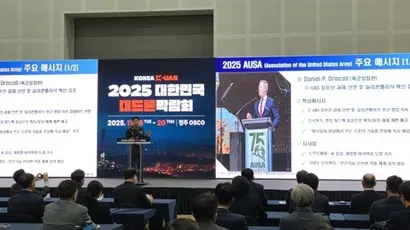
Although it was smaller in scale compared to major domestic defense exhibitions like ADEX, KADEX, and MADEX, it was notable that key stakeholders from the private sector, military, research institutes, and defense contractors gathered around the specialized theme of counter-drone systems. They formed a platform for knowledge exchange, sharing defense strategies against drone threats that have now firmly established themselves as asymmetric weapon systems, and showcasing cutting-edge technologies.
In particular, the fact that nearly 40 seminar sessions were held over three days maximized the advantages of a specialized exhibition. While broader defense exhibitions might only feature two or three sessions on drones due to their wide scope, this event proved the value of specialization by intensively presenting research achievements in counter-drone technology that would otherwise be dispersed across various defense exhibitions.
Among them, the "Hard-Kill Close-In Defense System" unveiled by LIG Nex1079550 and Hanwha Systems272210 undoubtedly drew the most attention. Existing counter-drone systems primarily relied on "Soft-Kill" methods, such as radio jamming or cyber hacking to disable or manipulate the GPS and communications of enemy drones. However, the "Hard-Kill" method is an active response measure that destroys targets by having an interceptor drone collide directly with them. This is considered an effective countermeasure against fiber-optic guided suicide drones or AI-based suicide drones that North Korea is likely to deploy in the future.
It is also a positive sign for the industry that this project was selected as a rapid pilot project by the Defense Acquisition Program Administration, with a goal to produce prototypes within two years. The "large corporation-startup cooperation model"—where Hanwha Systems partners with D-Makers and LIG Nex1 collaborates with Nearthlab—presents an ideal vision for defense R&D by combining the stable R&D infrastructure of large firms with the rapid and innovative solution development capabilities of startups.
Of course, there were clear limitations to this inaugural specialized exhibition. As the field of counter-drone technology is not yet widely known to the general public and media, the relatively low volume of coverage and public buzz was a disappointment. This reflects the reality that while the Ministry of National Defense is actively focused on strengthening offensive and utilization capabilities with a goal of "training 500,000 drone warriors," the importance of building defensive and interception systems against enemy drone threats receives relatively less attention.
Fortunately, with the Army Air Defense School leading the way, units in charge of counter-drone operations from the Army, Navy, and Air Force used this exhibition to lay the foundation for the military to conduct integrated counter-drone operations research. Furthermore, the move by various government agencies—including the police, the Korea Airports Corporation, the Presidential Security Service, and operators of nuclear and power plants, for whom drone defense is essential for protecting major national facilities—to seek solutions together is a green light for the construction of a pan-national threat response system.
You cannot achieve everything in the first step. However, this counter-drone exhibition deserves high praise for accurately identifying the current status of South Korea's counter-drone industry and successfully setting a national agenda regarding asymmetric threats.
For the South Korean counter-drone industry to establish itself as a core element of national defense—protecting our territory and the lives of our citizens—and to leap forward as a key export item in the global defense market, strategic interest and bold investment at the national level are urgently needed. I hope this exhibition serves as a catalyst for such change.