

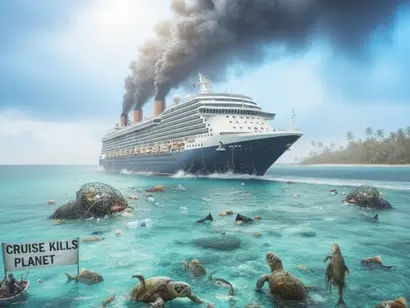
[비즈한국] The Saemangeum Development and Investment Agency (SDIA) and Jeonbuk State are accelerating strategies to turn the Saemangeum New Port into a core hub for the cruise industry. However, the cruise industry remains at the center of environmental controversy due to massive carbon emissions, marine ecosystem disruption, and various pollutants generated while docked at ports. This is precisely why many cities around the world, including those in Europe, have already introduced policies to restrict or ban cruise ship entries. Critics argue that it is inconsistent for Saemangeum, which promotes the creation of an RE100 industrial complex, to pursue the attraction of cruise ships, often labeled as "climate villains."
Saemangeum Pursues 'West Sea Cruise Hub'
On October 28, the SDIA held a final briefing on the "Basic Plan Service for Fostering and Attracting the Cruise Tourism Industry at Saemangeum New Port." Jeonbuk State is also expediting measures to foster the cruise industry at the new port, holding an interim briefing on the "Research Service for Activating Cruises and Establishing an International Cruise Terminal at Saemangeum New Port" on the 5th.
In October, Jeonbuk State applied for Gyeokpo Port and the upcoming Saemangeum New Port (scheduled to open in 2026) to be designated as new cruise ports of call. The goal is to leap forward into becoming one of the nation's top 8 cruise ports.
Regarding the competitiveness of Saemangeum New Port, an official from the Tourism Promotion Division of the SDIA stated, "Saemangeum's location is its strength; it is near many major Chinese cities and can serve as an intermediate port of call between Incheon and Jeju," adding, "Tourism resources such as Jeonju Hanok Village, Gunsan, Iksan, and the Gogunsan Islands are located in the vicinity."
Cruise Industry: Severe Carbon, Air Pollution, and Ecosystem Destruction
Cruises are considered major culprits of environmental destruction due to their massive greenhouse gas emissions, air pollution from burning heavy fuel oil, and waste generation. Often compared to "floating small cities," they are essentially massive resorts on water. Their energy consumption is enormous, as they are equipped with various auxiliary facilities for entertainment and leisure.
In terms of carbon emissions, it is known that they emit tens of times more carbon than trains and about three times more than airplanes for the same distance traveled. In a contributed article, author Kim Han-min analyzed that a 5-night cruise trip emits about twice as much carbon as a trip involving domestic air travel in the U.S. and a stay at a 4-star hotel.
Air pollution caused by the use of heavy fuel oil is also a serious problem. Heavy fuel oil, the primary fuel for cruise ships, emits far more toxic gases than gasoline or diesel. The nitrogen oxides and sulfur oxides emitted by cruise ships eventually lead to fine dust that adversely affects public health.
The Nature and Biodiversity Conservation Union (NABU) in Germany argued that assuming a large cruise ship carrying about 6,000 passengers consumes 100,000 gallons (approx. 380 tons) of fuel per day, a single cruise ship emits as much carbon dioxide as 84,000 cars, as much nitrogen oxide as 421,000 cars, and as much fine dust and sulfur dioxide as over 1 million cars per day.
Because cruise ships keep their engines running to operate internal facilities while docked, the air pollution persists. Kim Do-hyung, an activist at Sea Shepherd Korea, said, "The large amount of nitrogen oxides, sulfur oxides, and fine dust emitted by cruise ships destroys nearby cities and the surrounding environment," adding, "The engine noise at the docking site also has a negative impact on the marine ecosystem."
Addressing Sedimentation Risks and Safety Issues?
The government strengthened nitrogen oxide emission standards for domestic ships in 2021, and since 2022, it has tightened sulfur oxide emission regulations, mandating the use of low-sulfur oil with a sulfur content of 0.5% or less. However, critics point out that low-sulfur oil is still a heavy-oil-based fuel and not a fundamental solution.
An official from the SDIA's Tourism Promotion Division stated, "If facilities that can supply electricity at the port are installed, environmental destruction can be reduced, and the cruise industry itself is gradually becoming more eco-friendly."
However, critics argue that the utilization rate of "Alternative Maritime Power (AMP)"—which allows ships to receive power from land instead of using engines—is low because it is not mandatory. Although the Incheon Port Authority installed AMP at the international passenger terminal in 2020, as of this year, only 2 out of 9 berthed ships actually use it.
Critics also point out that since AMP use is not mandatory and burning low-sulfur oil for on-board power generation is cheaper than the cost of electricity from AMP, ships avoid using it. Furthermore, using AMP requires ships to install receiving equipment, which incurs additional costs and space issues.
Additionally, some point out that the sea area near Saemangeum New Port is experiencing sedimentation due to the seawall, causing water depths to become shallower. Shallow water increases the risk of cruise ship grounding. Yoo Gi-man, secretary-general of the Saemangeum Permanent Seawater Circulation Movement Headquarters, said, "Fishermen off the coast of Gochang testify that the water is getting shallower," adding, "There is a risk that it could become like Gunsan Port, which suffers from severe sedimentation problems."
In response, an official from the Ministry of Oceans and Fisheries, who is in charge of constructing Saemangeum New Port, stated, "We do not believe that Saemangeum is experiencing the same severe sedimentation as Gunsan Port," and added, "We plan to carry out continuous dredging to maintain a depth of 14m."
Why Is Saemangeum Pursuing Cruises While the Rest of the World Bans Them?
In many cities around the world, there are growing cases of restricting or banning cruise ship entries due to environmental pollution, waste discharge, and low economic impact. Cruise tourists often eat and shop on board, leading to criticism that they contribute little to the local economy, such as in accommodations or restaurants.
Nice, a famous resort city in southern France, has completely banned cruise ship entries starting in 2025. Nice Mayor Christian Estrosi strongly criticized them, stating, "Cruises cause environmental pollution and dump low-budget tourists who spend almost no money while only creating trash." Venice, Italy, has also banned cruise entries since 2021 to protect the city from air pollution and to preserve the Venetian Lagoon, a UNESCO World Heritage site.
Similar issues are raised in Jeju Island. There are many testimonies that local commercial areas near the port do not become revitalized, and tourists mostly travel by bus to visit only duty-free shops or cosmetics stores (like Olive Young). In 2017, a controversy arose when a cruise ship docked at Jeju Port left without the tourists ever disembarking, only disposing of waste.
Ko Kwon-il, co-representative of the Gangjeong Village Association Against the Naval Base, emphasized, "There is a story that in the Seogwipo traditional market, cruise tourists only sampled food without buying anything, so vendors removed their sampling stations," adding, "We need to rethink whether the cruise industry is truly promising, as it emits exhaust fumes without helping the local commercial district."