

[비즈한국] As the Seoul Metropolitan Government recently significantly relaxed height restrictions for the Sewoon District 4 redevelopment site located in front of Jongmyo Shrine, UNESCO has issued an official statement to BizHankook urging a Heritage Impact Assessment (HIA) for development projects near the shrine. UNESCO warned that depending on the results of the assessment, Jongmyo Shrine could be placed on the 'List of World Heritage in Danger.' It is understood that UNESCO has officially requested information from the South Korean government to review the matter. This is the first time UNESCO has issued an official statement to the press regarding development projects in the vicinity of Jongmyo Shrine.
In response to inquiries from BizHankook on the 18th, a UNESCO spokesperson stated, “UNESCO is closely monitoring the situation regarding changes to development policies around Jongmyo, particularly following recent reports that the permitted height for new developments has significantly increased.” The spokesperson added, “UNESCO has officially requested information from the Korean authorities so that this matter can be reviewed by the World Heritage Centre and the advisory bodies of the World Heritage Committee. Furthermore, this issue may be addressed as an agenda item regarding the ‘State of Conservation’ at the World Heritage Committee meeting to be held in July 2026.”
The spokesperson further emphasized, “UNESCO stresses that all future development projects near Jongmyo must undergo a rigorous Heritage Impact Assessment to evaluate the potential impact on the attributes that justify its inscription as a World Heritage site. If the assessment determines that there is a potential risk to these key attributes, the World Heritage Committee may consider inscribing the property on the ‘List of World Heritage in Danger.’”
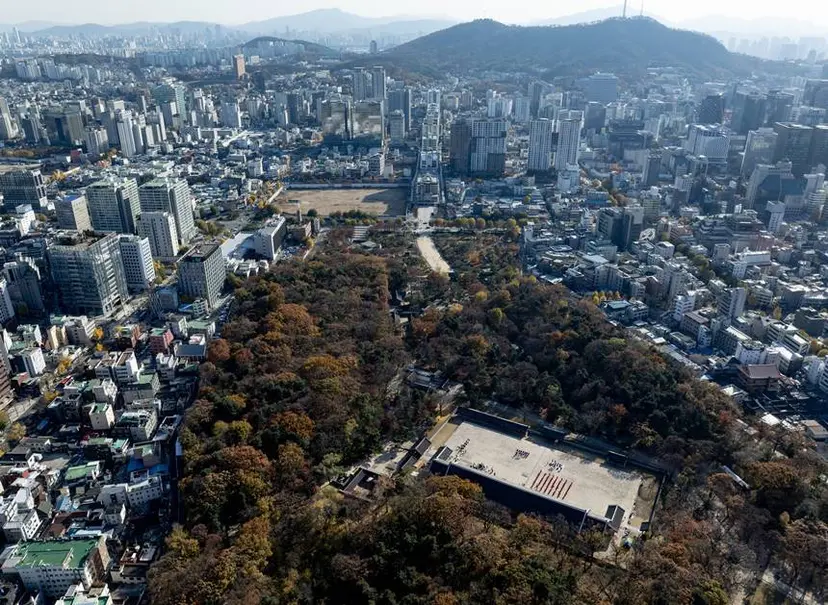
Previously, on the 30th of last month, the Seoul Metropolitan Government notified a redevelopment promotion plan that eases height restrictions for the Sewoon District 4 site, which is located in front of Jongmyo. The plan changes the maximum building height from the existing 55m on the Jongno side and 71.9m on the Cheonggyecheon side to 101m and 145m, respectively. For the Cheonggyecheon side, the maximum building height has effectively doubled. Since 2009, the Seoul Metropolitan Government and the Korea Heritage Service (formerly the Cultural Heritage Administration) had consistently adjusted the height standards through reviews by the Cultural Heritage Committee, ultimately setting the cap at 71.9m.
Jongmyo is a Confucian ancestral shrine in Korea inscribed as a World Heritage site. It is the place where memorial tablets of kings, queens, emperors, and empresses of the Joseon Dynasty and the Korean Empire were enshrined and rites were performed. King Taejo Lee Seong-gye, the founder of Joseon, completed the shrine in 1395 after designating Hanyang as the capital in 1394. It was situated to the left of Gyeongbokgung Palace in accordance with the Confucian principle of "Jurye," which dictates that ancestral shrines should be on the left and altars for state deities on the right. In December 1995, UNESCO designated Jongmyo a World Heritage site, citing it as an “outstanding example of a relatively intact Confucian royal shrine.” It was Korea's first World Heritage site alongside Seokguram Grotto, Bulguksa Temple, and the Janggyeong Panjeon Depositories of Haeinsa Temple.
In an evaluation report written just before the inscription of Jongmyo as a World Heritage site in 1995, the International Council on Monuments and Sites (ICOMOS), a UNESCO advisory body, emphasized: “The Jongmyo complex is surrounded by an appropriate buffer zone, but significant urbanization is underway beyond it. Ensure that the construction of high-rise buildings is not permitted in nearby areas that could impair the sight-lines of the site proposed for World Heritage status.” Prior to the notification of the Sewoon District 4 redevelopment plan, UNESCO requested that the Seoul Metropolitan Government conduct a Heritage Impact Assessment, but the city did not accept the request.
UNESCO told BizHankook, “Jongmyo was inscribed as a World Heritage site in 1995 as an outstanding example of a Confucian royal shrine. At the time of inscription, the advisory body's evaluation already noted that ‘the construction of high-rise buildings in adjacent areas that could negatively affect sight-lines within the World Heritage site will not be approved.’” They added, “Under the World Heritage Convention, UNESCO will work closely with the Korean authorities to ensure that the World Heritage site is preserved to the highest standards.”