

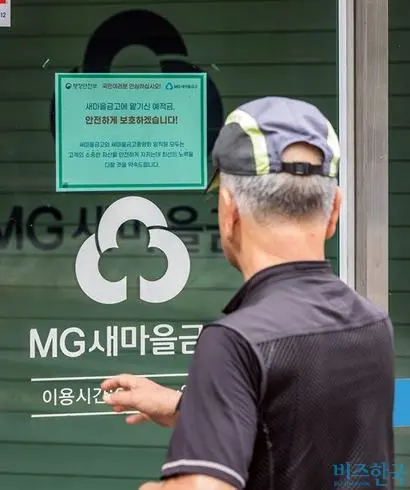
[비즈한국] Controversy continues to surround the financial soundness of the MG Community Credit Cooperative (KFCC). Since the bank run (mass withdrawal crisis) in July 2023, the KFCC has introduced various measures to manage its soundness, but it has failed to regain public trust due to deteriorating performance and rising delinquency rates. Within political circles, there are ongoing discussions about the need to strengthen management and oversight. Amidst this, as the KFCC enters the election process for its next central chairperson while facing the challenge of management reform, attention is focused on whether incumbent Chair Kim In will run for another term.
The KFCC's delinquency rate for the third quarter of 2025 stood at 6.87%. After soaring to 8.37% in the first half of 2025, the rate has managed to recover to the 6% range. The Korean Federation of Community Credit Cooperatives explained, "The mutual finance sector as a whole is experiencing difficulties due to the recent sluggish real estate and construction markets, as well as deteriorating profitability and rising delinquency rates." They added, "We are managing to reach a target delinquency rate in the 5% range by the end of 2025 by regularizing the sale and liquidation of non-performing loans, centered around the KFCC Asset Management Company (MG AMCO), which was launched in July."
Although they succeeded in lowering the delinquency rate compared to the first half of the year, it is not yet a level to be relieved about. This is because the delinquency rate in June 2023, when the bank run occurred, was also in the 6% range. Considering that the delinquency rates of other mutual finance institutions this year reached 7–8% (excluding Nonghyup), the situation is arguably worse than it was during the bank run, even accounting for the difficult environment. From 2018 to 2022, the KFCC's delinquency rate remained only in the 1–2% range.
The number of cooperatives at risk of insolvency is also increasing. According to the KFCC's first-half 2025 management evaluation, out of 1,267 cooperatives nationwide, 157 were reportedly given a Grade 4 (vulnerable) rating, and 8 were given a Grade 5 (dangerous) rating. In particular, the number of Grade 4 cooperatives has more than doubled compared to the end of 2024 (77). In the management evaluation, Grade 4 indicates a vulnerable financial state with serious management issues, while Grade 5 indicates a high possibility of bankruptcy due to a severely deteriorating financial condition.
According to KFCC supervision standards, cooperatives with a comprehensive evaluation grade of 4 or lower are classified as at risk of insolvency and are subject to demands for management improvement. Cooperatives subject to such demands must submit a management improvement plan to the chairperson and implement it within two years from the date of approval. The Ministry of the Interior and Safety (MOIS), the main supervisory body for the KFCC, stated in August that it "will steadily proceed with merging cooperatives at risk of insolvency with neighboring ones." Accordingly, 26 cooperatives completed mergers between July 2023, when the bank run occurred, and June 2025.
Profitability has also deteriorated. The KFCC posted a net loss of 1.3287 trillion won in the first half of 2025, an increase in deficit compared to the first half of 2024 (1.2019 trillion won). The MOIS explained, "Costs were incurred due to the accumulation of loan loss provisions (reserves set aside in anticipation of difficulties in recovering loans) and the sale of delinquent bonds," adding, "It is difficult to improve profitability due to regulations such as the delay in the recovery of the real estate market and the total management of household loans."

As concerns over soundness persist, the KFCC and the MOIS have prepared various improvement measures. The non-performing loans sold by the KFCC in the first half of the year to manage delinquencies amounted to 3.8 trillion won. Since the launch of MG AMCO, they have been pursuing bulk sales on a quarterly basis. The channels for selling non-performing loans have also been diversified to include the Korea Asset Management Corporation and asset-backed securitization, in addition to subsidiaries.
Plans to restore trust have also been introduced. In October, the 'KFCC Vision 2030 Committee' was launched, consisting of 11 members including MOIS officials and outside experts, with the goal of internal innovation and physical improvement. The committee plans to prepare an internal innovation vision by November and implement the plan starting in 2026.
In September, an integrated financial information system was built to compare the status of cooperatives nationwide. It was created to resolve the issue of low information accessibility due to cooperatives disclosing financial information individually. This is part of the KFCC management innovation plan announced by the MOIS after the bank run.
However, even these moves have failed to dispel public concerns. In September, President Lee Jae-myung mentioned to Minister of the Interior and Safety Yoon Ho-joong during a cabinet meeting, "The KFCC seems to be in a blind spot for management and oversight," adding, "It must be operated in a way that can help the local economy." The concerns have led to discussions about transferring supervisory authority. The supervising authority for the KFCC is the MOIS, but since the bank run, the Financial Services Commission has also been involved in management and oversight regarding credit businesses. During the National Assembly Political Affairs Committee audit this year, Financial Supervisory Service Governor Lee Chan-jin stated, "I fully agree with unifying the supervisory system," expressing a willingness to take over supervisory authority for the KFCC. However, there has been no progress in the transfer discussions.
With such a pile of unresolved tasks, eyes are also on the emergence of a new central chairperson. The KFCC will hold its 20th central chairperson election on December 17. The preliminary candidate registration period is until December 1, and the official candidate registration will take place from December 2 to 3. As part of management innovation, the MOIS revised the Community Credit Cooperative Act early this year, changing the central chairperson's term from a four-year term with the possibility of one consecutive reappointment to a single four-year term.
Chair Kim In was elected in a by-election held in December 2023 following the resignation of former Chair Park Cha-hoon. His term ends on March 14, 2026. Kim is the first chairperson elected after the system shifted to a direct election where the chairpersons of local cooperatives nationwide cast their votes, and he is considered highly likely to seek a second term. Because Kim took office before the law was revised, he is eligible for reappointment if he wins this election.