

[비즈한국] The Ministry of Oceans and Fisheries (MOF) has begun re-applying for trademarks for 'K·SEAFOOD' and 'K·FISH,' which are being used as national seafood brands. In the past, both names had their trademark registrations rejected on the grounds of "lack of distinctiveness." This time, the ministry has increased its chances of success by applying as composite trademarks combined with brand logos.

K·FISH is an integrated seafood export brand operated by the MOF. The ministry certifies the K·FISH brand to private companies that produce and process marine products such as oysters, abalone, dried seaweed (gim), flounder, and kelp after conducting quality inspections. Certified companies are permitted to use the K·FISH trademark on product packaging. The MOF explains that K·FISH is a brand whose quality is certified by the South Korean government and that obtaining and maintaining certification status is a rigorous process.
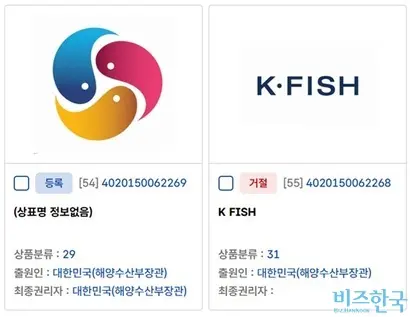
While the MOF has promoted that the national integrated brand K·FISH is trademarked both domestically and internationally, the reality is slightly different. The brand logo (symbol mark) applied for by the ministry in 2015 was registered, but the trademark for 'K·FISH' itself was rejected. According to the refusal decision from the Korean Intellectual Property Office (formerly the Intellectual Property Office) at the time, it was determined that "K·FISH consists simply of the alphabet 'K' connected by a middle dot to the very common English word 'FISH' which corresponds to the generic name of the designated goods," making it difficult to view as a unique brand.
Consequently, the MOF has operated the K·FISH brand domestically while only holding the trademark for the logo. However, the ministry re-applied for the K·FISH trademark this past September—the first attempt in about 10 years. Unlike the previous attempt where the logo and text were applied for separately, this time the K·FISH and K·SEAFOOD names were combined with the logo image in the application.
The product classifications for this application include Class 29 (processed fish foods), Class 31 (live crustaceans), Class 35 (processed fish), and Class 43 (specialty seafood restaurant services), all of which relate to marine life.

The MOF expects the current trademark application to be registered. An MOF official stated, "The trademark for the logo was registered in 2015, and we have been officially using it since 2017. This trademark application is aimed at expanding the trademark classification. Since we are proceeding after consultation with the Intellectual Property Office, we expect the trademark to be registered."
The trademarks currently applied for by the MOF are under review by the Intellectual Property Office. However, even if the ministry’s trademark is registered, it is difficult to consider that it will grant exclusive rights to the letters 'K·SEAFOOD' or 'K·FISH' themselves. Experts suggest that while trademark registration is possible, gaining exclusive rights to the text is difficult.
Gong Woo-sang, a representative patent attorney at Gong & You Patent & Trademark Office, analyzed, "The possibility of trademark registration seems sufficient. However, one must see it as registrable because it includes the logo. To secure exclusivity over the text, the 'K·SEAFOOD' and 'K·FISH' brands certified and operated by the MOF must be widely recognized. Without such status, it appears difficult to monopolize the text."
Yoon Shin-woo, representative patent attorney at Biz & Patent Law Firm, explained, "Because a logo with distinctiveness is already registered as a trademark, a trademark combining the logo and text is also likely to be registered. However, even if registered, the effect of the trademark right on the letters 'K·FISH' themselves can be seen as limited. This is because parts that lack distinctiveness—such as generic names, common terms, or prominent geographical names—have limited legal effect. In fact, one should consider that the letters carry no trademark protection. However, if the brand awareness of K·FISH grows, it is possible for them to gain distinctiveness and thus gain legal effect."