

[비즈한국] Not long ago, I received an interview request from a BBC reporter. They asked me to analyze why the drama 'Reply 1988' continues to enjoy global popularity on the occasion of its 10th anniversary. Hearing that it is popular in Europe—including the UK—and across the globe made me rethink the significance and value of 'Reply 1988'. It is also a case that allows us to diagnose the reality of K-content and gauge the path it should take.
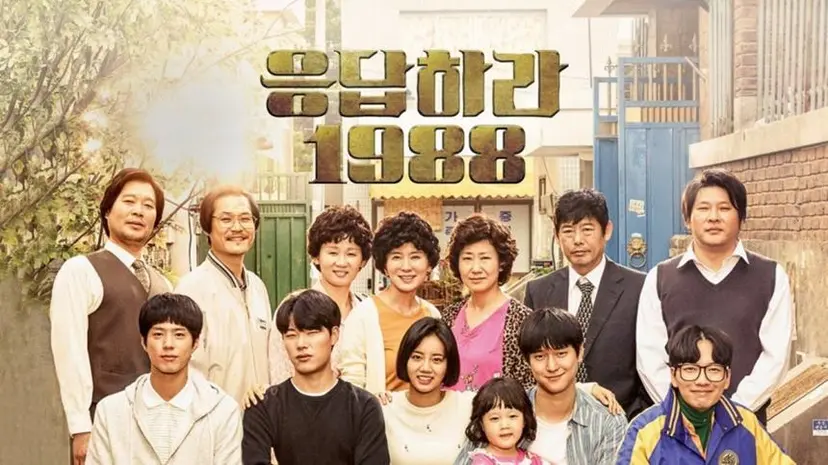
The drama 'Reply 1988' was heavily influenced by the foundations of its successful predecessors, 'Reply 1994' and 'Reply 1997'. 'Reply 1988' possessed even greater entertainment value and perfection than the previous series. While the earlier series had strong appeal elements that resonated with specific generations, 'Reply 1988' contained cultural elements that all generations could relate to. By highlighting the innocent friendships of adolescence through the generation of school uniform autonomy and dealing with family stories, it became a show that the whole family could enjoy together.
What is the reason for the universal popularity of 'Reply 1988' among viewers worldwide? Is it simply out of nostalgia for the past, or does it contain something we have lost in an increasingly online and globalized environment? The answer can be inferred from past examples. It is in the same context as why 'Autumn in My Heart' was more popular than 'Winter Sonata' in the Chinese-speaking world. While 'Winter Sonata' was exceptionally popular in Japan, 'Autumn in My Heart' gained great popularity not only in the Chinese-speaking world but throughout all of Asia. This is because 'Winter Sonata' focused on romance, while 'Autumn in My Heart' was a work centered on communities, including friendship, love, and family.
'Reply 1988' is, in particular, a drama filled with warm humanism that encompasses family and, by extension, local community through the friendships shared with neighborhood friends. The alleyway culture of Ssangmun-dong was once a daily routine, but it has now almost disappeared. While it is a memory for the older generation, the younger generation accepted it as an ideal space and a model for relationships. Although it is a glimpse of the past, it can be called an 'ancient future' that we should aspire toward. Many viewers who experience online mobile culture and uniform spaces filled with apartments and high-rise buildings have come to view the alleyways of 'Reply 1988' as ideal. The global popularity of 'Reply 1988' is not just about the past or the present, but is viewed as an ideal for the future.
Threats to daily life awaken the importance of small values. The COVID-19 pandemic also played a role in the global popularity of 'Reply 1988'. As people were unable to meet properly, they began to envy the main characters of the show, who were always hanging out together. People wanted to emulate their way of comfortably visiting each other's homes once the pandemic ended.
There is also a point to consider regarding the phenomenon that 'Reply 1988' remains very popular even as provocative, hardcore content has increased on Netflix. Two phenomena occurred on Netflix during the COVID-19 pandemic. As non-face-to-face content consumption increased, the number of fans of Korean dramas grew. At the same time, the number of subscribers preferring soft dramas over hardcore-style content increased, with a massive influx of female users. This can also be seen in the global popularity of 'When Life Gives You Tangerines'. On the contrary, hardcore-style works are not as successful as they used to be. Season 2 and 3 of 'Squid Game' failed to surpass the status of Season 1. The attention on works like 'When Life Gives You Tangerines' that touch upon relationships with friends can be considered in the same context.

'Reply 1988' is frequently mentioned, especially in the UK, as one of the greatest Korean dramas. Among the numerous Korean dramas aired around the world, why did 'Reply 1988' achieve this status? 'Reply 1988' is not just a single drama. It encompasses 'Reply 1994' and 'Reply 1997' and all previous series. It also captures the positive characteristics of Korean dramas and embodies the socio-cultural Korean aspects most excellently. It completely changed the flow of Korean dramas. In the Korean broadcasting scene, which was filled with trendy dramas, soap operas, and provocative genre dramas, it showed that a drama with a warm and positive worldview could also gain global popularity.
In conclusion, 'Reply 1988' goes beyond simply looking back at the past, containing not only a Korean framework but also the universal emotions and concerns of humanity. Finally, we were able to confirm that the saying "what is Korean is global" holds true, and that universal emotions have been conveyed. Through 'Reply 1988', Koreans have come to communicate and share culturally on equal footing with people around the world. We must continue to create examples where Korean dramas can converse with people across the globe with the same sentiments. This is the reason why K-content, which has been focused on hardcore genre pieces, should reflect on 'Reply 1988' once again. The path from local to global, from the alleyway to the global village, lies in 'Reply 1988'.
The author, Kim Heon-sik, has wandered through and navigated the forest of pop culture phenomena since his 20s, with the expectation that there is a way to make the world a better place through culture. He continues on the same path in the 21st century, where artificial intelligence and quantum computers are active, with the same belief.