

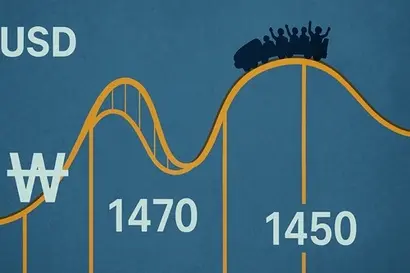
[비즈한국] The won-dollar exchange rate has shown extreme volatility over the past week, surpassing 1,470 won before retreating to the 1,450-won range. Although an unusual market trend saw the rate fluctuate by more than 20 won during the day, the market is currently showing signs of stabilization following the government’s verbal intervention and the release of a joint Korea-U.S. factsheet. On the 14th, the won-dollar exchange rate closed in the 1,450-won range at the Seoul foreign exchange market, down from the peak of 1,475 won recorded the previous day.
Market analysts suggest that the factors driving the recent rise in the exchange rate were more related to temporary supply and demand dynamics rather than structural issues.
Moon Da-woon, an analyst at Korea Investment & Securities, stated, "The recent sharp rise in the dollar-won rate is largely attributable to increased demand for dollars due to overseas investments by residents," adding, "It appears to have created a one-sided tilt toward selling the won and buying the dollar in terms of supply and demand." Moon explained, "As overseas investment by residents has expanded rapidly, expectations for further short-term weakness in the won have taken hold. During this time, exporters are increasingly incentivized to hold onto their existing dollars rather than selling them at the short-term peak of the exchange rate."
The weakness of the Japanese yen also acted as a factor fueling the depreciation of the won. When the yen-dollar exchange rate surpassed 155 yen during intraday trading on the 12th to reach a 9-month high, the won also experienced a concurrent weakening trend.
Park Sang-hyun, an analyst at iM Securities, analyzed, "Since the inauguration of the new Prime Minister Takaichi administration, the yen's weakness has persisted as expectations for additional interest rate cuts by the Bank of Japan have weakened." He added, "While the Japanese government is managing the speed of the yen's decline through verbal intervention, the prevailing expectation of further yen weakness is stimulating bearish sentiment toward the won."
In particular, an unusual situation recently emerged where government bond yields and the exchange rate surged simultaneously. Typically, rising bond yields and a weakening won induce risk-aversion, leading to a downturn in the stock market. This time, however, stock prices showed strength, defying established patterns.
Park explained, "The reason stock prices are rising despite the simultaneous surge in government bond yields and the exchange rate is that the change in fund flows—specifically the exodus of foreign capital from the government bond market due to expectations of a shift in interest rate policy—is playing a role, rather than economic fundamental risks."
The exchange rate, having hit a recent high, appears to have entered a stabilization phase following the authorities' response and the release of the factsheet.
After Deputy Prime Minister for Economy Koo Yun-cheol remarked on the 14th that "we plan to prepare measures to stabilize the exchange rate by discussing closely with major supply and demand entities such as the National Pension Service and exporters," the exchange rate fell by nearly 20 won. The subsequent release of the joint Korea-U.S. factsheet also helped alleviate market uncertainty.
Ryu Jin-yi, an analyst at KB Securities, assessed, "While there were no major changes in the details of the joint factsheet compared to previous announcements, the uncertainty that had arisen due to the delay in its release has now been resolved."
Experts are leaning toward the possibility that the exchange rate will continue a "breather" phase for the time being. This is because concerns over short-term money market tightness have eased following the resolution of the U.S. government shutdown, and global inflationary pressures have moderated due to falling oil prices, slightly weakening the factors supporting a strong dollar.
Analyst Park Sang-hyun predicted, "The resumption of federal government operations and the Federal Reserve's pursuit of interest rate control policies will eventually lead to an easing of the short-term money market crunch, which will result in stable government bond yields and downward pressure on the dollar."
Analyst Moon Da-woon noted, "At the 1,480-won level, there is a possibility of strategic currency hedging by the National Pension Service or fine-tuning by the authorities, so any further rapid rise in the exchange rate will be limited." She added, "To calm the upward trend of the exchange rate, the pressure for a strong dollar needs to clearly ease. We need to pay attention to the U.S. September employment report, which will be released as early as this week, as a trigger for a downward turn."
The weakness of the won is also affecting the real economy. According to a survey by the Federation of Korean Industries (FKI), the Business Survey Index (BSI) for November was 94.8, well below the baseline of 100. The decline in the non-manufacturing BSI dragged down overall business sentiment, which is interpreted as a result of the burden of import prices due to the rising exchange rate and concerns over shrinking consumption.
The market expects future exchange rate movements to be driven by internal and external variables, such as the Bank of Korea's interest rate policy, the U.S. Federal Reserve's monetary policy stance, and Japan's policy changes. Consequently, the prevailing analysis is that volatility is highly likely to continue for some time.
So, how should individual investors prepare for exchange rate volatility? With the exchange rate currently undergoing a correction near recent highs, advice is emerging to adopt a strategy of staggering currency exchanges when the rate spikes.
Furthermore, for investors with a high proportion of overseas assets, using currency-hedged products is suggested as a strategy to manage volatility. Additionally, sectors with a high reliance on raw material imports should prepare for short-term earnings pressure, as the rise in the exchange rate directly impacts profitability. Investors should also keep a close eye on global events, such as upcoming U.S. employment data and remarks from Federal Reserve officials.