

[비즈한국] In 2007, a million images of galaxies were released on a website. Kevin Schawinski, a doctoral student in astronomy at the University of Oxford, uploaded data observed by the Sloan Digital Sky Survey (SDSS), allowing anyone to view galaxy images and classify them by shape—whether they were disk or elliptical galaxies.
This project, dubbed "Galaxy Zoo," is cited as a stellar example of citizen science. It was the first time that observation data, once exclusive to astronomers, was made available to the public. Who would be interested in such tedious and seemingly useless work? Astronomers were skeptical, but the results were astonishing. In just 175 days, over 100,000 people from around the world participated, classifying the shapes of more than 40 million galaxies.
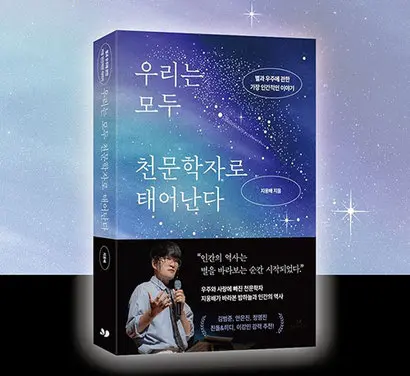
This is a story from the new book "We Are All Born Astronomers" by Ji Ung-bae, an astronomer and widely known YouTuber under the name "Space Dust" (Uju-meonji).
Even if one cannot understand complex and difficult physics, there are more people than you might think who long for space. I am likely not the only reporter who vaguely feels drawn to the night sky, wondering what lies beyond. Perhaps every human is an "astronomer" by birth—just look at the countless sci-fi novels and movies produced, and humanity’s resolve to keep venturing into space despite repeated failures.
The author, Ji Ung-bae, actually "confesses" that astronomy is not a particularly useful discipline. What help is it to our daily survival to study rocks colliding at the edge of the solar system or the ratio of dark matter in galaxies hundreds of millions of light-years away? However, he argues that precisely for that reason, astronomy is the most "human" of all sciences. When you think about it, humans don't only do things that are useful. In fact, isn't it more fun when we do things that are useless? The author says that humans are the only beautiful beings in this universe capable of watching the stars and finding joy in the act of doing so.
"We Are All Born Astronomers" shares the stories of many people who have enabled humanity to keep looking up at the stars, beyond just the Galaxy Zoo project mentioned earlier. The book begins with a romantic notion—that perhaps the "businessman who counts stars" in "The Little Prince" was an astronomer—and continues with stories of how, 100 years ago before digital cameras, starlight captured on glass plates looked like mold, and how Harvard Observatory hired young women for low wages to analyze the flood of observation data, calling them "computers" as they were the ones doing the calculations. Now, astronomy has advanced rapidly to the level of training artificial intelligence (AI) to find dwarf galaxies, track the movement of asteroids, and protect the Earth.
"We Are All Born Astronomers" also contains the unsolved secrets of the universe and the limitations of astronomy. Dark matter, which makes up most of the universe, shaped the cosmos as we know it, yet its true nature remains completely unknown. Astronomers are searching not just the skies but even deep underground to chase this "ghost"—dark matter, which neither emits, absorbs, nor reflects light. We still don't even know if dark matter is a real substance or simply a form of gravity. Humanity is but a fleeting moment in cosmic time, and even our understanding of the universe may not be the ultimate truth. However, the author says that the heart to admit what we don't know, rather than what we do know, is the heart of an astronomer, and that astronomy is a discipline that humbles humanity.
Author Ji Ung-bae is one of the most active science creators, moving seamlessly between academia and the public sphere. While teaching astronomy at Sejong University, he also operates the YouTube channel "Space Dust's Sage Time" (Uju-meonji-ui Hyeonja-times), which has 260,000 subscribers and over 40 million cumulative views, dedicated to making space accessible to the general public. He is beloved by astronomy enthusiasts for breaking down complex astronomical topics in an easy and entertaining way.
Once you close the book, your gaze will naturally turn toward the night sky. Even if what you see is just a satellite orbiting the Earth rather than a star, your mind’s eye will likely already be watching someone, somewhere, out in the deep reaches of space.