

[비즈한국] The Nuclear Safety and Security Commission (NSSC) has decided to extend the operational life of the Kori Nuclear Power Plant Unit 2. As this is the first instance of extending the lifespan of an aging nuclear reactor since the launch of the Lee Jae-myung administration, and given the government's stance against building new nuclear plants, attention is now focused on the future of nine other aging reactors awaiting renewal decisions. Civic groups and some political figures are strongly protesting the decision, labeling it a "hasty review."
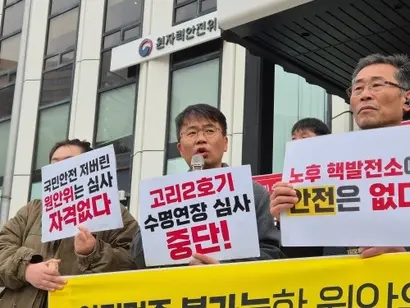
At the 224th meeting held at the NSSC main conference room in Seoul on the 13th, the commission approved the continued operation of Kori Unit 2 with five out of six commissioners in attendance voting in favor. Kori Unit 2 will now operate until April 8, 2033, extending its lifespan by 10 years beyond the original expiration date of April 8, 2023.
During the meeting, the NSSC reviewed the safety assessments of structures, systems, and equipment, as well as plans for equipment replacement. The commission concluded that sufficient safety margins are secured for the extended operation period, and that the radiological environmental impact assessment meets safety standards, including the impact of continued operation and major accidents, such as severe accidents.
Kori Unit 2 is expected to resume operation after Korea Hydro & Nuclear Power (KHNP) replaces safety management equipment and passes an on-site inspection by the NSSC. NSSC Chairman Choi Won-ho stated, "Through on-site inspections, we will thoroughly verify that KHNP's equipment improvements comply with safety standards to ensure that Kori Unit 2 operates safely."
Questions regarding the safety and documentation of Kori Unit 2 were also raised during the meeting. In particular, core inquiries focused on the radiological environmental impact assessment, which is intended to reflect environmental changes since the original operating license was granted. NSSC Commissioner Jin Jae-yong requested a comparison with past assessment results during continued operation and pointed out that under the old Atomic Energy Act, existing nuclear power plants were also required to submit supplementary documents.
In response, KHNP stated that past data no longer exists. They argued that while the old Atomic Energy Act included such provisions, the addendum was intended to supplement operating standards, and since environmental impact assessments are documents submitted only at the time of initial licensing, they were not required to submit them. A KHNP official said, "We conducted the radiological environmental impact assessment based on the current, changed environment," adding, "There was insufficient data reflecting the environment of the time to conduct the assessment based on past conditions."
Article 111, Paragraph 1 of the Enforcement Decree of the Atomic Energy Act, implemented in 1982, required environmental surveys to be conducted, and Article 5 of the Addendum mandated that facilities previously licensed should improve, supplement, and report on their conditions within one year.
Concerns were also raised regarding "compound disasters." The issue is that there is no scenario for when disasters such as earthquakes, floods, fires, or military attacks occur simultaneously. When asked about this by NSSC Commissioner Lee Kang-geun, both KHNP and the Korea Institute of Nuclear Safety (KINS) replied that they had not considered compound disasters.
Jeong Soo-hee, an activist with Busan Energy Justice Action, pointed out the danger of compound disasters, stating, "As seen in the recent forest fires in Gyeongbuk, normalized climate disasters are threatening nuclear power plants. Furthermore, the risk of missile attacks is growing, with Russia targeting Ukraine's nuclear plants and Israel targeting Iran's nuclear facilities."
Political circles also expressed significant opposition to the extension of Kori Unit 2. Yoon Jong-o, floor leader of the Progressive Party, held a press conference at the National Assembly on November 6 and urged, "Despite being an independent regulatory body tasked with supervising KHNP, Chairman Choi Won-ho, appointed by the Yoon Suk-yeol administration, is ignoring the lives and safety of the people as if he were a spokesperson for KHNP. Immediately halt the extension of Kori Unit 2, which is riddled with administrative flaws."
Civil society has criticized the Lee Jae-myung administration for pursuing a "dangerous choice" of extending aging nuclear plants while promoting an energy mix. Kim Hyun-woo, an advisor to the Anti-Nuclear Citizens' Action, pointed out, "Since there is no concrete timeline for new nuclear plants or SMRs, the government is resorting to expedient extensions of 30- to 40-year-old aging reactors. Renewable energy and nuclear power cannot coexist, and energy transition is impossible as long as aging nuclear plants occupy the stage."