

[비즈한국] The defense industry exhibition 'Defense & Security 2025 (D&S 2025),' held in Bangkok, Thailand, from November 10 to 13, is the largest single defense exhibition in Southeast Asia. This year’s event was a resounding success, with over 200 companies from 15 countries participating.
While the Asian region hosts several major defense exhibitions, including Korea's ADEX and KADEX, D&S 2025 was characterized by a "wide spectrum" of participants. Reflecting Thailand's unique geopolitical position, the event drew not only Western nations like the US and Sweden but also global defense powerhouses that are fiercely competitive on the international stage, including South Africa, Turkey, the UAE, and China.
Amidst this, major domestic defense firms such as KAI (Korea Aerospace Industries047810), LIG Nex1, Poongsan103140, and HD Hyundai Heavy Industries329180 occupied the entrance of the exhibition hall. Their booths were constantly crowded with Thai citizens as well as military and defense officials from across Southeast Asia, and I was able to witness this popularity firsthand.
However, it wasn't just the large defense contractors that I encountered on the ground. Overseas customers are no longer looking only at the giants. Instead, they showed keen interest in mid-sized companies, with active export consultations taking place everywhere.
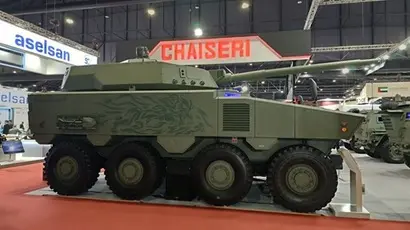
For example, motion control specialist MNC Solution signed a Memorandum of Understanding (MOU) with Chaiseri Metal & Rubber, Thailand's leading armored vehicle and military vehicle manufacturer, to expand technical and business cooperation. Chaiseri is a company deeply committed to armored vehicle development, having showcased five prototype models of armored vehicles and light tanks at this year's D&S 2025.
SK Oceanplanet, which participated in an overseas defense exhibition for the first time, was another Korean firm that drew attention. Thailand currently operates the Bhumibol Adulyadej-class frigate built by Hanwha Ocean042660. This ship was deployed in "actual operations" during a maritime power demonstration amid border disputes with Cambodia last May. Thailand is considering the purchase of additional frigates, a project estimated at 3 trillion won. While this project was initially known to be a rivalry between Hanwha Ocean and HD Hyundai Heavy Industries, SK Oceanplanet has also thrown its hat into the ring.
In an interview, SK Oceanplanet told me, "We were awarded the contract for the 2nd, 3rd, and 4th units of Korea's Chungnam-class frigates, which were launched last June, and we can deliver them without issue in 2026." They added with confidence, "As our construction capability for the Chungnam-class has been recognized, we offer more than just a low bid; we provide price-to-performance value and a proven ability to meet deadlines." They explained that while large shipyards are juggling numerous projects, such as next-generation destroyers (KDDX) and nuclear-powered submarines simultaneously, SK Oceanplanet can concentrate its capabilities solely on the Thai export-model frigate and domestic Chungnam-class construction, thereby enhancing customer satisfaction.
In addition, mid-sized firms such as Yonhap Precision, which manufactures various connectors, set up booths at D&S 2025. Although they did not have a booth, another mid-sized defense firm, Huneed Technologies, reportedly visited Thailand during the exhibition to discuss defense cooperation with the Thai military.
Why are overseas customers focusing on Korean mid-sized defense firms? This is tied to the journey of "indigenization" that the K-defense industry has undergone. While many countries are interested in developing their defense industries, finding reliable overseas partners is becoming increasingly difficult. We ourselves have faced hardships due to delays in deliveries, unilateral discontinuation of parts, lack of technology transfers, and price surges from overseas suppliers for components like K1 tank sights, FA-50 navigation equipment, and K9 self-propelled howitzer engines. Because of this, South Korea has pursued the indigenization of not just the exterior of weapon systems, but even their core components.
At D&S 2025, I had the opportunity to interview Chua Jin Kiat, Vice President of International Defense Business at ST Engineering, Singapore's largest defense firm, who expressed his agreement on this point.
Vice President Chua stated, "ST Engineering builds its own naval ships, armored vehicles, and howitzers, but due to the limitations of a city-state, we cannot manufacture every single part." He added, "There are very few countries that can provide proven parts for weapon systems through reliable contracts." He further revealed, "We will strengthen cooperation with South Korea’s mid-sized defense companies."
He also emphasized, "Unlike Tier 1 system integrators, 'Tier 2' companies—which produce suspension equipment or independent parts rather than just screws or bolts—do not compete directly with us and yet wish to expand their portfolios. They are the best partners for Singapore and ST Engineering."
Currently, South Korea’s mid-sized defense firms remain stuck in a "sandwich" position, overshadowed by the success of the broader K-defense industry. While the Defense Acquisition Program Administration and the Korea Defense Industry Association offer various support for small-sized companies, mid-sized firms are often excluded from these benefits simply because they are "too large." On the other hand, large system integrators pressure these mid-sized firms on costs, and especially when ordering export-type weapon systems where defense cost regulations do not apply, they often fail to guarantee fair profit margins, meaning the fruits of "Advance of K-Defense" do not trickle down to them.
It is bittersweet that while there is a flood of "love calls" from abroad, the reality of lacking mutual growth and cooperation within Korea remains a missed opportunity.