

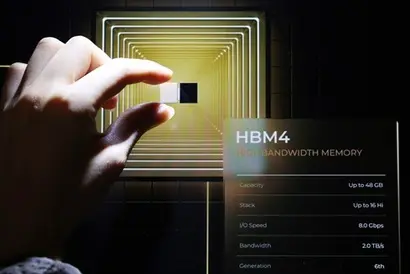
[비즈한국] OpenAI's GPT-3, released 5 years ago, was trained on approximately 45 terabytes (TB) of data. This is four times the amount of information held by the U.S. Library of Congress. Remembering and utilizing the training content is a different challenge altogether. Currently, the amount of memory used by AI systems to process data is insufficient. Bottlenecks that degrade computational speed and efficiency are obstacles that must be overcome for the arrival of the AI era. High Bandwidth Memory (HBM) is considered a core technology to solve this. This is why the memory semiconductor market, led by domestic companies such as SK Hynix000660 and Samsung Electronics005930, is being evaluated as having entered a "supplier-dominant" phase. Amid rising expectations for a reentry into a memory semiconductor supercycle (a long-term boom), capabilities in upstream and downstream industries such as supply chain, power, and packaging are also receiving attention.
AI Supercycle, Korea at the Center of a ‘Supplier-Dominant’ Market
The global competition to upgrade data centers to meet AI computing demand is expanding to the front lines of securing memory chips. Recently, major industry players have officially declared that next year's HBM supply is "sold out." During its Q3 earnings conference call on the 29th of last month, SK Hynix stated, "We have finalized our HBM supply plans for next year with our key customers." SK Hynix, which holds a 64% global market share in HBM this year, is expected to maintain its lead. SK Hynix's HBM has been sold out every year since 2023.
In its Q3 earnings report on the 30th of last month, Samsung Electronics indirectly mentioned that it is currently supplying HBM3E to Nvidia. During the conference call, the company explained, "We have set our HBM production plans for next year to be significantly expanded compared to this year. Customer demand for this planned volume has already been secured," adding, "We are internally reviewing the possibility of increasing production as additional demand is coming in."
Micron of the U.S., one of the three major players in the HBM market, is also a key supplier of core memory products to Nvidia. With a 21% market share this year, it is ahead of Samsung Electronics (15%). Micron stated in September that it is in discussions with clients to supply HBM4 volume and expects it to be sold out soon. Its customer base has increased from 4 companies in Q3 to 6 in Q4.
According to a report on the semiconductor downstream industry diagnostic by the Korea International Trade Association (KITA) on the 7th, semiconductor exports this year are recording an increase of around 30% entering the second half. If this trend continues, the global semiconductor market is projected to grow by 17.8% to $909 billion (1.3327 quadrillion KRW) next year. Driving this market growth is memory semiconductors (33.8%). Ryu Young-ho, an analyst at NH Investment & Securities, noted, "As AI enters the 'scale-out' (horizontal expansion) phase, the memory bottleneck is intensifying," adding, "We are in a phase where the importance of various memory combinations is being highlighted, beyond just focusing on HBM."
The concentration on AI and high-performance memory is raising concerns that shortages of memory chips for general IT products such as smartphones and home appliances could intensify. Jeon Bo-hee of the KITA International Trade and Commerce Research Institute said, "Since last year, the AI data center market has emerged rapidly, changing the demand paradigm," adding, "With the continued growth of AI data centers after next year, the restructuring of demand will accelerate, and by 2030, it will emerge as the overwhelming leader, accounting for 36% of total demand."
From AI Memory Hub to AI Infrastructure Leadership
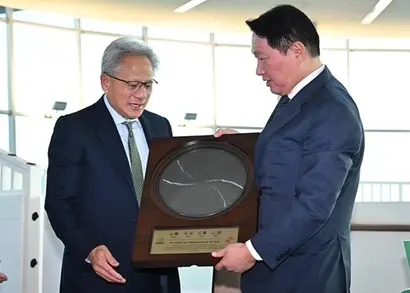
AI servers use more DRAM and NAND flash than conventional servers and are highly dependent on HBM for training and inference processes. This is the background for why Nvidia is strengthening its cooperation with domestic companies. Nvidia controls about 90% of the AI semiconductor market, and securing a stable supply of high-performance HBM is essential for maintaining a competitive edge.
The AI semiconductor boom is now evaluated to be spreading to a broad ecosystem including backward-linked industries like power and packaging, as well as data preprocessing and storage. To fully extract the efficiency of memory chips, support from high-efficiency power supply/cooling infrastructure and packaging technology is required. There is anticipation that this trend will provide expansion opportunities for the memory-centered Korean semiconductor industry.
The global semiconductor market is projected to grow 17.8% year-on-year in 2025 and continue high growth to $909.8 billion in 2026. An industry insider said, "Competitiveness in AI semiconductors will move beyond the chips themselves and be decided by data transfer efficiency and heat/power management capabilities," adding, "Packaging and power efficiency technologies are becoming critical areas."

The securities industry also sees the infrastructure investment trend leading to demand for semiconductor materials, parts, and equipment (SoBuJang). Hana Securities forecasted, "As the resumption of facility investments by Samsung Electronics and SK Hynix becomes visible, SoBuJang companies that were sluggish this year due to a gap in orders will shift to an earnings improvement trend starting next year."
The aforementioned industry insider explained, "In a structure where GPUs handle computation and HBM boosts computational efficiency, we must leverage our technology and investment leadership centered on AI memory to expand our ecosystem to power, packaging, and data infrastructure."
There are also voices calling for a big-picture approach at the government level. Han Sung-soo, head of the ICT Strategy Research Institute, pointed out, "AI memory semiconductors have gone beyond being parts that store data to becoming the core that determines system performance," adding, "To overcome the limitations of a private-sector-led approach, a model must be built through strategic R&D support from the government and close cooperation between industry, academia, and research."