

Higher Reduction Rates Set for Power, Transport, and Buildings
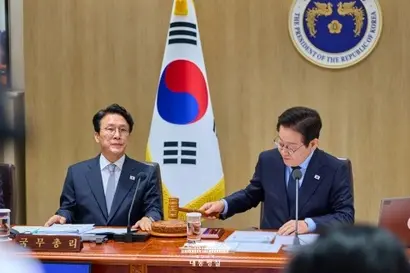
In a cabinet meeting held on the 11th, the government finalized and approved the 2035 NDC, the National Emission Permit Allocation Plan for the 4th planning period (2026–2030), and an amendment to the National Emission Permit Allocation Plan for the 3rd planning period (2021–2025).
The government confirmed the 2035 NDC, which aims to reduce emissions by 53–61% compared to 2018 net emissions (approximately 742.3 million tons of CO2eq). The NDC is a target submitted by each country to the United Nations Framework Convention on Climate Change (UNFCCC) every five years, as required by the Paris Agreement. The government plans to officially announce the finalized 2035 NDC at the 30th UN Climate Change Conference (COP30) being held in Belém, Brazil, until the 21st, and submit it to the UNFCCC secretariat within this year.
The government began discussions on the final 2035 NDC on September 8, proposing four reduction scenarios. At the time, the proposed scenarios were: 48% (industry proposal), 53% (linear reduction plan consistent with the 2050 carbon neutrality goal), 61% (Intergovernmental Panel on Climate Change (IPCC) proposal), and 65% (civil society proposal).
At the final public hearing held on the 6th, the government presented two options: 50–60% and 53–61%. Ultimately, the High-Level Party-Government Consultative Council agreed on a 53–61% reduction, which was then finalized by the Carbon Neutrality and Green Growth Commission and approved by the cabinet.
In his opening remarks at the cabinet meeting, President Lee Jae-myung said, "The transition to a carbon-neutral society is an unavoidable path for sustainable growth and for leaping into a global economic powerhouse, even if it entails pain." He added, "I ask that the government closely monitor the difficulties faced by the public and businesses during the process of renewable energy transition and greenhouse gas reduction from all angles."
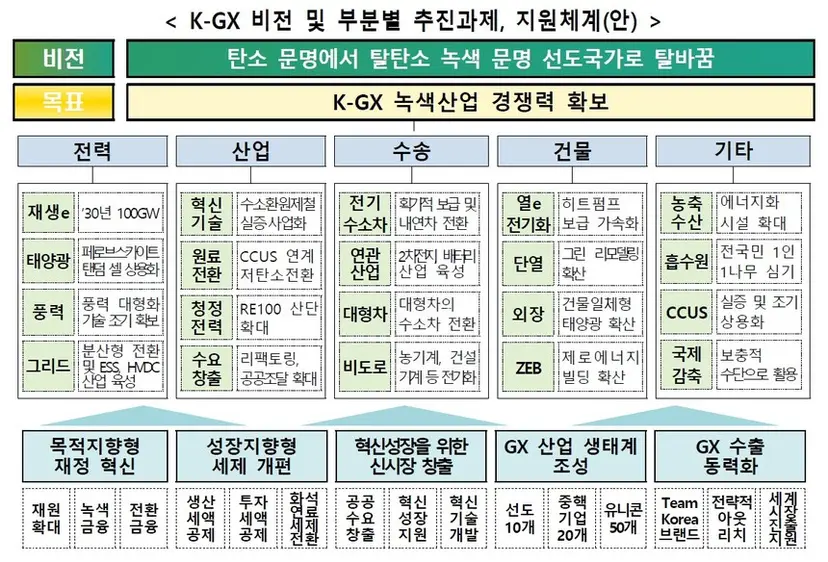
Looking at the detailed reduction targets, the reduction rates are relatively high in sectors such as power (68.8–75.3%), transport (60.2–62.8%), and buildings (53.6–56.2%). In the power sector, energy transition to renewables is planned; in the building sector, the spread of zero-energy construction, green remodeling, and the electrification of heat supply are expected; and in the transport sector, the expansion of electric and hydrogen vehicle supply will be accelerated.
The industrial sector, which emitted approximately 276.3 million tons of CO2eq in 2018—the second largest emitter after the power sector (approximately 283 million tons of CO2eq)—was assigned a reduction target of 24.3–31.0%. The government announced that the decarbonization of fuels and raw materials, along with the expansion of low-carbon product manufacturing based on innovation support, would be the primary reduction measures.
Industry: "Switch to Incentive-Based Approaches" vs. Civil Society: "Only Half the Level of Germany and Japan"
The industrial sector is concerned that the 2035 NDC will act as a significant burden. On the 10th, 14 organizations, including six major economic groups and eight industry-specific associations, issued a "Joint Industry Position Statement on the 2035 NDC."
In the statement, the industry argued that setting the 2035 reduction target at 53–61% when carbon reduction technologies have not yet been sufficiently commercialized places a heavy burden on the industry. Jung Eun-mi, a senior research fellow at the Korea Institute for Industrial Economics & Trade, pointed out, "80% of our industry consists of 'hard-to-abate' sectors such as steel and petrochemicals. Realistic transition is impossible through simple will or technological declarations alone."
They also called for strengthening the institutional framework focused on incentives rather than regulations. Kim Nok-young, head of the Carbon Reduction Certification Center at the Korea Chamber of Commerce and Industry (KCCI), stated, "We should not focus only on regulations that restrict carbon emissions but should foster and cultivate growth through incentives. Japan is actively supporting the development of hydrogen-based steelmaking technology at the government level." They also argued for the need to consider the timeline for carbon reduction technology advancement, noting that the commercialization of hydrogen steelmaking is not expected until 2037.
They emphasized the need for support measures such as tax and financial assistance for sectors with high reduction burdens and the expansion of infrastructure for carbon-free energy supply. As the power sector has high reduction targets, they also demanded restraint in electricity price hikes that could arise during the energy transition process.
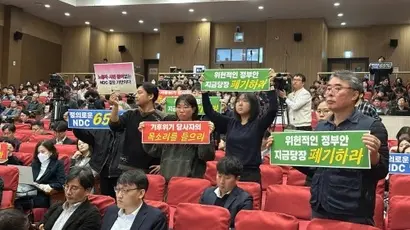
On the other hand, civil society criticized the 53% figure, which is the legally binding floor, arguing that it is likely to become the practical reduction target. They claimed this figure violates the spirit of the Constitutional Court's ruling and is unscientific.
In August last year, during a climate crisis constitutional appeal filed by Youth 4 Climate Action, the Constitutional Court ruled that parts of the Carbon Neutrality Act were unconstitutional, stating, "When setting national greenhouse gas reduction targets, it is constitutionally required to consider the responsibility for future environmental conditions."
The IPCC has recommended that the world reduce greenhouse gas emissions by an average of 60% by 2035 compared to 2019. Civil society argues that given Korea's significant responsibility for emissions and its status as a developed nation, a higher reduction target should have been set. With Korea having only achieved a 12.3% reduction from 2018 to 2024, the current situation requires the speed of reduction to nearly double to meet the 2035 NDC goal.
The environmental group Plan 1.5 issued a commentary criticizing the industry's claim that the target is impossible to implement, noting that Japan, another developed nation with a high share of manufacturing, has set an industrial reduction target of 40–43%, and Germany is at 60%. They argued that the Korean industry's target, which is only one-half to one-third of that of major competitors with similar industrial conditions, is not an excuse for it being impossible.
Yoon Won-seop, a senior researcher at the Solutions for Our Climate (SFOC), remarked, "The higher the NDC target is set, the more investment, finance, and government funding will flow into related fields. The detailed implementation plans to be revealed in the upcoming Carbon Neutrality Basic Plan and reduction technology roadmaps are what truly matter."
Industry and Ministry Clash Over Free Emission Permit Allocations
The industry is particularly concerned about the increased burden of emission permits resulting from the 4th allocation plan, which is linked to the 2035 NDC. They argue that calculating allocations based on the 2035 NDC reduction rates could exceed the actual reduction capabilities of companies. The emission permit allocation plan establishes the limit on greenhouse gas emissions assigned to each company by the government under the Emissions Trading Scheme (ETS), along with the criteria and methods. If companies exceed these limits, they must purchase additional permits.
The KCCI and eight industry-specific associations delivered a "Joint Industry Proposal Regarding the 2035 NDC and 4th ETS Allocation Plan" to the government on the 4th. In the proposal, they claimed that if the price of emission permits rises to 50,000 won, the total cost of purchasing permits over the 4th planning period would reach 5 trillion won.
The Ministry of Climate, Energy and Environment countered that the amount of "permit shortages" claimed by the industry is overestimated. The Ministry stated that even in the 4th allocation plan, it would maintain 100% free allocation for carbon-leakage-prone sectors such as steel, petrochemicals, cement, and oil refining in consideration of international competitiveness. Furthermore, they argued that the industry's estimates assume a scenario where emissions increase due to recovery in production volume, but given the trend of declining emissions seen in the 3rd allocation plan, permits will not be insufficient in the 4th period.
In response, the industry countered that industries like oil and steel, which have recently faced difficulties, may enter a recovery phase, and that purchasing emission permits could function as a regulation that slows down that recovery.
Kim Nok-young of the KCCI said, "It is true that the Ministry listens to the industry's position quite a bit regarding the ETS," but added, "However, even if free allocations are maintained, we must consider the burden of electricity price hikes resulting from the expansion of paid allocations in the power sector."
Conversely, Kwon Kyung-rak, a policy activist at Plan 1.5, pointed out, "Maintaining free allocations is undesirable as it violates the 'polluter pays' principle and could diminish companies' efforts to reduce greenhouse gases. Even in Europe, they are transitioning to paid allocations."
Regarding the industry's emission permit shortage scenario, he criticized, "No one can predict emission permit prices or greenhouse gas emission levels in 2030, as they depend on market conditions. It is highly likely that they have cherry-picked favorable data to inflate the costs."