

[비즈한국] Astronomy is the science of light. Every telescope looks at the ‘light’ flying in from the universe. That is why there is a particularly annoying presence in astronomy: dark matter. Dark matter, as it turns out, neither emits nor absorbs any light. It does not interact with light at all. Therefore, to a telescope that looks at light, dark matter is as good as non-existent. While we clearly have to assume the existence of dark matter to explain the universe, there is no way to see it—at least, not for astronomers.
As a result, in recent years, attempts to identify dark matter have largely shifted from astronomy to particle physics. Scientists go deep underground to install detectors, waiting for the traces left behind by a dark matter particle passing through by chance. Alternatively, they wait for unexpected energy deficits or excesses while relentlessly smashing protons in massive particle colliders. The reason these experiments are conducted deep underground is specifically to avoid interference from other cosmic rays and particles as much as possible.
But what if we went outside the Earth entirely? We could escape the noise created by humans on the ground and capture signals of dark matter in the universe more vividly. Recently, a bold experiment was even conducted to test the James Webb Space Telescope as a dark matter detector.
Wait, doesn't that sound strange? The James Webb is, strictly speaking, a telescope. It is a tool for looking at light—or rather, a tool for looking *only* at light. So, how on earth could we use the James Webb as a dark matter detector? The idea is truly ingenious.
How does a telescope take a picture? When cosmic light strikes a detector, electrons are ejected, and an electrical current flows. In fact, telescope cameras don't really "take photos" of light itself; they create images by detecting the current flowing from the impact of light. Stronger light results in a stronger current. However, because telescope detectors are not perfect, another type of noise occurs for very realistic reasons. Telescope detectors generate current not only from starlight but also from heat. This is why cooling is always extremely important for telescopes. If the telescope itself gets hot, unwanted current flows due to the heat rather than starlight, and the observation data becomes contaminated.
This is why, when observing with a telescope, astronomers often intentionally take black photos with the shutter closed. By doing so, they can identify the internal noise caused by the telescope's own heat while blocking out the influence of light coming from the sky. Afterward, they take the actual image of the night sky and subtract the pre-identified pure internal noise, allowing them to obtain cleaner, purer data with minimal noise contamination. The idea of using the James Webb as a dark matter detector stems exactly from this.
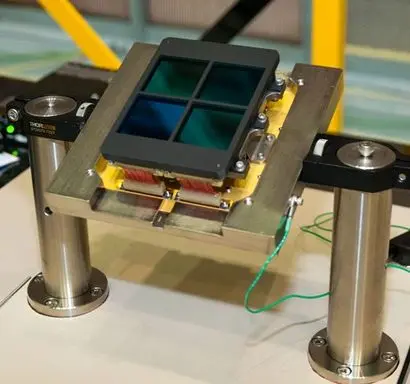
In this attempt, astronomers placed an opaque filter over one of the James Webb's NIRSpec detectors. They completely blocked any light from entering the sensor. It was as if they had closed the shutter on the James Webb camera. In that state, they detected the minute internal noise entering the detector. Humanity has long used sensors that convert light into electricity, including CCDs. Telescope cameras, smartphones, and digital cameras all work on the same principle. Therefore, we know very well what form the noise in a telescope detector should take and can model it. We can determine how much charge should be detected in each pixel of the James Webb's detector due to the telescope's own heat, strong cosmic ray particles flying in from space, and so on.
But what if, when we actually conducted the experiment with the James Webb's shutter closed, we detected more charge than expected? This could be interpreted as something we don't understand at all stimulating the telescope's detector. The important thing is that this experiment is conducted with the James Webb's shutter closed. In other words, no ordinary light enters at all. Starlight, galaxy light—nothing like that could be the cause. Instead, only one thing is possible: a ghost-like entity that could pass right through the detector shutter and touch the sensor—that is, dark matter. This is the very idea of using the entire James Webb telescope as a dark matter detector in this experiment.
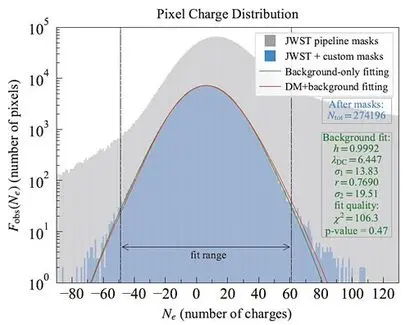
How did this ingenious experiment turn out? This graph shows the distribution of charge collected while the James Webb's NIRSpec shutter was closed. It is a histogram showing the distribution of how much charge was detected in each pixel of the detector. Looking at the light blue histogram, it takes on a distribution similar to a normal distribution, where the count of pixels smoothly increases and decreases from those with high charge to those with low charge. Here, the blue line represents the distribution of pure internal noise, excluding the effects of dark matter. Comparing the light blue histogram with the blue graph, there is effectively almost no difference. In other words, even in this ingenious experiment conducted with the James Webb's eyes closed, no traces of dark matter particles were particularly found.
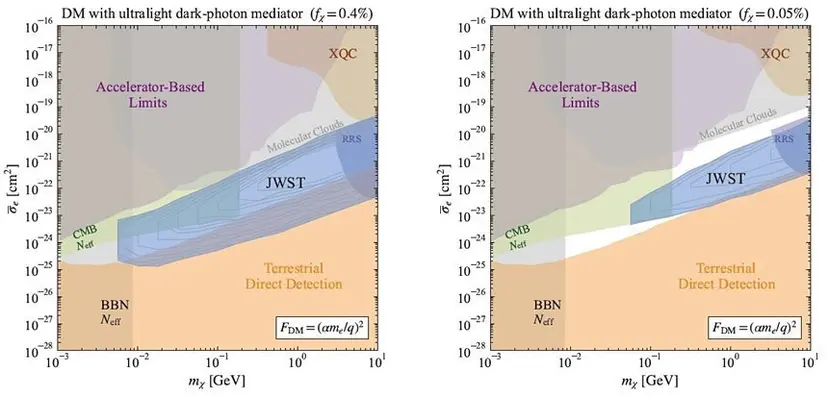
So, was this experiment a failure? Looking only at the results, one could say it was, because it failed to capture a dark matter signal. However, that isn't necessarily true. Rather, it is an important clue that tells us not where to look for dark matter, but where we *don't need* to look. This graph is fascinating. It shows the physical distribution of the dark matter candidate particles we are searching for. The horizontal axis represents the mass and energy levels of the dark matter particles. The vertical axis represents the effective cross-section, which indicates how easily dark matter particles interact with each other. A larger cross-section means they interact more easily even from a greater distance. In this graph, the shaded areas represent regions excluded through various experiments and observations. This means that dark matter particles cannot exist in the shaded regions.
Interestingly, humanity has been working on filtering out where dark matter particles *should not* be because we haven't been able to find them. By finding and excluding the range of physical quantities where dark matter particles cannot exist—such as whether their mass must be above or below a certain level, or whether their cross-section must be above or below a certain point—we are tightening the noose on dark matter particles using a method of elimination.
The interesting attempt to close the James Webb's shutter added another blue exclusion zone to this graph. In doing so, it once again narrowed the space where dark matter can hide. The probability that dark matter is hiding in the white, unshaded areas of the graph has increased.
This process of gradually excluding the ranges of physical quantities where dark matter cannot exist can be interpreted in two ways. One could view it as a process of narrowing the search range by continuously reducing the areas where dark matter could be hiding. It saves time by ensuring we don't bother searching in useless areas. And one could think that by gradually pressuring the range of dark matter's physical quantities, we will eventually find the one that has been hiding all along.
Or, one could see it as humanity doing something foolish—slowly shrinking the white area, acting as if we know what we are doing, while dark matter may not have existed in the first place. It could be seen as a form of self-consolation, where we convince ourselves that something must be hiding in the unshaded area while we slowly erase the white space, even if there was nothing there to begin with.
In the process of hunting for dark matter, astronomy and particle physics are closely linked. Because astronomy is the science of light, it is difficult to see dark matter that emits no light directly. Instead, astronomy provides guidelines on what characteristics an invisible entity should or should not have based on what *is* visible. Then, based on that, particle physicists on Earth design traps to catch dark matter.
The process of tracking dark matter represents the most fundamental philosophy held by modern astronomy: the concept of cosmological perception. We now know that everything visible is influenced by everything invisible, and everything we know is connected to everything we have yet to know. Dark matter is invisible. That is why, instead of opening the shutter of the telescope, we tried to see dark matter by closing it. We must close the eyes that have been open. Closing one's eyes to see—that is the very essence of dark matter.
Reference
https://journals.aps.org/prl/abstract/10.1103/s2q8-rzb3
Who is Ji Ung-bae? He loves cats and the universe. After watching 'Galaxy Express 999' as a child, he dreamt of sharing the beauty of the universe. Currently an assistant professor in the Faculty of Interdisciplinary Studies at Sejong University, he engages in various science communication activities, including lecturing and writing. He has authored books such as 'A Piece of the Universe Every Day,' 'Scientists of the Starry Universe,' 'Can't Go, But Can Know,' and 'Strange Questions That Come to Mind When Looking at the Universe,' and has translated books including 'The Hitchhiker's Guide to the Real Universe,' 'How I Killed Pluto,' 'Quantum Life,' and 'Cosmigraphics.'