

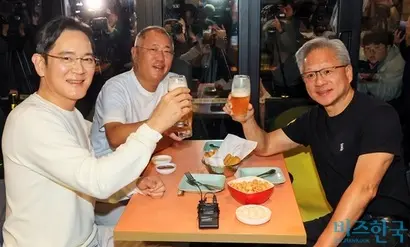
[비즈한국] On October 30, Nvidia CEO Jensen Huang visited Korea and forged a "Gganbu Alliance" (a pact between close friends) with Samsung and Hyundai Motor Company005380. Following a "chimaek" (fried chicken and beer) gathering with Samsung Group Chairman Lee Jae-yong and Hyundai Motor Group Chairman Euisun Chung, CEO Jensen Huang emphasized an AI alliance and promised to prioritize the supply of 260,000 Nvidia GPUs (Graphics Processing Units) to Korea by 2030.
GPUs are the core infrastructure of the AI era. While a CPU (Central Processing Unit) is designed to handle complex, individual tasks quickly, a GPU processes thousands of simple commands simultaneously. Since AI requires processing billions of data points at once, GPUs are essential. Consequently, the quantity of GPUs is sometimes viewed as a metric for a nation's industrial competitiveness.
Until now, AI research and development in Korea has largely relied on overseas cloud companies, but this supply agreement is seen as creating a foundation for domestic entities to train their own giant language models and industrial AI. Projections suggest this could accelerate the pace of "AI independence" across all industries.
Character
Nvidia CEO Jensen Huang, who gifted Korea with a supply of "GPUs," is a Taiwanese-American. Born in Taipei, Taiwan, on February 17, 1963, he immigrated to the U.S. at age 9. He spent his childhood at a boarding school in Kentucky, where he was frequently bullied for being an Asian boy who struggled with English. He recalls that whenever he crossed a bridge over rushing water, friends would shake the ropes, but by crossing that bridge every day, he cultivated his sense of balance and perseverance. This experience eventually led to the decisiveness he shows as an "unshakable CEO."
After graduating early from Aloha High School in Oregon, he earned a bachelor's degree in electrical engineering from Oregon State University and a master's degree in the same field from Stanford University. After graduation, he worked at semiconductor companies like AMD and LSI Logic, where he participated in microprocessor and graphics chip design.
He married Lori Huang in 1985 and has one son and one daughter.
Career
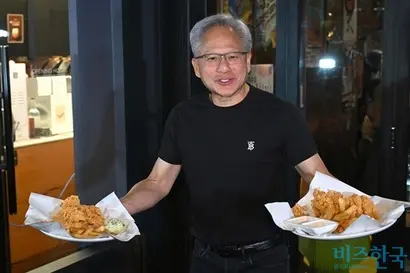
CEO Jensen Huang worked part-time at a Denny's restaurant when he was young, and it is known that he conceived his business plan there. Leveraging his engineering background, he co-founded Nvidia in 1993 with his colleagues Chris Malachowsky and Curtis Priem.
Anecdotes suggest that at the time of Nvidia's founding, his wife was pregnant with their second child, and they had only six months' worth of living expenses in their bank account.
Nvidia is a system semiconductor design and manufacturing company, and Jensen Huang has served as its CEO since its inception. Nvidia has now established itself as a leading AI semiconductor company with a market capitalization exceeding $5 trillion.
Capability
Although an engineer by trade, CEO Huang is considered a figure who also possesses exceptional management instincts. Nvidia faced a risk of bankruptcy due to the failure of its first product, the "NV1" graphics chipset, but the 1997 launch of the "RIVA 128" created a turnaround. As an innovative GPU that integrated 2D and 3D graphics functions, it received an explosive response from the market, leading Nvidia to record its first profit.
During this period, Jensen Huang forged an alliance with TSMC to solve the rapidly increasing demand for chips. The structure of Nvidia focusing on design while TSMC focuses on manufacturing became a standard for the global semiconductor industry thereafter.
Of course, the path of the alliance was not smooth. In early 1998, TSMC applied the wrong chemical process, forcing the disposal of tens of thousands of chips, and Nvidia faced another bankruptcy crisis. Jensen Huang managed to save the company by handing over shares to investors. He is said to have reminded his employees of the urgency by telling them, "Our company will be gone in a month."
In 2006, Jensen Huang introduced the "CUDA" platform, which moved the GPU beyond a graphics-only chip to allow for general-purpose computing. This redefined the GPU from a simple image processor into the core engine of AI. Later, as deep learning technology surged in the early 2010s, the GPU became the standard infrastructure for the AI industry.
Today, Nvidia holds more than an 80% share of the discrete GPU and AI-computing chip market. Beyond GPUs, it has built its own software ecosystem, including "Omniverse," a simulation platform for autonomous driving and robot learning. Entering the 2020s, Nvidia became the world's number-one semiconductor company by revenue, and in 2025, it rose to become the world's most valuable company by market cap. It is the first company to exceed a $4 trillion market capitalization. CEO Huang's leadership is so impactful that the term "Jensen Huang Syndrome" is used to describe how he has shifted the flow of technology and capital.
Critical
There is, of course, criticism. CEO Huang's personal asset management style has been a subject of controversy. According to foreign media reports such as The New York Times, he established a wealth transfer plan using trust structures that could legally reduce his inheritance and gift taxes by approximately $8 billion.
Critics also point out that the market is excessively dependent on GPUs. There are also antitrust issues. China is currently investigating Nvidia, alleging that the company violated approval conditions during its acquisition of Mellanox. Rival U.S. semiconductor manufacturer AMD has criticized Nvidia for exercising a virtually monopolistic position in the data center GPU market. There is also criticism that Nvidia's policy of limiting the release of drivers and technical documentation hinders the development ecosystem.
Challenges
Nvidia's next goal is "Physical AI." Jensen Huang presented this as Nvidia's target during his 2025 CES keynote speech. Physical AI is the realization of artificial intelligence that understands and moves within the real world. It refers to systems that, moving beyond the language and image recognition of existing AI, can think and react for themselves in physical environments such as robots, automobiles, and manufacturing lines. He stated, "Tokens were only applied to text or images in the past, but in the future, they will become the basis for understanding the physical world and guiding robot movement."
This has also led to the "Gganbu Alliance." CEO Jensen Huang has joined forces with Samsung Electronics005930 and Hyundai Motor Company to engage in wide-ranging cooperation, including GPU supply, AI infrastructure construction, and talent cultivation. He has made Korea a test bed for Physical AI. However, political and geopolitical situations, such as the policies of the Trump administration in the U.S., leave room for potential threats to the Gganbu Alliance.