

[비즈한국] Companies sometimes make decisions that are difficult to explain by money alone. Understanding the laws and systems hidden within those decisions can help clarify the underlying situation. 'Useful Business Tips' introduces insights to help understand business trends.
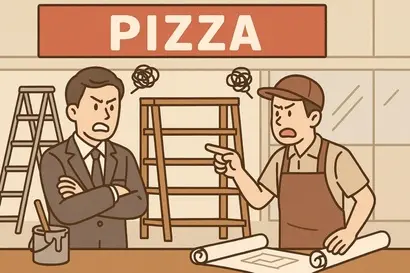
Disputes in the franchise industry are endless. Franchise headquarters and franchisees have different goals. Simply fulfilling the contract in good faith does not prevent all future conflicts. Headquarters seek the perpetuity of the brand through continuous investment. However, many franchisees are more interested in cost-saving than in maintaining brand value. This is because for franchisees, generating stable profits within their operational tenure is paramount.
The point where their interests sharply contrast is store environment improvement, or interior renewal. Headquarters want to periodically replace store interiors, such as signage. Competition in the domestic food service and retail industries is fierce. Since it is impossible to revive a dead brand, they try to provide a sense of novelty by periodically replacing interiors.
However, franchisees are not happy about new investments for interior upgrades. There is no guarantee that interior renewals will contribute to increased sales and profits. In some cases, franchisees even raise concerns, suspecting that headquarters are using interior renewals as a way to channel work to specific contractors.
As a result, even within the same brand, many branches have different signage or interiors. Signage from version 1.0, 2.0, and 3.0 are often mixed. From the perspective of headquarters, this phenomenon harms the consistency of the brand and the essence of the franchise business. Therefore, they directly or indirectly suggest that franchisees who maintain outdated interiors replace them.
The Fair Transactions in Franchise Business Act prohibits headquarters from demanding interior renewals from franchisees without justifiable cause. Article 12-2 (Prohibition of Unfair Coercion of Store Environment Improvement, etc.) Paragraph 1 stipulates that 'franchise headquarters shall not coerce store environment improvements without justifiable cause as prescribed by Presidential Decree.'
In relation to this, Article 13-2 (Scope and Procedures for Bearing Costs of Store Environment Improvement, etc.) Paragraph 1 of the Enforcement Decree of the same Act defines the 'justifiable cause as prescribed by Presidential Decree' as two cases: △when the aging of store facilities, equipment, or interior is objectively acknowledged, or △when it is difficult to maintain the uniformity of the franchise business or when normal business operations are significantly hindered due to hygiene or safety defects, or equivalent reasons.
Ultimately, the renewal reasons permitted by law are limited to the franchisee's voluntary consent, hygiene, or safety issues. However, since the purpose of headquarters seeking interior renewals is generally to maintain a luxurious image or for marketing, these do not meet the legal criteria for justification. This is because they are unrelated to the franchisee's voluntary decision or defects in hygiene or safety.
Then, how far does 'coercion' extend? The Fair Trade Commission notice stipulates that it 'refers to causing a franchisee to perform certain acts against their free will, regardless of the method such as threats, demands, requests, or suggestions, and includes indirect or implicit coercion that creates an objective situation where the franchisee cannot help but comply with the headquarters' intent, even without direct or explicit coercion.' Therefore, depending on the situation, even the act of headquarters mentioning interior renewals or creating circumstances where renewal is unavoidable can be a violation of the Franchise Business Act.
In particular, in cases where unfair coercion of store environment improvement is an issue, the headquarters has the obligation to prove that there is a justifiable cause and that no violation of the law has occurred. This is based on the structure of the clause, which is 'prohibition in principle' and 'permitted as an exception,' and the fact that it uses the phrase 'justifiable cause' rather than 'unfairness,' which would imply that the Fair Trade Commission must prove the requirements for punishment. It means the intensity of the regulation is quite strong.
Because of these regulations, it is virtually impossible for headquarters to replace or change store interiors in a disciplined manner with the same design at the same time. Therefore, headquarters open company-owned stores in core commercial districts as a form of flagship store, apply the latest interiors there, and then proceed with interior renewals for franchises only when a franchisee changes or when the 10-year contract renewal claim period expires and a new contract is signed.
Meanwhile, questions are being raised about this practice as well. Some suggest that the provision prohibiting unfair store environment improvement under the Franchise Business Act should be applied without exception even when changing franchisees, transferring a business, or renewing a contract, arguing that otherwise, headquarters will cite various reasons to circumvent the regulations.
However, interpreting the law according to such opinions is risky when considering the following circumstances. Currently, it is difficult for famous Korean franchises to open new stores due to regulations prohibiting opening stores within a certain distance of existing ones. It is also common for existing stores to be maintained for decades.
In this situation, if the provision prohibiting store environment improvement were applied even when changing franchisees or renewing contracts, headquarters would effectively have no opportunity to implement interior renewals. Since there are no new store openings, there would be no way to implement new interiors, and all renewals for existing stores would be prohibited.
Ultimately, a realistic balance would be to leave it to the franchisee's autonomy during the 10-year franchise agreement renewal claim period, and allow for renewal discussions when a franchisee changes through business transfer or when a new contract is signed. This is because, typically, the initial investment would have been recouped after about 10 years.
The brand management of headquarters and the investment recovery of franchisees are always in a tense relationship. While forced interior renewals without justifiable cause under the law are prohibited, a reasonable interpretation is required in reality. However, all discussions must be premised on legitimate procedures and sincere consultation.