

[비즈한국] Is there any title more intuitive and explicit than this? The drama 'The Story of Manager Kim, a Large Company Employee with a Seoul Apartment' (The Story of Manager Kim) shows a class consciousness so clear that not a single keyword needs explanation. He lives in Seoul, and he owns his home—not renting or leasing. He works at a large conglomerate and has served for 25 years, reaching the position of manager. On top of that, he has an understanding wife and a proud son. His wife, as befits the wife of a large corporation's manager, is a full-time housewife, and his son is a student at a prestigious Y University. The situation of the protagonist, Kim Nak-soo (Ryu Seung-ryong), seems to be a successful life that has nothing to envy.
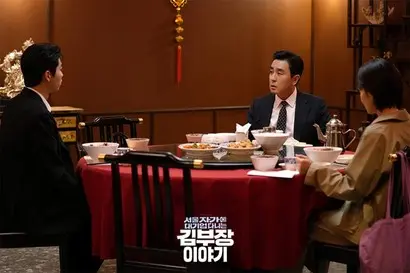
However, while Kim Nak-soo takes pride in his success, he is not a satisfied person. He ranks everything around him and constantly compares where he stands within that hierarchy. Look at how he searches for a bag in a price range between the 3 million won bag owned by Executive Director Baek Jung-tae (Yoo Seung-mok) and the 2.5 million won bag of Assistant Manager Jung Sung-gu (Jung Soon-won) on his team. He frowns at Jung Sung-gu's foreign car while expressing joy at Section Chief Song Ik-hyun's (Shin Dong-won) compact car, only to be floored by the realization that the compact car is just for commuting and that the section chief actually owns an expensive vehicle. Naturally, he is dumbfounded by the fact that the neighboring team's Manager Do Jin-woo (Lee Shin-ki) lives in a high-end, newly built apartment in Banpo, just like Executive Director Baek Jung-tae. Do Jin-woo, who is a junior to him and a graduate of a junior college, living in a home he owns in an apartment that costs 3.8 billion won for a lease and 6.8 billion won to buy! Shocked by this unbelievable reality, he accidentally hits a hole-in-one at a golf course, but ironically, it leads to a "sad-funny" situation where he ends up spending hundreds of thousands of his own money.
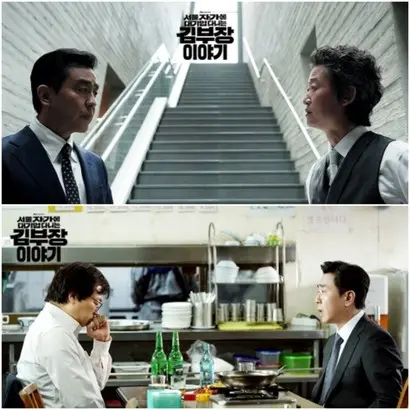
Aside from his unhappiness caused by constant comparison, Kim Nak-soo's situation is also precarious. Although he has raced ahead without ever being passed over for promotion, there is no guarantee he will become an executive next year. Kim Nak-soo acts as if he has no doubt about his promotion, but he secretly feels threatened by Manager Do Jin-woo. He blames his subordinates, but he is bothered by the fact that there is a significant gap between his team and Manager Do's team—not just in performance, but in team atmosphere as well. He is also stunned that his prestigious-university-bound son, Soo-gyeom (Cha Kang-yoon), has no intention of joining a large corporation after graduation. The son says he is going to take a position with an absurd title, 'Chief Disruption Officer (CDO)', at a startup with an even stranger name. He is also bothered by his wife, Ha-jin (Myung Se-bin), who seems to be sizing up his promotion while contemplating her own second act in life.

Despite this, Kim Nak-soo believes everything will be solved once he is promoted. However, the company has already decided to cast him aside. While he was a capable salesman in the field, they judged that his ability as a manager leading a team was lacking. And that's reasonable; Kim Nak-soo is diligent (a perfect attendance award at a company?), but his work style is no different from that of the 20th century. He protests that he is not like his "kkondae" (bossy/outdated) bosses of the past, but he is a "kkondae" himself. He is an unreasonable boss who engages in 'micro-management' through his own limited lens rather than encouraging his team members' talents, so there is no way the company would view him as executive material. To make matters worse, luck isn't on his side. An unexpected incident hits the company, and although he manages to clean it up somehow, the souvenir photo of his hole-in-one at the golf course becomes the catalyst for suspicion of price-fixing among the three major telecommunications companies, leading to Baek Jung-tae "cutting off the tail" to save himself. He tries to squeeze out every bit of sales performance to keep his hopes alive, but he is eventually demoted to the head of the safety management team at the Asan plant.
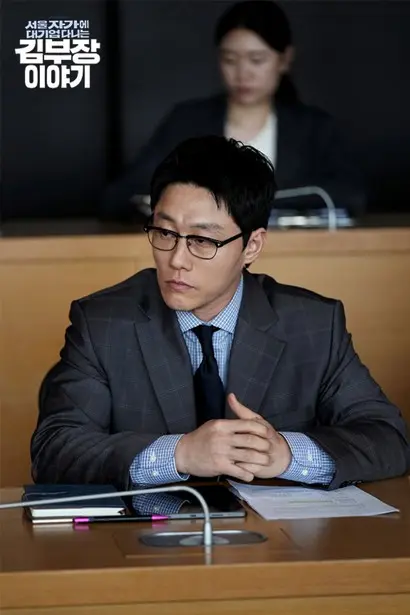
What's interesting is the strange feeling I have toward Kim Nak-soo. Kim Nak-soo is someone I would never want to encounter as my boss. Even as a father or husband, he barely clears the passing grade by today's standards. Yet, when I watch Kim Nak-soo, I feel an overwhelming sense of pity. It’s because I know that while he clearly possesses many things, they are built on a fragile foundation that could crumble like a sandcastle. Even though he is buried in a sense of authority and classism, I feel pity because I know he is an ordinary human who—while prone to comparing, being jealous, and narrow-minded—also has a vulnerable side.
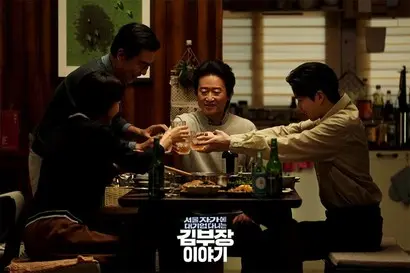
He has many annoying traits, but when you tear him down, Kim Nak-soo isn't a bad person; his biggest mistake is simply failing to adapt to the changing era. Who could easily blame a life lived faithfully like an ox, believing that if you just work hard and dedicate your body to the company, you will receive due compensation? So, seeing him at the end of episode 4, shouting “I’m still a useful guy!” after being sentenced to demotion, there must be many people who project themselves, or their future selves, or their own fathers onto him.
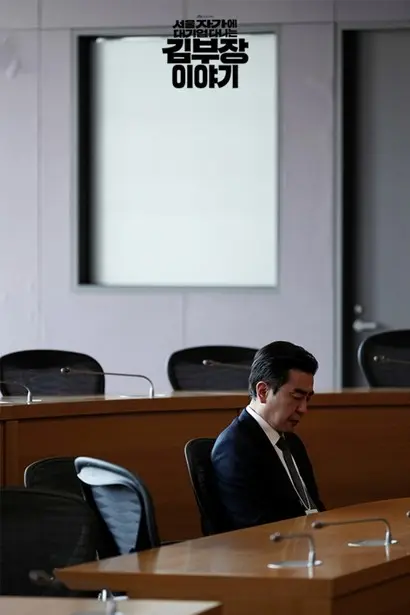
The Kim Nak-soo in the drama was likely born in 1972 or early 1973. Born during the period with the highest population statistics in South Korea, he must have spent his whole life in endless competition. He is a contemporary of Yoo Man-soo (Lee Byung-hun), born in 1970 from the movie 'Can't Help It' released last September, and they share the commonality of having worked at one company for 25 years and eventually being pushed out. He is the same age as Kang Tae-poong (Lee Jun-ho), the protagonist of the tvN drama 'Taepung Trading', which is also airing on weekend nights like 'The Story of Manager Kim.' Although 'Taepung Trading' differs in that it is set in 1997 when the IMF crisis hit, it is significant that today's popular culture is featuring men born in the 1970s, now middle-aged, as protagonists. Remember how the novel 'Father' gained syndrome-level popularity during the IMF era, and retro-style dramas like 'Eunsil-i,' 'Gook-hee,' and 'Wang-cho' were popular? It feels like proof that our current reality is just as harsh, and so even while I enjoy watching 'The Story of Manager Kim,' I am suddenly filled with fear. It is not only Kim Nak-soo who is standing at a crossroads of crisis.
Who is the author Jung Soo-jin?
Has worked for various magazines, covering and writing about movies, travel, and popular culture. Does not want to fall behind trends, but has become an "old-fashioned person" who watches the latest dramas only to predict the same old clichés for the next scene. Currently drifting in the vast ocean of OTT services, trying to regain a lost sense of touch, and her current wish is for an integrated OTT subscription plan to be released.