

[비즈한국] Amid the resurgence of nuclear power as an alternative to meet growing electricity demand and combat climate change, a BizHankook investigation has confirmed that South Korean construction companies have reached an all-time high in overseas nuclear project orders this year. The majority of these orders come from the Czech Dukovany nuclear power project, led by Korea Hydro & Nuclear Power (KHNP). With Hyundai E&C000720 and Samsung C&T028260 currently engaged in front-end engineering and design (FEED) phases, the scale of overseas nuclear orders is expected to grow significantly as these projects expand.
According to data requested by BizHankook from the International Contractors Association of Korea (ICAK), the value of overseas nuclear projects secured by South Korean builders this year (as of October) reached $19.6 billion (11 projects), or approximately 28 trillion won, marking the highest annual cumulative order volume in history. This is the highest level in 15 years, surpassing the 2010 record of $18.7 billion, when Korea Electric Power Corporation (KEPCO)015760, Samsung C&T, Hyundai E&C, and Doosan Heavy Industries won the Barakah nuclear power project in the United Arab Emirates (UAE). The next highest year for cumulative orders was 2022, which saw only $2.5 billion (1 project).
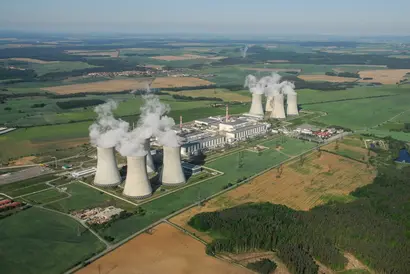
The bulk of this year's overseas nuclear order volume stems from the new Czech nuclear project. Last June, KHNP signed a primary contract for the Dukovany II nuclear power plant to supply two 1,000MW-class Korean-model reactors, the 'APR1000'. The contract is valued at $18.7 billion. As the prime contractor, KHNP plans to provide the entire scope of nuclear plant construction—including Engineering, Procurement, and Construction (EPC), commissioning, and fuel supply—in partnership with KEPCO E&C (design), Doosan Enerbility034020 (main equipment and construction), Daewoo E&C047040 (construction), KEPCO NF (nuclear fuel), and KEPCO KPS (commissioning and maintenance).
Previously, KHNP CEO Hwang Joo-ho stated, “This contract is a magnificent achievement that once again proves the technological prowess and reliability of South Korea’s nuclear industry on the global stage. KHNP will strive to enhance the global competitiveness of our domestic nuclear ecosystem, fulfill our responsibilities to future generations through safe and sustainable energy, and ensure the successful implementation of our cooperation with the Czech Republic.”
The global nuclear energy market is expected to expand significantly. According to a report published by the International Atomic Energy Agency (IAEA) in September, global nuclear capacity is projected to increase by more than 2.6 times, from 377GW(e) at the end of last year to a maximum of 992GW(e) by 2050. This figure accounts for all currently operating reactors, planned shutdowns, potential license renewals, possible power uprates, and future construction projects. It is estimated that up to 24% of new nuclear capacity will come in the form of Small Modular Reactors (SMRs).
The scale-up of nuclear energy originated from an international consensus. In November 2023, at the UN Climate Change Conference (COP28), 25 countries, including South Korea and the United States, recognized the role of nuclear energy in achieving the United Nations (UN) Sustainable Development Goals and pledged to triple nuclear capacity by 2050 compared to 2020 levels (375GW of installed capacity). For the first time since annual summits began in 1995, the 198 signatories to the UN Framework Convention on Climate Change officially called for "accelerating the deployment of low-emission technologies, including nuclear power, for decarbonization."
South Korea is currently regarded as an emerging powerhouse in the international nuclear market. Bloomberg Businessweek assessed in May that Korea is in a position to win approximately 43% of the 400 new nuclear projects currently being planned or negotiated worldwide. Based on this, it predicted a high probability that South Korea will emerge as a major nuclear exporter over the next decade. Conversely, it noted that the U.S. and France, once industry leaders, have records of rising costs and construction delays, while current powerhouses China and Russia may face hesitation from Western nations due to security concerns.
Indeed, positive news regarding overseas nuclear orders continues to arrive. Last month, Hyundai E&C signed a FEED contract with Holtec International for the construction of four large-scale reactors within a 'Combined Energy and AI Campus' in Texas, USA. This marks the first time a South Korean company has entered the U.S. nuclear market, and it is speculated that Hyundai E&C will likely handle the EPC phase in the future. Samsung C&T, which has made SMR business a new growth engine, is currently conducting the FEED for an SMR in Romania in partnership with U.S.-based NuScale Power. This project is expected to complete its FEED within this month and begin construction next year.
A construction industry official noted, "As the demand for electricity for AI and data centers explodes, the realization is spreading that existing eco-friendly energy sources cannot simultaneously meet the dual challenges of stable power supply and climate change response. As many countries reconsider their nuclear phase-out policies and include nuclear power in their energy mix, the market size is growing. Given that major Korean construction firms like Samsung C&T, Hyundai E&C, and Daewoo E&C have made nuclear power a core part of their portfolios, the number of nuclear orders is expected to rise further in the future."