

[비즈한국] The Agency for Defense Development (ADD) is set to build a testbed for developing key stealth technologies for next-generation fighter jets. While this testbed will not be equipped with engines or capable of actual flight, it will be built to full scale, integrated with stealth technology and a next-generation AESA radar, and utilized for various testing purposes. ADD will collaborate with the industry over the next four years to develop this testbed.
On October 29, ADD held the ‘2025 Future Challenge Defense Technology R&D Project Planning Presentation’ at the Osong Convention Center. This event was organized to introduce key research necessary for future next-generation weapon systems—rather than technologies for immediate application—and to brief participating companies on schedules, budgets, and research goals.
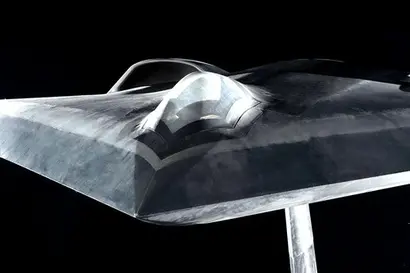
At the event, ADD announced that it would launch new projects in line with the 2026 defense budget proposal announced by the Ministry of Economy and Finance on August 29. The Ministry’s announcement included an allocation of 63.6 billion won to "initiate the development of 'stealth bridge' technology for the development of a South Korean next-generation stealth fighter," and ADD plans to proceed with actual research projects to implement this.
So, what does ‘stealth bridge technology’ mean? It refers to core technologies required to realize stealth fighters, specifically broadband stealth fighters. This includes airframe structural technology for stealth fighter manufacturing, material technology that absorbs and reflects radio waves and infrared radiation for stealth purposes, and future AESA radar technology.
To secure these technologies, ADD will pursue three research tasks over 48 months. The first task is 'stealth airframe structural design and core integration verification technology.' This includes technology to quickly design stealth fighters according to requirements and apply stealth features to key areas such as air intakes, engine exhausts, and internal weapon bays.
The second task is 'aviation multi-functional composite materials and low-observable sensor technology.' This involves developing heat-resistant materials and specialized engine nozzle materials essential for stealth aircraft, as well as next-generation AESA radar. In particular, unlike existing fighter AESA radars that use a single frequency band, the next-generation AESA radar to be developed will feature broadband transmission and reception capable of freely using a wide range of frequencies from low to high, low-observability, as well as Electronic Support (ES) and Electronic Attack (EA) capabilities.
The final task is 'stealth technology for radar cross-section (RCS) integrated control.' This includes production technology for special glass (canopy) that does not reflect radar waves and technology for measuring the actual radar detection avoidance performance of stealth aircraft.
Such technology research is usually in the earliest stage of weapon development and often remains at the laboratory level, making it difficult to attach great significance to it. However, by constructing a 'full-scale airframe testbed,' ADD expects to present a concrete blueprint for the 'South Korean next-generation fighter.'
The full-scale testbed resulting from the three research tasks will, simply put, be a physical object that "has no engine or wheels but is infinitely close to an actual stealth fighter." Although it is a mock-up that cannot fly due to the absence of certain components, it will feature the same shape, materials, and structure as the real thing, and above all, it will be equipped with a next-generation AESA radar.
The purpose behind ADD building a testbed so close to an actual aircraft is to facilitate the development of next-generation fighter technologies, which will begin in earnest in the 2030s. As developing a next-generation fighter is a highly difficult challenge, the Air Force, as the requesting military branch, has demanded verification of whether the technology to actually implement a tailless stealth fighter exists.
Participation from companies specializing in electronic equipment, airframe structures, and materials is expected for this stealth testbed, which will be co-researched by firms under ADD's leadership. In particular, companies like Korean Air003490 and Korea Aerospace Industries (KAI)047810 are expected to show great interest and take on the challenge to secure a leading position in next-generation fighter development. As Korean Air has experience in manufacturing a full-scale mock-up of a stealth drone with a 15m wingspan (KAORI-X2), attention is focused on which companies will participate in the next-generation fighter testbed project.