

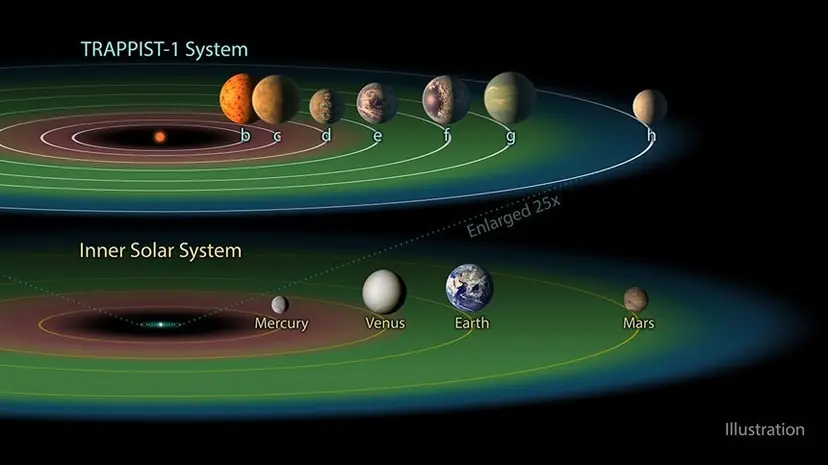
[비즈한국] TRAPPIST-1 is one of the most closely watched exoplanet systems. In 2017, astronomers discovered a staggering seven planets there, comparable to the eight planets orbiting our own Sun. The sight of so many planets orbiting at once ignited hope that many more multi-planet systems exist throughout the universe. Furthermore, all seven are rocky planets similar to Earth.
Even more surprising is that four of these planets are located in the "Goldilocks zone," where life might be possible. TRAPPIST-1d sits on the inner edge of this zone, e and f in the middle, and g on the outer edge. If luck were on our side, it would be a location where we could discover several exoplanets harboring life simultaneously. With the James Webb Space Telescope (JWST) now in space, it has observed the TRAPPIST-1 planets extensively. For life to thrive, these planets must, like Earth, be covered by an atmosphere.
Bleak results have already been announced for the two innermost planets, b and c, indicating no significant signs of an atmosphere. Planet b appears to have almost no atmosphere, much like Mercury, and for planet c, we only confirmed ambiguous data that might suggest a very thin atmosphere. However, the other four planets in the Goldilocks zone have yet to be analyzed in earnest. While JWST was conducting its observations, powerful stellar flares erupted, making data analysis take much longer than expected.
The highly anticipated analysis of the JWST observations for planet TRAPPIST-1d has finally been released. What were the results? As everyone hoped, does an atmosphere exist on a planet within the Goldilocks zone of TRAPPIST-1?
The existence of the TRAPPIST-1 planets was discovered through "transits," where the light from the central star dims as the planets pass in front of it. As seven planets pass in front of the star at different intervals, the light from the central star changes in a highly complex pattern. After closely analyzing these patterns, astronomers were able to determine the total number of planets and their respective orbital periods.
By effectively utilizing these transits, where the exoplanet and the star align, it is also possible to detect the presence of an atmosphere. An attempt was made to identify an atmosphere there using Hubble Space Telescope observations in 2018. However, unlike JWST, Hubble primarily observes visible light and has a smaller mirror, making precise atmospheric observation difficult. To confirm an atmosphere with Hubble’s performance, a planet would need to be a large gas giant with a thick atmosphere, like Uranus or Neptune. For a rocky planet with a thin atmosphere, it is difficult to judge whether an atmosphere exists using only Hubble observations.
In the 2018 Hubble observations, astronomers concluded that planets d, e, and f definitely lacked thick hydrogen atmospheres. However, they suspected that planet g, on the outermost edge of the Goldilocks zone, might have an atmosphere, though it remained ambiguous. They also suggested the possibility that planet g might not be a rocky planet, but rather a small gas planet, a "mini-Neptune."
Crucially, the conclusion was not that planets d, e, and f "cannot have an atmosphere." The key finding is that they appear not to have a thick atmosphere like Jupiter. While this might seem like a desperate conclusion at first glance because no atmosphere was found, that is not necessarily the case. It could actually be a hopeful finding. These planets are suspected to be rocky planets like Earth, which could mean they possess thin atmospheres like Earth's.
To confirm a thin atmosphere, JWST is required. Specifically, because JWST observes in infrared wavelengths, it is well-suited to identifying components directly linked to life on Earth, such as water and carbon dioxide. JWST targeted the moment when TRAPPIST-1d transited in front of its central star. Although this planet is only 2% of the distance from its star as Earth is from the Sun, the central star itself is so small that the light hitting the planet is similar to the sunlight reaching Earth.
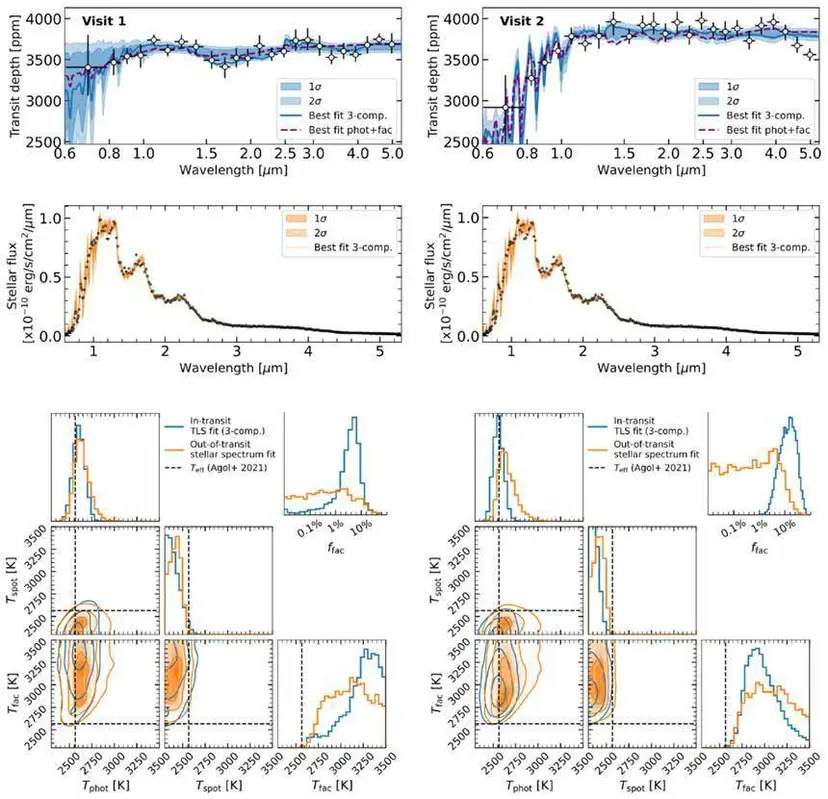
If TRAPPIST-1d had an atmosphere containing various chemical components, the spectrum of the star should show traces of absorption by those chemicals while the planet is in transit. However, the observed spectrum is quite flat. The level of absorption by chemical components is negligible. Astronomers tested various chemical compositions, such as methane, carbon dioxide, and water, to find the scenario that best explains the observed spectrum. Yet, no components—methane, carbon monoxide, water, carbon dioxide, or sulfur dioxide—showed a clear signal. During initial analysis, ammonia seemed to show a meaningful signal, but further analysis concluded that this was not due to actual atmospheric composition; rather, it was a sort of optical illusion caused by the unstable fluctuations of the central star itself during the transit.
The results of this analysis leave two intriguing possibilities. The first is that the planet might possess a very high-density, thin, low-lying atmosphere, similar to Mars. This scenario best explains the observational data. The second possibility is that, like Venus, thick clouds high up in the atmosphere completely masked any spectral signatures of the atmospheric components. While this is relatively unlikely, it cannot be entirely ruled out. We had hoped that this planet would resemble Earth, but in reality, it is highly likely to be a world similar to Mars or Venus. Of course, neither is a world where we could live. Sadly, astronomers who had not yet given up on TRAPPIST-1 are once again facing despair.
There is a reason this discovery is particularly bitter for astronomers. The TRAPPIST-1 star is a red dwarf, much smaller and more diminutive than the Sun. This type of star is the most common in the universe. Red dwarfs, which are much smaller and dimmer than stars like our Sun, are far more abundant. In fact, most stars where exoplanets have been found so far are such red dwarfs. However, this finding points to the desperate conclusion that life may not be able to survive on red dwarfs. We may have to give up on most of the exoplanets we have discovered so far that orbit red dwarfs.
Because red dwarfs are small stars, the convection that mixes the interior and exterior of the star is intense. Consequently, charged particles churn complexly outside the star’s surface, and magnetic fields become tangled on the star’s surface. Material from the star's surface is rapidly ejected along these magnetic fields, causing the stars to release flares that spew energy into space. As these flares sweep across neighboring planets, the remaining atmosphere on those planets is continuously stripped away, and ultimately, the planets cannot retain an atmosphere for long. The stellar wind pouring out from the central star blasts the planet's surface with massive amounts of cosmic radiation, making it impossible for any life to survive. In particular, planet d, which JWST observed this time, is on the inner edge of the Goldilocks zone, making it very close to the central star and most vulnerable to stellar winds.
If so, can we have expectations for planets e, f, and g, which are slightly further away? While they are slightly farther from the central star, potentially allowing them to retain their atmospheres, observing them is tricky because they are further away. Since their orbital periods are longer, missing one transit requires a longer wait for the next. Furthermore, because the distance between the star and the planet is greater, the intensity of the starlight passing through the planet’s atmosphere is weaker, making it even harder to determine the spectrum. To collect enough light, we would need a telescope larger than JWST, which is impossible for now. Therefore, we must use methods to amplify faint signals by collecting data from multiple observations rather than just one. Consequently, moving toward planets e, f, and g, which are further from the central star, requires a longer wait to secure analyzable data and necessitates more of JWST’s observation time.
Facing these realistic limitations, astronomers have begun asking more fundamental questions: Can we really confirm definitive evidence of the alien life we seek with current observational technology? We have mainly been searching in places presumed to have environments similar to Earth. Being "Earth-like" ultimately means a small rocky planet covered by a much thinner atmosphere, not a thick one like Jupiter’s. Frustratingly, our current technology can only confirm the presence of an atmosphere when it is as thick as Jupiter's. It is difficult to draw clear conclusions about a thin, Earth-like atmosphere with our current technology.
With red dwarfs being the most common stars in the universe, must we now abandon all hope for exoplanets around them? The night sky, which once felt noisy and filled with countless lives, suddenly feels quiet.
References
https://www.nature.com/articles/s41467-024-52642-6
https://iopscience.iop.org/article/10.3847/1538-4357/adf207
https://iopscience.iop.org/article/10.3847/2041-8213/adf62e
https://iopscience.iop.org/article/10.3847/2041-8213/adf42e
https://www.nature.com/articles/s41586-023-06232-z
About the author, Ji Woong-bae: Loves cats and the cosmos. After watching "Galaxy Express 999" as a child, he dreamed of sharing the beauty of the universe. He is currently an assistant professor in the Faculty of Liberal Arts at Sejong University, engaging in various science communication activities including lectures and writing. He is the author of books such as "Everyday a Piece of the Universe," "Scientists of the Starry Universe," "Cannot Go But Can Know," and "Strange Questions That Come to Mind When Looking at the Universe," and translated books including "The Hitchhiker's Guide to the Real Universe," "How I Killed Pluto," "Quantum Life," and "Cosmigraphics."