

[비즈한국] iM Financial Group has announced its third-quarter earnings. Compared to the third quarter of 2024, immediately following its transition to a commercial bank, iM Financial saw an improvement in performance, but iM Bank itself experienced a decline. iM Bank has been pursuing a "new hybrid" strategy, centering retail banking on digital channels while focusing corporate banking on face-to-face operations. However, due to intense competition from major commercial banks and internet-only banks, as well as sluggish performance, it has struggled to establish a significant presence in the market.
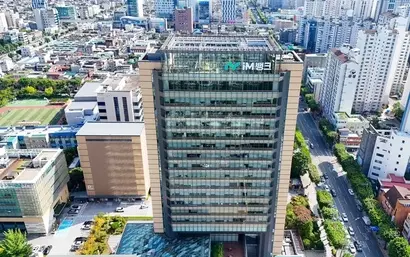
iM Financial’s net profit for the third quarter of 2025 was 122.4 billion won, a 19.3% increase from the same period last year (102.6 billion won). On a cumulative basis, it reached 431.7 billion won, a 70.9% increase from the previous year (252.6 billion won). iM Financial explained, "As a result of preemptively setting aside loan loss provisions related to securities firm PFs last year and strengthening the soundness management of all subsidiaries, the amount of loan loss provisions this year has decreased significantly."
The core subsidiary, iM Bank, recorded a Q3 net profit of 110.2 billion won, down 16.8% from Q3 2024 (132.4 billion won). During the same period, interest income fell from 380.4 billion won to 373.7 billion won, while non-interest income rose from 9.1 billion won to 27.9 billion won. However, compared to the second quarter of this year (iM Financial: 155 billion won, iM Bank: 131.3 billion won), both the holding company and the bank saw a decrease in net profit.
The deterioration in bank performance appears to be due to an increase in loan loss provisions. In the third quarter of this year, iM Bank's provision for loan losses was 89.4 billion won, an increase from 55.6 billion won in the third quarter of 2024. Provisioning involves pre-reflecting costs for debt expected to be unrecoverable in the future; if these provisions increase, net profit decreases. The bank had defended its performance by reducing these provisions in the first half of this year, but this trend has now reversed.
Other indicators have also worsened compared to the same period last year. Operating revenue (sales) for Q3 2025 was 936.4 billion won, a 12.5% decrease from Q3 2024 (1.0703 trillion won), breaking the 1 trillion won threshold. This is also a 21.9% decrease compared to the second quarter of this year (1.1994 trillion won). Operating profit for the same period fell 12.6% year-on-year (from 157.1 billion won to 137.4 billion won).
iM Bank transitioned to a commercial bank on May 16, 2024, following approval from financial authorities. Although 18 months have passed, critics say its presence as a commercial bank remains weak. Given that the top 5 commercial banks (KB Kookmin, Shinhan, Hana, NH Nonghyup, and Woori) each generate quarterly net profits of around 1 trillion won, narrowing the scale gap is no easy task.
Digital transformation also has a long way to go. When iM Bank launched as a commercial bank, it announced a "New Hybrid Bank" model. The core concept is to combine the strengths of internet-only banks and traditional banks: focusing retail banking on mobile platforms while expanding corporate banking through face-to-face channels. iM Bank has highlighted strategies such as developing non-face-to-face exclusive financial products and linking with external platforms through digital channels.
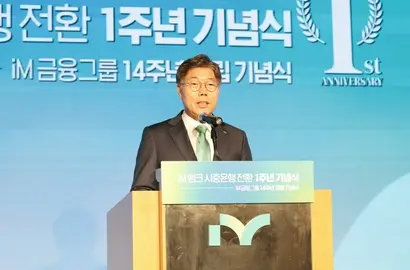
iM Financial’s monthly active users (MAU) in Q3 2025 stood at only 2.02 million (combined iM Bank, M-Shop, and corporate banking). While higher than regional banks whose app MAUs remain under 1 million, it is significantly lower than major commercial or internet-only banks. KB Kookmin Bank’s KB Star Banking has an MAU of 13 million, and Shinhan Bank’s SOL Bank has over 10 million. Toss Bank recently reached 10 million, and Kakao Bank is approaching 20 million.
Collaboration results with internet-only banks have also not been clear. In the second half of 2024, iM Bank signed business partnerships with Toss Bank and Kakao Bank. The agreement with Toss Bank was for digital channel activation, and the agreement with Kakao Bank covered collaboration in areas like loan comparisons and product/service development.
According to the agreement, iM Bank products were supposed to be available for application via the "Mortgage Comparison Service" launched by Kakao Bank this year, with users able to view results within the Kakao Bank app; however, it has been confirmed that iM Bank has not yet joined as a partner for the mortgage comparison service. Discussions with Toss Bank earlier this year regarding a joint loan product failed to lead to a launch.
The bank also appears to be taking a breather on expanding its nationwide branch network. In the second quarter of this year, iM Bank entered the Chungcheong region by opening one branch each in North and South Chungcheong provinces and added one more branch in Seoul. No new branches were opened in the third quarter. In the first quarter, new branches were opened only in the Gyeongsang region (4 in Daegu, 3 in North Gyeongsang).
Meanwhile, as the bank has rebranded itself to leap forward as a nationwide institution, attention is also focused on whether a new bank head from outside the Daegu-Gyeongbuk region will be appointed. Currently, Chairman Hwang Byung-woo of iM Financial Group serves concurrently as the head of iM Bank. With Chairman Hwang, who extended his term as bank head by one year in December 2024, expressing his intention to step down, iM Financial has initiated a management succession process to appoint the next bank head. The selection of the final candidate will be completed in December.
iM Financial Group recently announced a plan to supply 45 trillion won in productive and inclusive financing over the next five years, in line with the government's stance. It appears to be joining the trillion-won investment competition among some commercial banks. iM Financial's productive financial investment includes regional financial support for the Daegu-Gyeongbuk, Southeast, and Central regions. Chairman Hwang stated, "We have materialized our social responsibility for industrial transformation and balanced regional growth," adding, "We will realize a sustainable financial ecosystem where regions and industries grow together by combining productive finance with a regional financial base."