

[비즈한국] The 21 member countries participating in the Asia-Pacific Economic Cooperation (APEC) summit adopted the 'Gyeongju Declaration' on the 1st, covering key APEC issues including trade and investment, digital innovation, and inclusive growth. After concluding the APEC summit schedule, President Lee Jae-myung assessed that stability on the Korean Peninsula is directly linked to peace in the Asia-Pacific region and the entire world, and requested cooperation from the G2 nations—the U.S. and China—as well as neighboring countries.
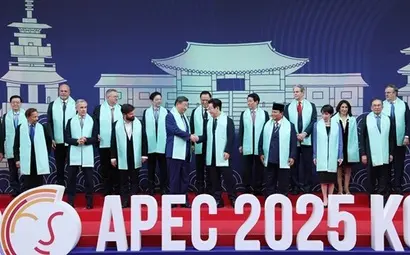
APEC Summit Closes, Emphasizing 'Diplomacy of Dialogue and Coexistence'
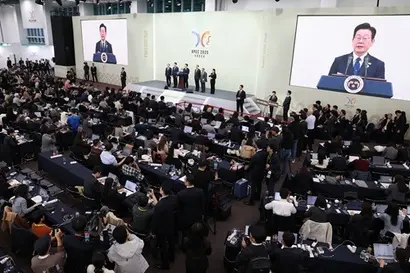
President Lee announced the adoption of the 'Gyeongju Declaration' during a press conference for domestic and foreign media immediately following the closing of the Gyeongju APEC summit. The Gyeongju Declaration consists of a total of 25 detailed items. Based on the fundamental framework of APEC's three key pillars—'Connection, Innovation, and Prosperity'—it encompasses major discussions on core APEC issues such as trade, investment, digital innovation, and inclusive growth. It also reflects the shared understanding and willingness of members to cooperate on artificial intelligence (AI) and responding to demographic changes, which were priorities pushed by our government.
President Lee stated, "The Republic of Korea will continue to accompany APEC on its journey toward development and prosperity in the Asia-Pacific region," adding, "I hope that all APEC members, including the next host country, China, will carry forward the determination shown in Gyeongju."
At the event, President Lee introduced parts of his diplomatic vision for Northeast Asia and emphasized the active roles of the U.S. and China for peace on the Korean Peninsula. He expressed a strong commitment to improving South Korea-China relations and stated that he would continue shuttle diplomacy while pushing for expanded cooperation in South Korea-Japan relations. President Lee emphasized, "Peace and stability on the Korean Peninsula are crucial not only for Northeast Asia but for world peace," adding, "While peace and stability require strong deterrence as a prerequisite, in the final stage, there must always be a willingness for dialogue, compromise, coexistence, and mutual prosperity."
He continued, "Although the North is suspicious of, angry at, and acting hostilely toward the South Korean government, significant effort is needed to change this suspicion and confrontational mindset and situational judgment," and explained, "We are taking proactive measures to the extent possible to help the North feel at ease and at least partially trust the South for the sake of peace. Such efforts will continue in the future."
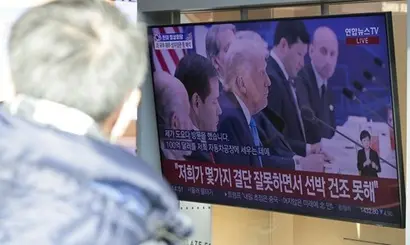
Regarding the U.S., he said, "Because there are clear limitations to trying to solve Korean Peninsula issues through inter-Korean dialogue alone, the role of the U.S. (as a party to the Armistice Agreement) is important." He added, "Ensuring that President Trump fulfills his role as a 'peacemaker' on the Korean Peninsula, just as he intends, is also a path to securing South Korea's security and peace," and noted, "I told him during this summit that I would continue to work hard. I believe that is how it will turn out."
On South Korea-China relations, he stated, "While there appear to be no particular problems on the surface, it is difficult to consider the relationship as fully normalized or restored in substance," adding, "I believe substantive relationship restoration and strengthening of practical cooperation are essential, and I intend to focus discussions on those points."
Highlighting that even though the U.S. and China appear to be in a hostile relationship, cooperation and support often coexist behind the scenes, he mentioned that South Korea and China also have a relationship where cooperation and confrontation coexist. President Lee said, "I intend to create and increase many opportunities for cooperation and communication regarding economic and private exchanges that benefit both countries, as well as roles for peace and stability in Northeast Asia."
'Gyeongju Declaration' Covering AI and Demographics… A New Milestone for Asia-Pacific Cooperation
Along with the Gyeongju Declaration, a total of three major outcome documents were adopted, including the 'APEC AI Initiative' and the 'Joint Framework for Responding to Demographic Change.' The APEC AI Initiative is the first written joint vision for AI by APEC and the first summit-level agreement on AI in which both the U.S. and China have participated. It reflects the South Korean government's basic AI policy and practical AI cooperation measures, such as the realization of an AI-based society and the establishment of an Asia-Pacific AI Center.
The APEC Joint Framework for Responding to Demographic Change is APEC's first comprehensive demographic cooperation initiative. It was created based on the recognition that demographic changes, such as low birth rates and aging populations, are common challenges in the region. This is also the first time that the cultural creative industry has been explicitly mentioned in an APEC summit document. The leaders recognized the cultural creative industry as a new growth engine for the Asia-Pacific region and codified the need for cooperation.
President Lee highly praised the achievement of the three major declarations and stated, "The Republic of Korea will continue to accompany APEC on its journey toward development and prosperity in the Asia-Pacific region."
The Presidential Office stated, "The Gyeongju Declaration is highly significant in that it provided a direction for comprehensive cooperation among the 21 members on major global economic issues, including trade, amidst deepening uncertainty in the international economy."