

[비즈한국] Every year, the government releases its budget proposal for the following year along with a five-year National Fiscal Management Plan. This is intended to overcome the limitations of a one-year planning horizon and to establish expenditures from a medium-term perspective, thereby increasing policy efficiency and fiscal soundness.
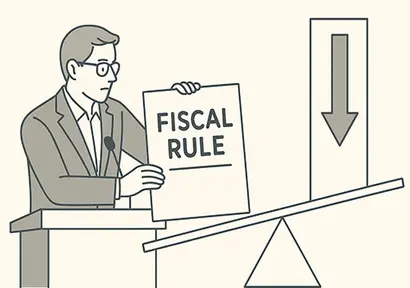
However, an examination of the National Fiscal Management Plans released by incoming governments and their subsequent actual results shows that total revenue (fiscal revenue) has consistently fallen short of projections, while total expenditure (fiscal spending) has actually been higher than planned. This signifies that South Korea’s fiscal soundness has been deteriorating faster than the government anticipated. In light of this, the International Monetary Fund (IMF), in its ‘2024 Article IV Consultation Report on Korea’ released this past February, recommended the introduction of ‘fiscal rules’—which mandate that fiscal soundness indicators do not exceed a certain level—to address the situation.
According to the National Fiscal Management Plan released in October 2008, the first year of the Lee Myung-bak administration, total revenue for 2008 was projected at 274.3 trillion won, with total expenditure at 257.2 trillion won. Perhaps because it was near the end of the year, there was almost no discrepancy, with actual 2008 total revenue at 274.2 trillion won and total expenditure at 275.2 trillion won.
However, for the subsequent years, while total revenue was projected at 295 trillion won in 2009, 314.7 trillion won in 2010, 339.2 trillion won in 2011, and 367 trillion won in 2012, actual total revenue increasingly fell short of forecasts, coming in at 291 trillion won in 2009, 290.8 trillion won in 2010, 314.4 trillion won in 2011, and 343.5 trillion won in 2012. As for total expenditure, the government planned for 273.8 trillion won in 2009, 290.9 trillion won in 2010, 308.7 trillion won in 2011, and 326.7 trillion won in 2012, but actual spending exceeded the plan each year, reaching 284.5 trillion won in 2009, 292.8 trillion won in 2010, and 309.1 trillion won in 2011. Notably, in 2012, the final year of the Lee Myung-bak administration, total expenditure was 325.4 trillion won, which was 1.3 trillion won less than the plan.
Looking at the National Fiscal Management Plan released in September 2013, the first year of the Park Geun-hye administration, total revenue for 2013 was projected at 372.6 trillion won and total expenditure at 342 trillion won. As with the Lee Myung-bak administration, the actual total revenue and expenditure in 2013, the first year of the term, matched these projections. However, unlike the Park Geun-hye administration's projected total revenue of 396.1 trillion won for 2014, 415.2 trillion won for 2015, and 439.1 trillion won for 2016, actual total revenue only slightly exceeded the projection once, in 2014, at 369.3 trillion won.
Contrary to the forecast that it would exceed 400 trillion won in 2015, it remained at 382.4 trillion won, and even in 2019, it failed to cross the 400 trillion won threshold, reaching 391.4 trillion won. Although tax revenue fell far short of initial plans, the Park Geun-hye administration at least reduced actual spending slightly compared to the total expenditure plan. While total expenditure was planned at 357.5 trillion won in 2014, 373.1 trillion won in 2015, and 389.7 trillion won in 2016, actual expenditures were 355.8 trillion won in 2014, 375.4 trillion won in 2015, and 386.4 trillion won in 2016.
The Moon Jae-in administration, which took office following the impeachment of former President Park Geun-hye, projected total revenue of 447.2 trillion won and total expenditure of 428.8 trillion won for 2018 in the National Fiscal Management Plan released in August 2018, its first year of budget planning; these matched the actual total revenue and expenditure. However, the gap widened thereafter. The Moon Jae-in administration projected total revenue of 481.3 trillion won in 2019, 504.1 trillion won in 2020, 525.4 trillion won in 2021, and 547.8 trillion won in 2022, but actual revenue was 476.1 trillion won in 2019, 481.8 trillion won in 2020, 482.6 trillion won in 2021, and 553.6 trillion won in 2022—falling tens of trillions of won short of projections each year, except for 2022.
Conversely, total expenditure exceeded the plans. Planned total expenditure was 470.5 trillion won in 2019, 504.6 trillion won in 2020, 535.9 trillion won in 2021, and 567.6 trillion won in 2022, but actual total expenditure was 469.6 trillion won in 2019, 512.3 trillion won in 2020, 558 trillion won in 2021, and surpassed 600 trillion won in 2022, reaching 607.7 trillion won.
In the case of the Yoon Suk-yeol administration, the National Fiscal Management Plan announced in August 2022, its first year, set total revenue for 2023 at 625.9 trillion won and total expenditure at 639 trillion won, with actuals of 625.7 trillion won and 638.7 trillion won, respectively, both slightly lower than planned. However, while the projections for 2024 were 655.7 trillion won for total revenue and 669.7 trillion won for total expenditure, actual total revenue was only 612.2 trillion won, a shortfall of 43.5 trillion won. Although total expenditure, at 656.6 trillion won, was approximately 13.1 trillion won less than initially planned, the significant shortfall in total revenue caused a major shock to the nation's finances.