

[비즈한국] The accident management plan for Kori Nuclear Power Plant Unit 2 in Gijang, Busan, which has reached the end of its design life, has been approved. With the approval of the accident management plan—considered a major hurdle—speculation is mounting that the license for the continued operation of Kori Unit 2 is imminent. Civic groups are strongly opposing the move, claiming that the review of the accident management plan was conducted illegally and in a hasty manner.
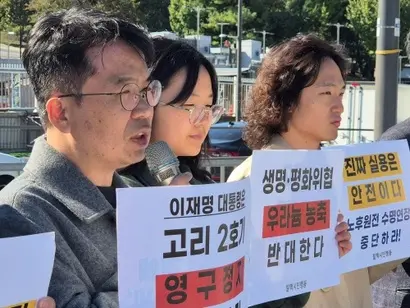
The Nuclear Safety and Security Commission (NSSC) held its 223rd meeting on October 23 and approved the accident management plan for Kori Unit 2 with 6 out of 7 commissioners in attendance voting in favor. The accident management plan is a comprehensive manual for responding to potential accidents at nuclear power plants. It includes accident response strategies, organizational structure, training plans, and covers not only design-basis accidents but also responses to severe accidents.
Civic groups criticized the decision as a hasty review pushed through even though core safety assessment items were not fully addressed. They pointed out that the plan was approved despite ongoing concerns that critical elements for severe accident response, such as atmospheric dispersion factors and criteria for responding to aircraft collisions, had not yet been established.
NSSC regulations state that when assessing the suitability of a reactor facility site, radiation exposure must be measured by applying an atmospheric dispersion factor of at least the '95th percentile' in the event of an accident. However, this accident management plan used the 50th percentile, effectively applying a more lenient standard. The atmospheric dispersion factor is an indicator of how well pollutants are diluted or dispersed; a higher value means that pollutants do not disperse well, leading to higher concentrations at that location.
NSSC Chairperson Choi Won-ho proceeded with the vote, stating, "Once the review is concluded, I will table the relevant notification proposal at the next meeting." The NSSC secretariat announced that it plans to review the proposed amendment to the notification at the 224th meeting, scheduled for November 13.
The decision on the continued operation of Kori Unit 2 has not yet been finalized. This is because procedural flaws have been pointed out in the Safety Assessment Report (PSR) and the Radiological Environmental Impact Assessment, both of which are essential documents for approving continued operation.
In the case of the PSR, controversy arose because Korea Hydro & Nuclear Power (KHNP) submitted it after the statutory deadline. KHNP was required to submit the PSR by April 8, 2021—two years before the design life expired—but submitted the report one year late on April 4, 2022. Consequently, it was fined 3 million won.
Civic groups argue that accepting the document despite it being submitted past the deadline is illegal. In response, the NSSC secretariat stated, "We received a legal review from the Government Legal Service confirming that the decision on approval remains valid even if based on documents submitted after the deadline."
The Radiological Environmental Impact Assessment also faces criticism for failing to describe changes in the surrounding environment. The Enforcement Decree of the Nuclear Safety Act stipulates that if continued operation is intended, an environmental impact assessment reflecting changes since the original operating license must be conducted.
Lee Heon-seok, a policy committee member at Energy Justice Actions, emphasized, "Unlike 40 years ago, many circumstances have changed, such as the impact on densely populated areas like apartment complexes nearby. Aging nuclear plants must be re-examined based on current circumstances and standards."
There is also criticism regarding the appropriateness of deciding on continued operation while only 6 out of 9 commissioners remain, as the terms of other members have expired. Notably, 2 of the 3 members whose terms have expired were engineering experts. In response, the NSSC secretariat stated, "We have requested the National Assembly to appoint members, and there is no legal problem with proceeding with the meetings. Furthermore, the documents related to the continued operation license have already been reviewed by an expert committee."
Civic groups raised their voices, claiming that the NSSC is conducting a hasty review with the intent to extend the lifespan of Kori Unit 2. Ahn Jae-hun, Secretary General of the Korea Federation for Environmental Movements, criticized the commission, saying, "If the NSSC chairperson is at the point of asking what else there is to review after the expert committee has already done so, the NSSC should be disbanded. Viewing safety reviews as an inefficiency is an attitude that disregards the lives of the people."