

[비즈한국] 6:20 AM on October 30, 2025, is a time that will be forever recorded in the history of the Republic of Korea Navy. This is because U.S. President Donald Trump has officially authorized the 'construction of a nuclear-powered submarine for South Korea.' The supply method announced by President Trump involves the U.S. providing the nuclear fuel for the submarines, while the construction will take place at the Philadelphia (Philly) Shipyard in the U.S., which is owned by Hanwha Ocean042660.
Nuclear submarines represent a 'history of challenges and setbacks' for South Korea, which has consistently sought their acquisition for over 20 years. In 2003, during the Roh Moo-hyun administration, a secret task force was formed to build nuclear submarines as part of independent national defense, but the project collapsed after it was exposed to the media due to internal circumstances. Even during the Moon Jae-in administration, the acquisition of nuclear submarines was discussed with the U.S. whenever opportunities like FTA renegotiations arose, but it never came to fruition. This authorization for construction is truly the fruit of 20 years of persistent effort.
So, are nuclear submarines an 'invincible weapon' that 'must be possessed'? Not necessarily. There has not been complete consensus within the Navy regarding the pros and cons of acquiring them. Arguments have consistently been raised that priority should be placed on building a force centered on conventional submarines or enhancing surface ship capabilities, such as aircraft carriers, instead of nuclear submarines. This is because there are realistic difficulties associated with securing them.
A nuclear submarine in itself is not the 'ultimate weapon.' Strictly speaking, the ultimate weapon is a ballistic missile submarine (SSBN) equipped with submarine-launched ballistic missiles (SLBMs) carrying nuclear warheads. If a nuclear submarine, which costs over 3 trillion won per unit, is equipped with 12 conventional-warhead SLBMs, its actual offensive capability is not much different from the destructive power of a single strike carried out by a squadron of four KF-21 fighter jets.
The construction process for nuclear submarines is also not easy. Fortunately, the Republic of Korea is a leader in Small Modular Reactor (SMR) technology and has long taken an interest in developing SMRs for ships. In particular, since the Korea Research Institute of Ships & Ocean Engineering (KRISO) plans to build a testbed for SMR-propelled ships by 2028, securing core technologies is expected to be possible within three years.
The problem is that there are significant differences in size and characteristics between SMRs for merchant ships and reactors for nuclear submarines. Reactors for submarines must be highly miniaturized to fit into limited spaces. Generally, the size and weight must be reduced to less than half of those used for merchant ship SMRs.
However, these technical challenges and debates over necessity are tasks that can be fully overcome, considering the immense strategic benefits that securing nuclear submarines will bring and the persistent efforts of South Korea's shipbuilding industry and Navy. This decision will bring significant strategic benefits to both South Korea and the United States.
First, unlike the 'AUKUS' project with Australia, the U.S. gains clear strategic benefits. AUKUS is a project where the U.S. builds and provides nuclear submarines to Australia, but this has resulted in the U.S. giving up some of its own submarine power, leading to a current stalemate. As construction has been delayed, Australia has requested the lease of U.S. Virginia-class submarines, creating a problem where the number of submarines available to the U.S. Navy decreases.
Conversely, the South Korean nuclear submarine plan authorized this time is based on a 'Korea-led, U.S. Philly Shipyard construction' model. This does not affect the production output of the Newport News Shipyard, which builds U.S. Navy nuclear submarines, meaning there is no disruption to the U.S. Navy's force enhancement. Furthermore, the South Korean government and Hanwha Ocean will invest in the Philly Shipyard—which lacks submarine construction capability—to equip it with the necessary facilities. In other words, this authorization can be seen as having a strategic intent to expand U.S. nuclear submarine production capacity with South Korean capital, going beyond simply enhancing the South Korean Navy's power.
Additionally, even if nuclear submarines are not equipped with nuclear weapons, there are ways to maximize their strategic utility. This involves referencing the operational concept of the 'Guided Missile Nuclear Submarine (SSGN)' operated by the Soviet Navy during the Cold War.
The Soviet Oscar-class SSGN was a weapon with a clear objective: being a 'U.S. carrier strike group killer.' To counter this, the U.S. had to spend huge budgets to build F-14 fighter jets, Phoenix missiles, and Aegis destroyers. The Oscar-class was equipped with 24 P-700 'Granit' missiles optimized for striking aircraft carriers, and even as of 2025, there is still no proper, perfect countermeasure against high-speed missiles launched by surprise from submarines.
By benchmarking this, South Korean nuclear submarines can perform the key missions of 'checking Chinese carrier strike groups' and 'tracking Chinese nuclear submarines.' In peacetime, they track and monitor the Chinese fleet, and in contingencies, they engage immediately. By using this capability as leverage in negotiations with the U.S., South Korea can receive a stronger 'extended deterrence' even without nuclear weapons and further strengthen its own strategic deterrent.
Of course, various support assets are needed to operate nuclear submarines, but they do not require as many resources and personnel as an aircraft carrier strike group. Since nuclear submarines are basically premised on independent operations behind enemy lines, they do not require numerous escort assets and dozens of expensive aircraft like an aircraft carrier does.
To maximize the utility of 'South Korean nuclear submarines,' the following strategies are required:
First, the currently planned 'Jangbogo-IV' project should be transitioned into a nuclear submarine project, but developed as a 4,500-ton class submarine capable of selectively applying conventional propulsion or nuclear propulsion depending on the design, similar to the 'Orca' class that France exported to the Netherlands. This would satisfy the needs of the ROK Navy and also secure business viability through overseas exports.
Second, it is urgent to expand the unmanned weapon systems and satellite assets to support the Jangbogo-IV nuclear submarines. To track and attack enemy carrier strike groups, we must secure over 40 Very Low Earth Orbit (VLEO) imaging radar satellites currently under research and establish a military low-orbit communication satellite system. It is also essential to secure submarine-launched unmanned underwater vehicles (UUVs) and unmanned aerial vehicles (UAVs) for target acquisition to exchange information with satellites.
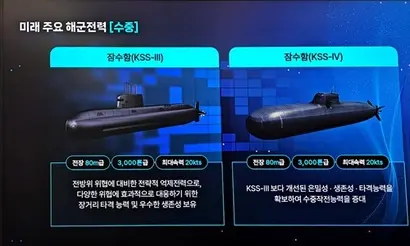
Third, we must accelerate the development of a submarine-to-ship version of the hypersonic missile 'Hycore,' which is currently under development. The current Jangbogo-III submarines are equipped with 'Haeseong-V' high-speed anti-ship missiles, but a faster and more lethal hypersonic missile, the 'Haeseong-VI,' should be deployed as soon as possible. Fortunately, following the surface-to-ship version, an air-to-ship version of Hycore for KF-21 integration is being researched. This air-to-ship version should be improved for submarine launch, and the submarines should carry 12–16 or more, which is higher than the payload (10 missiles) of the Jangbogo-III.
This is just the beginning. As a shipbuilding powerhouse, South Korea can achieve fast construction unlike Australia, but there are many technical challenges to overcome. Above all, the fact that they must be built at the U.S. Philly Shipyard, which has no submarine production facilities, will be the biggest barrier. However, having grasped this historic opportunity, I trust that the government, the shipbuilding industry, and the Navy will join forces to acquire nuclear submarines in the fastest and most efficient way possible.