

[비즈한국] Not just a simple "finished product," but an endlessly continuing "process." This is the direction of architecture as seen by Yoon Han-jin, co-CEO of FHHH Friends, one of the hottest architectural groups in Korea today. By reinterpreting cities and daily life, Yoon aims to infuse imagination and humor into everyday spaces. Serving as a speaker at the Brand Biz Conference 2025, held on the 28th at the Four Seasons Hotel Seoul in Jongno-gu, Seoul, Yoon spoke freely on "How We Work."

Yoon spontaneously changed the original lecture title, "If You Walk Together, You Might Meet Everyone in the World," creating a cheerful atmosphere unique to FHHH Friends from the start. FHHH Friends has recently gained prominence in the architectural community, winning the Grand Prize at the "Seoul Architecture Award" this past September for its "Core Dissolution System," which recognizes architectural works that have contributed to the development of Seoul's architectural culture and technology.
The firm was praised for moving away from traditional construction methods and implementing a "cantilever structure" that creates column-free space in the center of the building, filling the interior with natural light to create a bright and pleasant environment. Furthermore, their capabilities have been recognized globally through the design of the new headquarters for HYBE352820, the entertainment company behind BTS, which embodies the firm's new brand identity and system. Other notable projects include "Daechoong Amusement Park" and "Around Headquarters" in Yeonnam-dong, as well as the "House of a Manly Man" in Miryang, Gyeongnam.
Yoon introduced the mottos that have served as milestones for FHHH Friends since its establishment in 2013. Despite the "reckless" start with co-CEOs Han Seung-jae and Han Yang-gyu after quitting their stable jobs, they maintained a challenging attitude rather than conforming to reality. Yoon emphasized, "Regulations are merely minimum guidelines, but people usually design things safely just to avoid breaking them. However, we try as much as possible to avoid things done out of mere habit."
Pointing out the reality that multi-family housing often necessitates wall-bearing structures due to floor area ratio regulations in building codes, Yoon shared his efforts to develop ideas to break free from this. Wall-bearing structures are cost-effective because they eliminate the process of building columns and beams, instead transferring loads directly from the top to the first floor. However, since most walls support the weight of the building, remodeling is difficult, effectively limiting the building's utility unless it is completely reconstructed. Citing a multi-family housing project in Yeonyeon-dong, Yoon explained, "We created a structure supported by only four columns to exclude structurally obstructive elements, meaning it can be easily repurposed if necessary."
They also attempt to differentiate "neighborhood living facilities," the most common type of commercial building in Korea. Yoon confessed, "There are clients who request a budget of 6 to 7 million won per pyeong when the construction cost should actually be over 12 million won. Sometimes we wonder if we should really take on such projects." In these cases, he said he focused on finding the fundamental meaning of architecture rather than seeking something new. "We focused on the architecture itself by placing stairs and elevators in the center and arranging the necessary parking on both sides," Yoon noted. "After the building was finished, it stood out from the surrounding buildings, giving it a grand feeling."
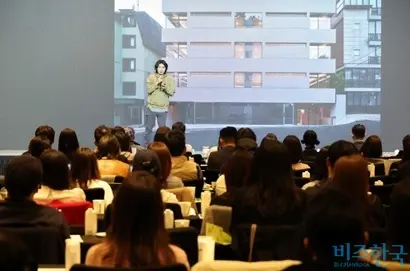
Yoon's romantic view of buildings was clearly visible in a project carried out near the Gyeongui Line railway tracks. The building was situated on a plot of land split by the creation of the tracks. A boundary survey revealed that the owner was using only half of the plot, and that specific portion was being used by local seniors as a community lounge. Yoon said, "Thinking about the meaning of the road, I wondered if we could yield some space on the first floor, so I persuaded the owner and built the structure in a triangular shape."
After Yoon's lecture, all the speakers gathered for an open talk on collaboration, followed by a Q&A session with the audience as the final segment.
When asked about the fear of being consumed as something "one-off," Hong Joo-seok, CEO of Urbanplay, replied, "It is bound to be consumed one-off. However, the energy of the relationships created through collaboration can remain in someone's heart." Shin So-hyun, CEO of OIMU, said, "I feel that once it's consumed as an image, it's not easy to gain empathy again, but since I work in the field of creation, I want to play a role in constantly sending messages to society."
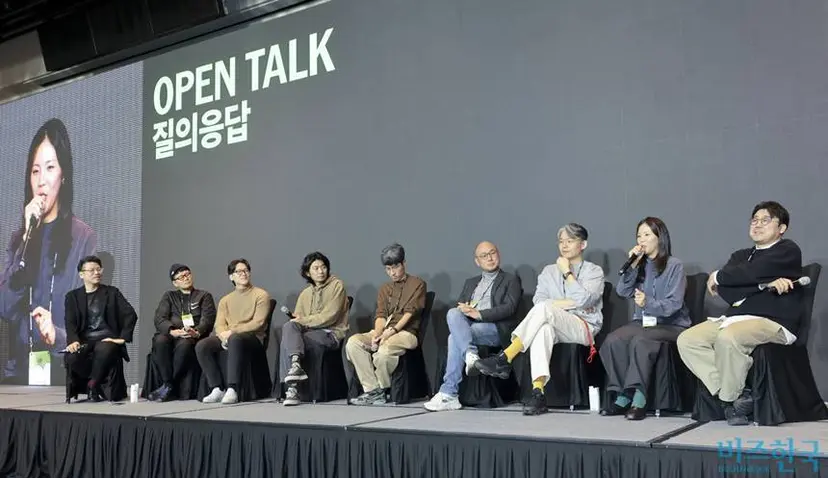
When asked about the secret to surviving and pushing through at the crossroads of survival while running a brand for over 10 years, the speakers gave contrasting answers. Hong Joo-seok of Urbanplay advised, "I experience it every day, even now. When the timing is right, it comes out with a different kind of impact. I think the important thing is how you contain that within yourself and how well you build that framework."
Lee, CEO of Your Mind, shared his secret(?), saying, "If you solve the problems you face in the 2nd or 3rd year, different ones come in the 5th or 6th year. I don't get too hung up on things going well or poorly." Yoon Han-jin of FHHH Friends said, "When I tried to force a breakthrough during difficult times, things worked out even less. I realized that people don't perish easily. Even when things were really tough, something remained connected and kept us going. I don't have those kinds of worries anymore."
Moderator Kim Eo-jin, co-CEO of Everyday Practice, concluded, "Just as the speakers' answers are all different, it seems everyone has their own way of growing. Let's find our own ways."