

[비즈한국] “Cities also need an operating system (OS).” Hong Joo-seok, CEO of Urbanplay, made this remark while appearing as the fourth speaker at the ‘Brand Biz Conference 2025’ on the 28th. CEO Hong found the answer in this statement while pondering why neighborhood bookstores are disappearing while independent ones are emerging, why corporate permanent stores are shrinking while pop-up stores are increasing, why children's stores are vanishing due to low birth rates while more attractive kids' spaces are appearing, and why local regions are fading while ‘local’ trends are on the rise.

Urbanplay is a company specializing in urban content. It was founded in 2013 with the belief that cities also need an operating system (OS). The company researches, consults, plans, and develops urban spaces to allow the 'software' of content to run on the 'hardware' of urban space. Over the years, it has connected regions and creators by planning projects such as the neighborhood management service ‘Bound,’ the local creator lounge ‘Yeonnamjang,’ and the regional art festival ‘Yeonhui, Walk.’ It has also integrated corporate brands into spaces, such as through consulting for the renewal of the Hyundai Motor Company005380 headquarters and exhibitions commemorating the 60th anniversary of Seongsimdang.
CEO Hong Joo-seok, who founded Urbanplay, is a space design expert. After majoring in architectural design at Hanyang University, he earned a master's degree from the KAIST Graduate School of Culture Technology. He founded Urbanplay in 2013, driven by the belief that content within an urban space is more important than its outward appearance. After 12 years of challenge and innovation, he has built an urban content company with 20 billion KRW in annual revenue, collaborating with about 1,000 teams of creators every year.
Urbanplay was born during the process of urban reorganization centered on software. The recognition that hardware-centric cities, which had grown based on capital and distribution, were transforming into software-centric cities based on content led CEO Hong to start the business. CEO Hong stated, "As the economy entered a low-growth phase and many things shifted to online, I thought that new forms of consumption could emerge for the content people want and for new spatial experiences."
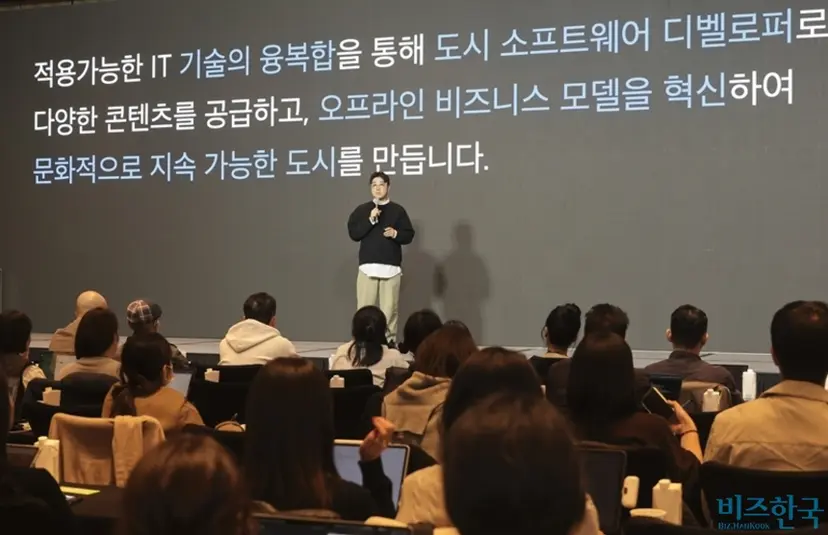
Born from this realization, Urbanplay is engaged in business that breathes content into urban spaces. While the form of each project varies, they generally create new urban spaces that connect scattered content producers (creators) with consumers. CEO Hong explained, “Urbanplay’s solution leads through content investment, production, development, and operation. Our work involves fostering great creators, producing spatial content that creates synergy with those creators, bringing them together to materialize content, and operating the space so that the experience becomes a sustainable structure.”
One of the representative projects is the neighborhood management service ‘Bound.’ Urbanplay created spaces where creators could utilize underused local spaces to supply content, allowing the region and the creators to coexist. CEO Hong said, “Regions had many underused logistics assets and a lot of marketing needs. We thought about how to connect curators with investors or landlords who could invest capital in local business, as well as the consumers who want to consume these offerings.”
CEO Hong identified six characteristics that determine an attractive urban space: △Local Heritage, △Contemporary Creativity, △Specialty in areas such as design, △Locality, △Curation utilizing planning ability, and △Community (Fandom). CEO Hong emphasized, “Ultimately, I believe that keeping differentiated content experiences fresh is the core of spatial experience. If that is achieved, as time passes, the density of the experience increases, and I believe it becomes a space that can fundamentally deliver the brand.”
CEO Hong added, “I thought the most important part was making things that don't generate profit into a sustainable business structure. Our job is to prove with numbers the essential value that everyone feels is valuable.”